


Share Article:


GivingTuesday is a global day of giving held on the Tuesday after Thanksgiving. It’s a way for charitable organizations to amplify their message, reach new supporters, and boost their end-of-year fundraising. In fact, since GivingTuesday was established in 2012, the day has raised over $18.5 billion.
We’ve compiled everything your nonprofit organization needs to know to get the most from GivingTuesday—including 10 engaging GivingTuesday campaign ideas, steps to launching your campaign, and tips to help you stand out from the crowd and raise more.
What is GivingTuesday?
GivingTuesday is a day-long global movement and an independent nonprofit. It began as an online fundraiser with a hashtag (hence the spelling: GivingTuesday). Since then, it has grown to become an international day of fundraising, participated in by nonprofits worldwide.
The goal of GivingTuesday is to inspire generosity, support, and collaboration among nonprofits and their supporters. Many nonprofits also use it as a way to jump-start year-end fundraising and achieve their annual goals.
Want to learn more about year-end giving? Read 10 steps to a successful year-end giving campaign for more information.
4 steps to a winning GivingTuesday strategy
To get the most from GivingTuesday, you’ll need a clear sense of your goals and strategy.
Whether you’re participating for the first time or you’re looking for ways to make this year’s campaign even better than last year’s, set yourself up for success by following the steps below:
1. Plan ahead
Start planning your GivingTuesday strategy early, ideally in September or October. Make sure to address the following:
- Create marketing materials: Develop newsletters, social media posts, videos, and graphics in advance. Make a content calendar so you’ll know exactly when to post.
- Last year’s results: If you participated in GivingTuesday last year, remind yourself what worked and what you might need to adapt.
- GivingTuesday goals: The more specific your goals, the easier it will be to create tailored messaging that resonates. Plus, it’ll be easier to measure success and adapt next year.
- Budget: Decide how much you’re willing to spend on your campaign. Common GivingTuesday costs include additional marketing assistance, event overhead expenses, or paid social media ads.
- Fundraiser type: Based on your goals and budget, decide which type of fundraiser would be best for your organization—whether that’s an email campaign, livestream event, or Facebook fundraiser (we’ve collected 10 ideas to increase charitable giving this GivingTuesday below).
- Assign roles: Decide which team member will own your GivingTuesday campaign. Your GivingTuesday campaign should live with one team member—ideally, one with marketing expertise.
2. Optimize your donor journey
An optimized and accessible donation form is the foundation of every successful fundraising campaign. Make a small donation to your nonprofit to review the donor experience, and review the following:
- Accessibility: Is your donation page easy to navigate to from your website and social media?
- Convenience: Ideally, your supporter should be able to give in just a couple of clicks and with multiple payment methods—like credit cards, PayPal, or check.
- Fast-loading: Eliminate any barriers to giving by ensuring both your website and donation page load quickly.
- Mobile-optimized: Make sure you’re set up for mobile donations—25% of donors give using their mobile.
Try launching a giving page just for GivingTuesday. Share your goals and a live goal tracker, as well as an eye-catching image, an explanation of how your fundraiser works, and an overview of your mission.
Choose a fundraising platform that lets you easily optimize donation forms and makes the donor journey as smooth as possible.
3. Share your campaign
Spread the word about your campaign at least two weeks before GivingTuesday, and ramp up your marketing efforts as the day approaches. Share your campaign on social media, your website, and your newsletter.
Don’t disappear once GivingTuesday is over. Keep sharing your progress and describe how the money raised has made a positive difference.
4. Practice donor stewardship beyond GivingTuesday donations
GivingTuesday isn’t just about a 24-hour-long fundraising boost—it’s a chance to build lasting relationships with new supporters.
To keep new supporters invested, you’ll need to create a donor stewardship program with regular, thoughtful donor communication and opportunities for involvement that extend beyond fundraising—like volunteering opportunities and events.
10 GivingTuesday Campaign fundraising ideas
Whatever your mission, goals, and budget, we’ve got GivingTuesday campaign ideas to excite your audience and help you raise money.
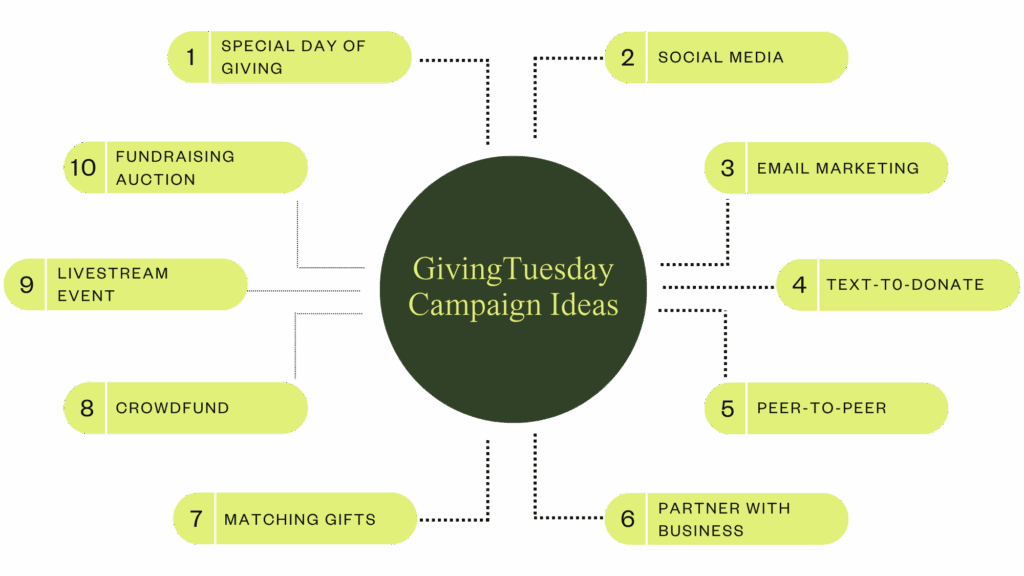
1. Social media campaign
GivingTuesday began as a social media generosity movement. It’s grown since then, but social media is still a great way to capitalize on the generosity GivingTuesday inspires.
Meet your audience where they are, and create a campaign that plays to each social media platform’s strengths. For example, you could post a shareable beneficiary highlights reel to your Instagram story or advertise a livestream event on Facebook.
Designate a team member to respond to messages and comments throughout the day. Don’t forget the GivingTuesday hashtag.
2. Email marketing campaign
An email marketing campaign is an effective, lower-lift way to fundraise. You’ll likely be vying for your audience’s attention, so try to include a personalized, attention-grabbing subject line.
Make your requests specific, and share how each donation will positively impact your cause—this way, supporters can easily imagine the difference their donation makes and feel more inspired to give.
Segment your donors by their giving history, so you can personalize your messaging and request tailored giving amounts.
3. Text-to-donate
Text-to-donate campaigns are a fast and personal way to reach your donors.
Craft a concise and compelling message summarizing your goals and mission. Include specific giving amounts and a link to your mobile-optimized donation page. Follow up immediately to any GivingTuesday donations with an automated thank-you message.
4. Peer-to-peer fundraising
Peer-to-peer fundraising helps build community among your supporters, turns donors into mission advocates, and helps spread your mission well beyond your existing base.
Simplify things for participants by offering all the resources they’ll need to fundraise on your behalf, including information on your cause and easily shareable donation pages.
Sponsored challenges, such as races, readathons, or sporting events, are all great examples of peer-to-peer fundraising campaigns.
5. Partner with a business
GivingTuesday helps increase nonprofit visibility to businesses—it’s the ideal time to form a new partnership.
Ask local businesses if they’ll donate a percentage of their GivingTuesday sales to your cause. Then, highlight their contribution on your website and social media. If possible, kick off your campaign before Black Friday and Cyber Monday to capitalize on end-of-year sale spending.
6. Launch a matching gift campaign
Whether you partner with a foundation, business, or an individual, find a sponsor willing to match all donations made within a specific timeframe. Advertise your matching gift campaign in advance, and outline the specific details of the match so there’s no ambiguity.
7. Crowdfund
Ideal for nonprofits looking to fund a specific program or campaign, crowdfunding campaigns can help you reach your goals fast.
Create a crowdfunding campaign with a platform like GoFundMe or Kickstarter, and start by sharing it with your existing network. Bear in mind that some crowdfunding platforms operate on an “all-or-nothing” model, meaning you only receive funds if you meet your goals.
8. Host a livestream event
With a Livestream event, your supporters can participate from anywhere in the world. Popular livestream fundraisers include concerts, virtual trivia, or educational workshops and events related to your mission.
You could either run your livestream as a more traditional fundraising gala, or consider a sponsored challenge—like a 24-hour dance party, painting contest, or virtual run.
9. Host a fundraising auction
Silent auctions are a fundraising favorite. They’re easy to incorporate into other types of fundraising events, and if you request business-donated prizes, they can also be a low-cost way to strengthen partnerships.
Many nonprofit fundraising platforms offer the ability to host virtual auctions, meaning supporters can participate from anywhere.
10. Create your own day of giving
Take inspiration from GivingTuesday to create your own day of fundraising—a day that is unique to your organization. Institutions such as the Purdue for Life Foundation have built up their giving day into their biggest fundraising day of the year. If you create your own day, you won’t be competing with other nonprofits for attention. Come up with your own hashtag, and anticipate that you’ll need to put some effort into your marketing strategy to help raise awareness.
Tips for a successful GivingTuesday strategy
However you decide to participate this GivingTuesday, there are a few simple steps you can take to create a memorable campaign with fundraising benefits that extend into the new year.
- Tie to year-end fundraising: Did you know charitable giving is at its highest in December? View GivingTuesday as the launch point for your end-of-year fundraising strategy.
- Create a sense of urgency: Set your GivingTuesday campaign apart by making it more specific and urgent than your other campaigns. Whatever your fundraising goals, let supporters know how valuable their contributions are.
- Include a strong CTA: Specific calls to action like “Donate $50 to help feed a family for one week” are often more impactful than vague requests, like “Give today.”
- Follow up with supporters: Solidify new relationships by following up with supporters shortly after GivingTuesday. Close out your campaign with a thank you post and an overview of your GivingTuesday achievements.
- Know your audience: Stay donor-centric in your communications and focus on impact-driven subject lines—you’ll likely be competing for attention, so you’ll need your campaign to be eye-catching.
- Reach out to local news: If you’re planning something big for GivingTuesday, reach out to a local news station to increase publicity.
- Promote monthly giving: Encourage recurring donations to help sustain fundraising efforts. Recurring donors give 42% more annually compared to one-time donors.
- Get feedback: Follow up with a short feedback form to your supporters to learn what worked well and what you can adapt for next year.
- Keep track of results: Track your GivingTuesday beyond the total amount fundraised. Review your social media engagement, along with the number of new donors.
Remember, there’s no one “right way” to participate in GivingTuesday. If you don’t have the bandwidth for a more elaborate campaign, fundraising could be as simple as sharing some social media posts with a donation link (though we recommend taking advantage of this global day of generosity as much as possible!).
By following the steps and campaign ideas above, you can look forward to a GivingTuesday that accelerates your fundraising into the years to come.
GivingTuesday FAQs
How to stand out on GivingTuesday?
Get a head start and plan your campaign early. Make specific fundraising asks, tailor your fundraiser to your audience, and be explicit about how supporters’ donations will fuel your mission.
How to do a GivingTuesday campaign?
Determine your goals and budget, and decide on the type of fundraiser you’d like to run. Create marketing materials to share on social media. Follow up with thank-you messages for new supporters, and keep up engagement by offering additional ways to get involved.
How to ask for donations on GivingTuesday?
Many nonprofits use social media to collect donations on GivingTuesday. Email campaigns, text-to-donate, and direct mail campaigns are all effective ways to request GivingTuesday donations. However you communicate, make specific requests, share your goals, and highlight what donor generosity can help you achieve.
What is the most profitable fundraising event?
While there’s no one best type of fundraiser, large-scale events that attract high-ticket donors, like galas or auctions, tend to be some of the most lucrative. Peer-to-peer fundraisers are known to help nonprofits broaden their network and lead to long-term fundraising success.
Check out our GivingTuesday templates for email, social, and text.
Want to go deeper into planning? GivingTuesday’s website includes plenty of free resources to help kick off your fundraiser.

Be the first to read our resources.
The world is changing quickly—and our resources help you stay on top of it all. Sign up to get new insights, success stories, and more, sent right to your inbox.
Explore related resources.
-
GivingTuesday templates for email, social, and text

Post GivingTuesday templates for email, social, and text
Get your free GivingTuesday templates for email, social, and text to create impactful campaigns and raise more for your cause.
-
#GivingTuesday has come and gone – but what’s next?!

Post #GivingTuesday has come and gone – but what’s next?!
By now, you know the premise of Giving Tuesday: to encourage people to do good and counter the mass spending...
-
How to plan a fundraising gala

Post How to plan a fundraising gala
Learn about different gala types, budgeting, tips for success, and 8 steps to boost donor engagement and revenue.