


Share Article:


Starting a planned giving program results in a structured, long-term fundraising strategy designed to secure future gifts. Planned gifts are charitable contributions arranged today but fulfilled later, often through wills, bequests, estate plans, or life income gifts. A “legacy gift” is a type of planned gift that’s fulfilled after the donor passes.
A planned giving program strengthens your nonprofit’s financial stability and deepens donor relationships. It also creates a dependable pipeline of major gifts to support your mission for decades.
Launching a program begins with understanding your donor base and identifying supporters most likely to make a planned gift commitment. You’ll also need the right internal structure and tools, such as donor databases, predictive analytics, and prospect research software, to manage outreach, track commitments, and prioritize prospects effectively.
Follow these 15 steps to build, implement, and grow a successful planned giving program.
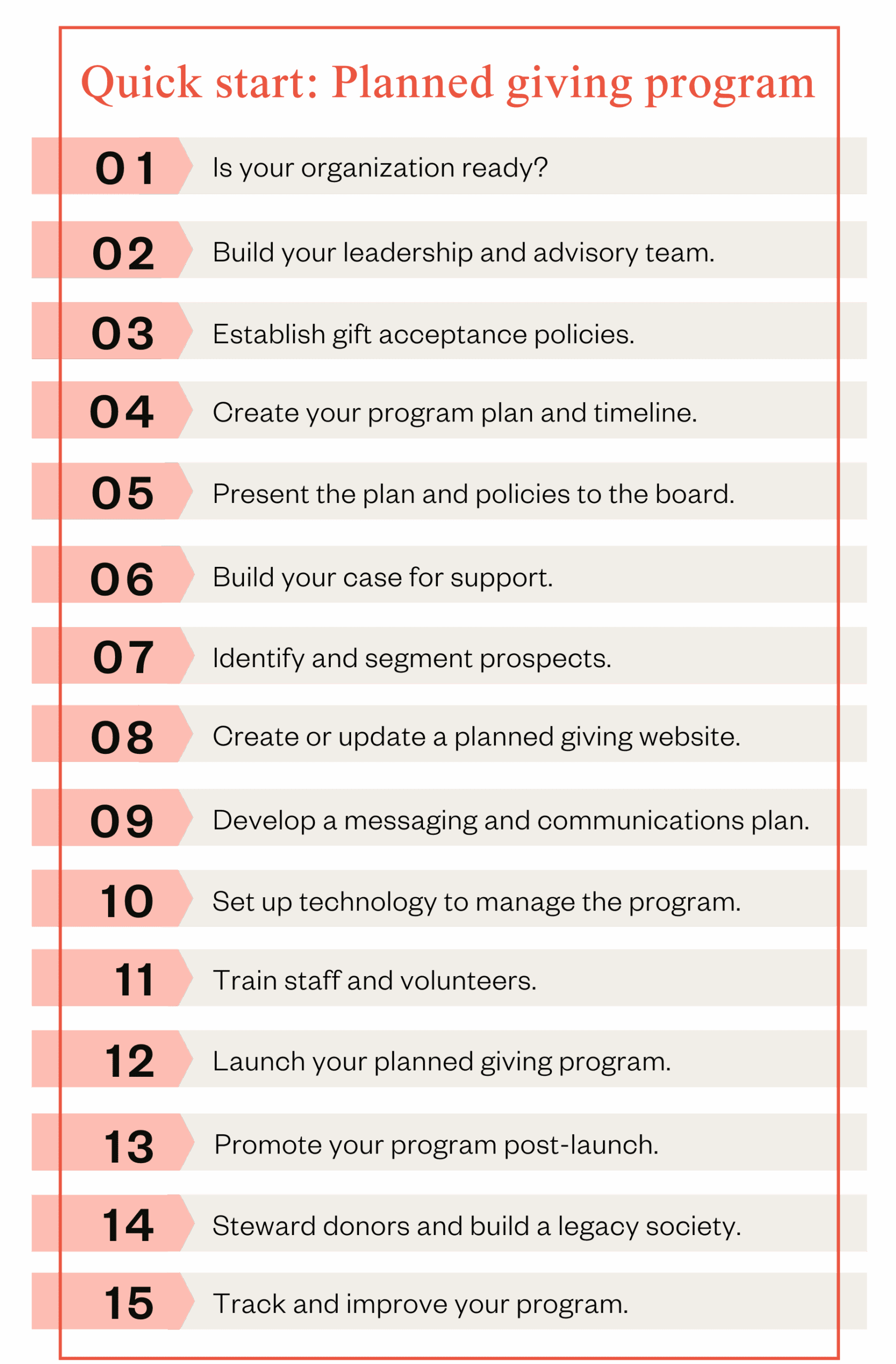
Step 1: Is your organization ready?
Your organization is ready to start a planned giving program when it has stable governance, a healthy donor database, leadership support, and the tools to manage long-term fundraising.
Readiness checklist:
- Governance and compliance: Confirm your tax-exempt status, bylaws, basic risk controls, and review legal and tax considerations for planned giving.
- Board support: Ensure leadership understands planned giving and backs a long-term commitment.
- Donor database health: Make sure contact information and giving history are accurate to identify loyal donors.
- Staff capacity: Confirm you have enough staff and volunteers to manage outreach, donor conversions, documentation, and stewardship.
- Technology infrastructure: Have fundraising intelligence tools in place. Prospect research software analyzes giving potential, and a fundraising CRM tracks donor data and allows you to manage outreach.
Goal: Ensure your organization has a stable foundation, capable staff, and the right tools to manage planned giving effectively.
Step 2: Build your leadership and advisory team
Assemble a team to guide and run the planned giving program by:
- Forming an advisory committee: Recruit three to five external experts (e.g., a business owner, financial advisor, attorney) and a board member. They advise on policies, prospect identification, and marketing, and provide periodic reports to the board.
- Hiring a planned giving officer: Assign at least one dedicated staff member to manage daily operations, including donor outreach, marketing, stewardship, and tracking program data. Ideally, they should have 10 or more years of experience in nonprofit fundraising and planned gifts.
Goal: Assemble a knowledgeable team that will guide, implement, and maintain a strong planned giving program.
Step 3: Establish gift acceptance policies
The advisory committee will assist in drafting your gift acceptance policies to ensure planned gifts are handled consistently and responsibly.
Tasks to complete:
- Define accepted gifts: List which planned gifts your organization accepts, such as bequests, beneficiary designations, charitable gift annuities, trusts, securities, real estate, or retirement assets. Your team will find additional clarity on common planned gift types in our Planned giving guide, which breaks down each structure and its core benefits.
- Set conditions: Establish minimum thresholds, restrictions, and conditions for each gift type.
- Determine review and refusal criteria: Specify who evaluates gifts and when a gift may be declined due to cost, legal risk, or mission misalignment.
- Plan recognition: Outline how donors will be recognized, such as through legacy societies, reports, appreciation events, and ongoing updates.
Goal: Protect your organization, simplify gift administration, and give the board a clear, adoptable policy framework.
Step 4: Create your program plan and timeline
Define your planned giving program’s goals, framework, budget, and staffing. Include advisory support to guide your plan and timeline.
What to build into your timeline:
- Finalize policies, processes, and documentation for program setup.
- Assign roles for outreach, stewardship, and internal coordination.
- Prepare your soft-launch plan and select a small group of prospects.
- Build a full-launch marketing schedule across channels.
- Integrate planned giving into major campaigns, year-end giving, GivingTuesday, and other initiatives.
Goal: Build a clear, actionable roadmap that aligns your team, organizes your rollout, and demonstrates program readiness to internal leaders and board members.
Step 5: Present the plan and policies to the board
Walk your board through the program structure, timeline, gift acceptance policies, and staffing plan. Demonstrate that the program is ready to proceed and secure their endorsement.
Step 6: Build your case for support
Your case for support explains why planned giving matters and shows donors how their legacy will create a lasting impact. It also gives staff clear, consistent language for outreach.
Actionable tasks:
- Create a legacy impact story: To make the impact real and relatable, highlight one or two short examples of how past planned gifts strengthened your mission.
- Define your value proposition: Explain why a planned gift is meaningful. Focus on long-term impact, mission stability, and the donor’s ability to shape the organization’s future.
- Outline legacy society benefits: List what donors receive as members, such as recognition, special updates, and appreciation events. Keep benefits simple and mission-aligned.
- Prepare talking points for staff: Summarize your message into three to five core statements to use in emails, meetings, and donor conversations.
Goal: Provide staff and donors with a clear, compelling message that strengthens understanding of your program and inspires planned giving commitments.
Step 7: Identify and segment prospects
Identifying strong planned giving prospects helps you focus on donors who are able to make meaningful long-term contributions. Research shows that planned gifts make up to 30% or more of comprehensive campaign totals (page 13 of the PDF). A typical planned gift is 200 to 300 times the size of an individual’s most significant annual gift (page 31 of the PDF). Early identification and segmentation are two of the most valuable steps in your program.
Research your existing donor database
Analyze your CRM data for donors who show consistent commitment through:
- Giving history: Frequency, recency, and total giving
- Longevity: Years giving or volunteering
- Engagement: Event attendance, volunteer activity, survey responses, and other interactions
Leverage wealth and philanthropic indicators
Use wealth screening tools to assess financial capacity to make a larger or long-term gift. These tools evaluate assets such as:
- Real estate ownership
- Securities
- Investments
- Business interests
Also, review philanthropic history—past support to your organization or similar causes. When combined, these indicators help you understand who has the ability to give and who is most inclined to support planned giving.
Identify new prospects using prospect research software
Prospect research software uncovers new individuals who:
- Give to organizations with similar missions
- Have a history of charitable activity, but limited contact with your organization
- Show financial indicators that suggest capacity for a planned gift commitment
Score, segment, and prioritize in your CRM
Score and tag prospects to sort them into meaningful groups designated in your donor pyramid for targeted outreach. Use multi-lens modeling to give a more complete view of each donor and ensure your planned giving pipeline is data-driven. To build a scoring model, look at:
- Capacity: Ability to give
- Affinity: Connection to your mission
- Propensity: Likelihood of giving based on past behavior
Watch for behavioral signs
Pay attention to donor conversations and cues. Strong signals include donors who:
- Talk about retirement or long-term financial planning
- Ask about non-cash gifts, endowments, or legacy impact
- Express a desire to make a lasting difference beyond their lifetime
Respect privacy and ethical boundaries
Ethical prospecting builds trust and protects donor relationships. Always protect donor data, follow privacy laws, and avoid intrusive outreach. Make it easy for supporters to self-identify by offering a planned giving interest form, website page, or conversation prompts during donor meetings. This keeps the process transparent and donor-centered.
Goal: Build an ethical, data-driven prospect pipeline that focuses outreach on donors most likely to make meaningful planned gifts.
Step 8: Create or update a planned giving website
A dedicated website provides a central hub for donors to learn about planned gifts and take action.
Actionable tasks:
- Include clear content, such as a planned giving definition, gift types, FAQs, sample bequest language, disclosures, and a contact form.
- Link from your main donation or “Ways to Give” page.
- Align language and visuals with your messaging plan (Step 9).
- Test forms and links to confirm functionality.
Step 9: Develop a messaging and communications plan
Clear, donor-centered messaging helps supporters understand planned giving, why it matters, and how to participate. Use effective planned giving marketing strategies to expand reach, engage donors consistently, and inspire planned gift commitments.
Actionable tasks:
- Craft simple, compelling messages: Highlight long-term impact and legacy. Keep the tone warm and avoid technical or legal jargon unless linking to deeper resources. Example themes include:
- “Create a lasting legacy.”
- “Support a mission you care about for generations.”
- “Make an impact beyond your lifetime.”
- Use storytelling to build emotional connection: Stories help donors see the real-world impact of planned gift commitments. Include short quotes or testimonials to make the stories relatable. Share brief examples of:
- How past planned gifts strengthened your mission
- Why supporters choose to leave legacies
- The future impact donors will help to create
- Plan your communications calendar: Map out a month-by-month schedule to keep planned giving visible year-round. Include donor stories, mission milestones, and timely reminders tied to holidays or anniversaries.
Goal: Build consistent, engaging messaging that connects emotionally with donors and keeps planned giving visible throughout the year.
Step 10: Set up technology to manage the program
Fundraising technology gives you the tools to initiate, track, manage, and grow your planned giving program. When your systems work together, your program becomes more organized, data-driven, and scalable.
Actionable tasks:
- Track donor intentions: Use your CRM to record planned gift commitments, update donor profiles, and monitor follow-ups.
- Automate reminders and stewardship: Set automated notifications for key milestones, such as anniversary acknowledgments or gift updates, to maintain consistent donor engagement.
- Generate reports: Use dashboards and analytics to monitor donor activity and program progress, adjusting strategies as needed.
Step 11: Train staff and volunteers
Effective planned giving requires staff and volunteers who understand the program and donor needs.
Actionable tasks:
- Clarify roles: Ensure frontline fundraisers, donor relations staff, and finance personnel know their responsibilities in identifying prospects, handling inquiries, and tracking gifts.
- Prepare for donor questions: Train staff to answer common questions about bequests, life income gifts, and other planned giving options. Provide scripts and talking points to maintain consistency.
- Understand when to involve advisors: Refer donors to attorneys, financial planners, or tax advisors for questions beyond your team’s expertise to ensure donors receive accurate guidance.
Step 12: Launch your planned giving program
Launch your planned giving program in a phased approach to test and refine your messaging before full rollout.
Actionable tasks:
- Activate your soft launch: Reach out to a small group of loyal donors and test your messaging, emails, and any printed materials. Collect feedback from staff and donors to refine your approach.
- Implement full launch: Publish your planned giving content across all channels, including email, social media, direct mail, and events. Ensure staff and board members know their talking points and response protocols so they’re prepared to respond to donor inquiries.
- Integration: Coordinate with major gifts, annual giving, and communication staff so that planned giving feels consistent and integrated across all donor touchpoints. This ensures a smooth addition to your existing campaigns.
Goal: A phased approach reduces mistakes, builds staff confidence, and helps donors engage with the program seamlessly.
Step 13: Promote your program across channels post-launch
Once your program is live, maintain visibility to keep planned giving top of mind for donors.
Actionable tasks:
- Multi-channel outreach: Promote planned giving using both digital and print outreach to reach donors of all ages. Effective channels include:
- Email newsletters
- Website features and blog posts
- Social media posts
- Direct mail inserts or brochures
- Annual reports
- Community publications
- Maintain consistent messaging: Reinforce core themes like long-term impact, donor legacy, and mission support in every channel.
- Personal outreach to loyal donors: Identify long-term or highly engaged supporters and reach out directly via personalized letters, phone calls, or one-on-one meetings. Approach these conversations with sensitivity, highlighting impact, gratitude, and the donor’s personal legacy.
- Link to your planned giving webpage: Make it easy for donors to learn more or start a conversation.
- Ongoing schedule: Follow your communications calendar (from Step 9) to keep content fresh. Update messaging as needed based on donor engagement and feedback.
Step 14: Steward donors and build a legacy society
Stewardship ensures that planned giving donors feel valued and strengthens long-term relationships, while encouraging future planned gifts.
Actionable tasks:
- Personalized acknowledgment: Thank donors promptly and personally using handwritten notes, phone calls, and emails. Highlight the impact of their gift to reinforce their legacy.
- Establish a legacy society: Create a “Legacy Circle” or “Heritage Society” to recognize supporters who have included your organization in their estate plans. Offer members special communications, event invitations, and public recognition.
- Offer meaningful recognition: Host annual appreciation events and include donors in newsletters and on physical and digital donor walls. Ensure recognition reflects both your mission and the donor’s contribution.
Step 15: Track and improve your program
Measure the success of your planned giving program and use insights to strengthen your efforts over time.
Actionable tasks:
- Review monthly or quarterly reports on donor activity, including inquiries, confirmed intentions, and realized gifts.
- Analyze trends in donor engagement and gift size to identify opportunities for improvement.
- Share insights with your staff and board members to inform decisions and align efforts.
Legal, tax, and compliance considerations
Ensure your planned giving program operates within legal and regulatory requirements to protect your organization and donors.
Key considerations:
- Understand the difference between non-binding and binding bequest commitments.
- Document all planned gifts accurately, including any restrictions or conditions.
- Protect donor privacy and handle sensitive information responsibly.
- Refer donors to qualified legal or tax advisors for personal guidance as needed.
- Ensure compliance with state charitable registration, IRS rules, and the Uniform Prudent Management of Institutional Funds Act (UPMIFA) guidelines.
Common planned giving challenges
Nonprofits sometimes struggle with limited staff, program complexity, or low donor awareness when starting a planned giving program.
Overcome challenges by:
- Focusing on top prospects to maximize impact with limited staff
- Breaking complex processes into manageable steps for your team
- Using donor data to guide outreach and identify likely planned gift donors
- Sharing clear examples of past impact to raise awareness and inspire support
Start a planned giving program with data-driven insights
A planned giving program benefits both your organization and your donors. It helps secure major gifts and build lasting legacies. Every nonprofit has the potential to strengthen its financial stability and mission impact by having a structured program in place.
Successful programs begin with understanding your donor base. Use fundraising intelligence tools to identify supporters with the capacity, interest, and inclination to make planned gifts. With this approach, your organization will build a sustainable, lasting planned giving program that engages donors and supports your mission for years to come.
Be the first to read our resources.
The world is changing quickly—and our resources help you stay on top of it all. Sign up to get new insights, success stories, and more, sent right to your inbox.
Explore related resources.
-
Unrestricted grants for nonprofits: How they work, where to find them, and how to apply

Post Unrestricted grants for nonprofits: How they work, where to find them, and how to apply
Secure flexible funding with unrestricted grants for nonprofits. Learn how they work, where to find opportunities, and how to apply successfully.
-
How to use nonprofit data visualization to tell your story

Post How to use nonprofit data visualization to tell your story
Learn best practices in nonprofit data visualization to transform complex data into an engaging, accessible story that rallies donor support.
-
Client Innovator Spotlight: Michelle Bates, Purdue for Life Foundation
Post Client Innovator Spotlight: Michelle Bates, Purdue for Life Foundation
Building the infrastructure that powers opportunity at Purdue for Life Foundation As Vice President of IT at the Purdue for...