


Share Article:


Planned giving is a powerful strategy for increasing your success with nonprofit fundraising. Planned giving donations are typically much larger than annual or even major gifts, although you won’t know exactly when you will receive them or exactly how much they will be.
Any registered nonprofit organization can implement a successful planned gift program with expert guidance and the right software tools. Let’s see how charitable organizations from large to small can leverage planned giving to enhance their current fundraising strategies.
What is planned giving?
Planned giving for nonprofits refers to charitable donations that are planned for an unspecified future date. It involves donors bequeathing sizable gifts to nonprofits through financial and estate planning vehicles like a will or trust.
Planned giving funds are either dispersed over time (in the case of a trust) or upon the donor’s passing (in the case of a will). For this reason, the circumstances preceding a planned gift can sometimes be sensitive. Be sure to approach them accordingly.
Planned giving vs legacy giving
It’s important to distinguish between “planned giving” and “legacy giving” (or “legacy gifts”). “Planned giving” encompasses any kind of giving that is planned ahead of time, whereas “legacy giving” occurs specifically upon the donor’s passing. “Legacy giving” is a subset of “planned giving.”
Planned gifts vs memorial funds
The main difference between planned gifts and memorial funds is timing and structure. A planned gift is arranged by a donor during their lifetime through estate planning. A memorial fund is created by loved ones after a person passes to collect immediate tribute donations.
How planned giving fits into a nonprofit fundraising strategy
Planned giving is one of the most significant sources of income for nonprofit organizations, putting it at the top of the donor pyramid. Planned gifts are often as large as or larger than major gifts.
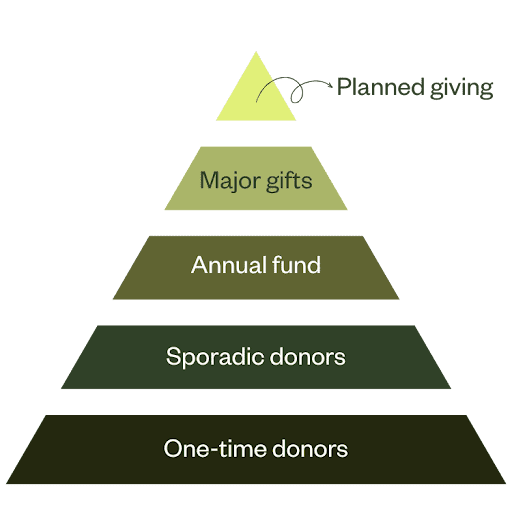
An interesting point to note about planned giving is that it allows typically small recurring or one-time donors to contribute a much larger amount than they could during their lifetime. Including these donors in your planned giving marketing plan in addition to wealthy donors could unlock significant funds that were previously going untapped.
Are you ready for the “great wealth transfer”?
A staggering $30 trillion is set to pass from Baby Boomers in the coming years. Start building your planned giving program today and help donors create legacies that last.
Common types of planned giving
Planned giving can take different forms, determined by the donor’s preference.
| Gift vehicle | Income to donor | Tax benefit | Primary donor profile |
| Bequest | No | Reduces estate taxes | Donors of any income level |
| Charitable gift annuity | Yes (guaranteed fixed) | Immediate tax deduction; a portion of the annuity payments may also be tax-free | Seniors seeking guaranteed income |
| Charitable remainder trust | Yes (fixed/variable) | Income tax deduction; deferred capital gains tax; reduces estate taxes | High-net-worth individuals |
| Charitable lead trust | No | Reduces estate and gift taxes for heirs | High-net-worth families |
| Retained life estate | No | Immediate tax deduction | Homeowners wishing to stay in their home |
| DAFs and non-cash assets | No | Immediate tax deduction; avoids capital gains taxes | Donors with appreciated stocks or cryptocurrency |
1. Bequest
A bequest is a gift left in a will for a group, organization, or individual. For charities, this normally takes the following forms:
- General bequests: Property taken from the assets of an estate. This can be a specific gift amount or a percentage.
- Demonstrative bequests: Gifts from a source like a bank account or stock portfolio.
- Specific bequests: Personal property like cash, jewelry, artwork, antiques, and other tangible assets.
- Residuary gifts: Gifts from the remainder of any debts or expenses that must be paid.
Bequests are the simplest and most popular type of planned giving, and also the most accessible for donors of any income level. They are the best place to start when commencing a planned giving program for the first time.
Bequests and non-probate assets
Non-probate assets, such as retirement accounts, life insurance policies, or assets held in a trust or joint tenancy, cannot be bequeathed in a will. However, these assets can be donated by updating the ownership agreements or designated beneficiaries to include your nonprofit organization.
Bequest intention notifications
Donors are not obligated to notify nonprofit beneficiaries of a bequest. They can just write you into their wills, and you’ll receive a gift upon their passing. However, unannounced planned giving makes prospects hard to identify since you’re not able to figure out how many donors are a part of your planned giving program.
It’s a good idea to ask planned donors for a bequest intention, which is a written promise that your organization will be included in the will. This can be a simple promise or include more specific details such as a percentage amount.
2. Charitable gift annuity
A charitable gift annuity is an agreement between a donor and a nonprofit organization in which the donor transfers assets to the organization. The nonprofit sends regular payments to the donor and/or other beneficiary from the fund until they die, and then keeps the remaining assets.
Charitable gift annuities provide tax deductions for the donors and potentially significant funds for the nonprofit organization. Keep in mind that the agreement must comply with all of the applicable laws in the states where both the organization and the donor are located.
3. Charitable trust
A trust is a legal entity in which an individual holds or invests property as the owner. Upon their death, the trust is usually divided among multiple beneficiaries. The person who transfers assets to the trust is referred to as the “trustor,” “grantor,” or “benefactor.”
The four different types of charitable trusts you’ll encounter include:
- Charitable remainder trust: A charitable remainder trust is a tax-exempt trust created to reduce taxable income by dispersing earnings to noncharitable beneficiaries over a specified period. The remainder is then given to one or more charities of the trustor’s choosing.
- Charitable remainder annuity trust: A charitable remainder annuity trust pays out a fixed percentage of the initial value of the assets held to the beneficiary (the trustor) during their lifetime or a set number of years (up to 20 years). The remainder is then donated to one or more charities of the trustor’s choosing. No assets can be added or withdrawn after the trust is established.
- Charitable remainder unitrust: A charitable remainder unitrust is similar to a charitable remainder annuity trust except that additional contributions can be made after the trust is created. The value of the trust is calculated at the beginning of each year as the basis for percentage-based distributions during that year.
- Charitable lead trust: The inverse of a remainder trust, this trust provides financial support to multiple causes over a set period of time. After this period, the remainder of the trust is given to the noncharitable beneficiaries, usually family members.
4. Retained life estate
A retained life estate is an alternative strategy to donating real estate outright. In this arrangement, the donor makes the charity a joint legal owner or “remainderman” of their property. They then continue to use the property until their death as the “life tenant,” at which time ownership of the property passes automatically to the charity.
5. Donor-advised funds (DAFs) and non-cash assets
Donor-advised funds (DAFs) and non-cash contributions represent the fastest-growing segment of charitable planned giving. Nonprofits can capture these gifts through two main planned giving strategies:
- DAF beneficiary designations: Donors name your nonprofit as the beneficiary of their donor-advised fund to receive any remaining assets upon their passing.
- Appreciated stock and crypto: Donors transfer appreciated assets directly to your organization, avoiding capital gains taxes while receiving a full fair-market-value tax deduction.
Flexible planned giving options within a clear major gifts strategy help donors make larger, more impactful gifts than they could ever afford with cash alone.
Want even more information about planned giving types?
Discover key insights, donor benefits, and actionable steps to identify top planned giving prospects.
Benefits of planned giving for nonprofit organizations
There are many benefits of planned giving for nonprofit organizations:
- Highest ROI of all giving types: Planned gifts typically have the highest return on investment (ROI) of all types of nonprofit revenue because they are significantly larger (on a per-gift basis) than what most people give in one-off or recurring donations.
- Potentially significant source of funds: The financial impact of a planned gift is typically much larger than that of a loyal donor’s monthly or annual donation.
- More eligible donors: Planned giving is accessible to people of all income levels because it’s based on a percentage of the donor’s saved assets rather than a fixed dollar amount.
- Diversified revenue streams: The more revenue streams your nonprofit has, the more resilient your organization will be in the event of an economic downturn or change in giving patterns.
- Stronger relationships with donors: Planned giving strengthens donors’ relationships with nonprofits because it represents a long-term commitment. It’s essential to properly steward your donors to maximize these benefits and ensure the planned gift comes to fruition.
- Increases other types of giving: Donors who establish a planned gift increase their annual giving by up to 77 percent. This statistic proves that estate commitments complement rather than compete with current donations.
Benefits of planned giving for donors
Primary benefits of planned giving for donors include:
- Create a legacy: Planned giving allows dedicated supporters to leave a lasting impact on a cause they care about.
- Tax advantages: Planned giving provides various opportunities for saving on estate and/or capital gains taxes, depending on the type and timing of the gift. It’s best to advise interested individuals to consult with a tax professional regarding the planned giving strategy that would be most tax-effective in their case.
- Opportunity to designate the purpose of the funds: Planned gift donors can specify how they would like a planned gift to be used (within the scope of the organization’s work). They don’t typically have this opportunity when making one-off, monthly, or annual donations.
Tip: Maximize the impact of these advantages in your program with our dedicated article on planned giving benefits.
How to start a planned giving program
A formal planned giving program will help you uncover potential new supporters and ensure everyone is well informed about the specifics so the donation process goes smoothly. Follow these core steps to build, launch, and grow a successful program for your nonprofit organization.
Phase 1: Planned giving program readiness and governance
Lay the groundwork for a successful planned giving program before taking it public.
- Research planned giving thoroughly: Begin by researching planned giving in detail. Consider your organization’s readiness to accept planned gifts before moving forward.
- Build a planned giving team: You will need a solid team behind you to make your planned giving program successful. This team should include a planned giving officer, a marketing specialist, a gift administration specialist, and a database manager.
- Identify prospective donors: Identify several potential planned giving donors using prospect research, ideally using intelligent prospect research software, before pitching the idea to your organization’s leadership. This will help you gauge how viable the idea is (in terms of resource allocation) and help you develop a strong case to present to the board.
- Form an advisory committee: Set up an advisory group of local professionals that includes estate lawyers, accountants, and/or financial planners. This group will build clear gift acceptance policies that protect your nonprofit and set rules for minimum gift sizes, property appraisal steps, and guidelines for turning down risky donations. Members also act as ambassadors who introduce you to potential donors in their networks.
- Create a plan: Meet with the planned giving team and draw up a plan for how the program could work in your organization.
- Approach the board: Schedule a meeting with your nonprofit board to educate the leadership about the benefits of planned giving and present your ideas for a dedicated planned giving program.
- Appoint or hire a planned giving officer: Your planned giving officer is the staff member who is solely responsible for the day-to-day operations of the program. You can either appoint a staff member to take on this role or hire an external expert.
Phase 2: Planned giving program collateral and marketing
- Create a planned giving brochure: Prepare a planned giving brochure to present to interested donors. This brochure should include a moving description of the program, contact details, and your organization’s “case for support.”
- Create bequest templates for donors: Provide simple sample language on your website and in brochures that donors can take to their estate attorneys. Giving donors ready-to-use phrasing makes it easy for them to include your organization in their will.
Sample bequest language to use
“I give, devise, and bequeath to [legal name of your nonprofit], located at [Street, City, State] (EIN: [tax ID number]), [insert $ dollar amount, percentage of estate, or specific asset] to be used for its general charitable purposes.” - Create a marketing strategy and calendar for the program:Marketing planned gifts involves the creation of a range of print and media resources. Be sure to add Planned Giving Month to your calendar to give your team a clear annual focus for targeted bequest campaigns. Remember to add a dedicated planned giving page and donation option to your website.
- Launch your program: Set an official launch date for your planned giving program. This is the date you will start accepting and processing planned gift notifications from donors.
Phase 3: Planned giving program stewardship and growth
- Establish a legacy society: Create a dedicated recognition group for donors who include your nonprofit in their estate plans. To launch the society, pick a meaningful name (e.g., “Legacy Circle,” “Visionaries Circle,” “Pillar Society”), invite current legacy donors to join as founding members, and announce the group in your newsletter. You can steward these members with small perks like regular impact updates, annual report listings, or an annual donor lunch.
- Keep communicating: Small but consistent communications today gradually cultivate strong relationships with potential donors to gain gifts in the future.
- Acknowledge and steward planned giving donors: Acknowledge and steward planned giving donors diligently using a nonprofit CRM to make sure no one falls through the cracks. Following clear major donor stewardship steps helps your team build long-term trust and keep every legacy supporter engaged.
- Track progress and adjust as needed: Track your progress based on your initial goals and continue to grow and refine your strategy over time.
Ready to get started? Get the full roadmap with our guide on How to start a planned giving program.
FAQs
1. Do you count promised bequests on financial statements before the money arrives?
You do not record promised bequests as current income or assets on your formal financial statements. Because donors can change their wills at any time, accounting rules treat revocable gifts as informal commitments rather than active balance sheet revenue. You should track these future promises in your donor database and only log them as official revenue once the donor’s estate is settled.
2. Should our new planned giving program focus on complex gifts or simple bequests?
A new planned giving program should focus almost entirely on simple bequests. The majority of planned gifts come from simple provisions written into a will or beneficiary designation form. While there are manytypes of planned giving available to donors, nonprofit teams save time and money by promoting straightforward gifts rather than setting up complex legal structures like annuities or trusts.
3. Who are the best prospective donors to target when launching a planned giving program?
Your most loyal lifetime donors are your best prospects for legacy giving. Donors who give modest amounts consistently for 5 or 10+ years show a deeper commitment to your mission than wealthy one-time contributors. Focus your initial outreach on long-term annual donors, dedicated volunteers, and board members.
4. What legal information must you list on your website for potential bequest donors?
Your website or brochure needs to clearly show your nonprofit organization’s official legal name, corporate mailing address, and nine-digit Federal Tax ID (EIN). Providing these details ensures estate attorneys will draft the bequest documents correctly. It’s also helpful to publish simple sample bequest language that donors can download and take to their lawyers.
Secure your nonprofit’s future with planned giving
Planned giving can propel your organization forward if done well. The beauty of this strategy is that it allows donors of all income levels to make a significant contribution to your cause.
It’s essential to dedicate time to careful research and planning at the beginning. This will allow you to establish a planned giving program that is feasible for your nonprofit organization and aligned with your goals. The right approach, coupled with the right people and tools, will help you maximize your program’s success.

Be the first to read our resources.
The world is changing quickly—and our resources help you stay on top of it all. Sign up to get new insights, success stories, and more, sent right to your inbox.
Explore related resources.
-
Unrestricted grants for nonprofits: How they work, where to find them, and how to apply

Post Unrestricted grants for nonprofits: How they work, where to find them, and how to apply
Secure flexible funding with unrestricted grants for nonprofits. Learn how they work, where to find opportunities, and how to apply successfully.
-
How to use nonprofit data visualization to tell your story

Post How to use nonprofit data visualization to tell your story
Learn best practices in nonprofit data visualization to transform complex data into an engaging, accessible story that rallies donor support.
-
Client Innovator Spotlight: Michelle Bates, Purdue for Life Foundation
Post Client Innovator Spotlight: Michelle Bates, Purdue for Life Foundation
Building the infrastructure that powers opportunity at Purdue for Life Foundation As Vice President of IT at the Purdue for...