
Share Article:


Executive Summary
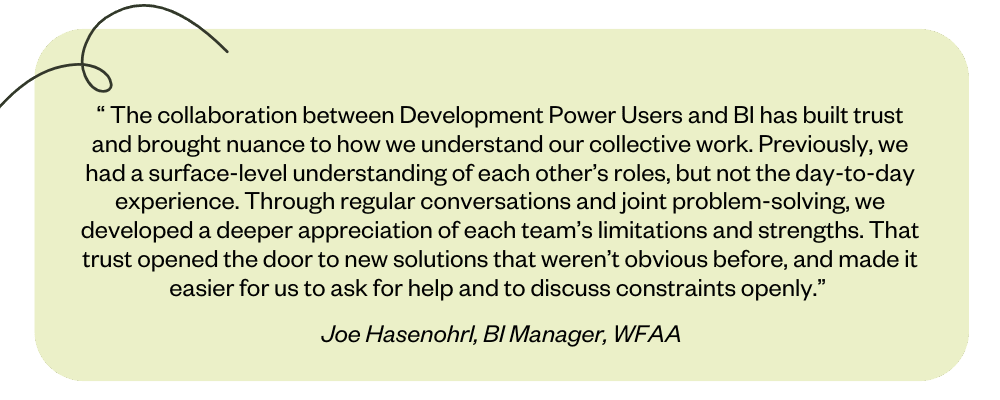
The Wisconsin Foundation & Alumni Association (WFAA) transformed its advancement organization by building Communities of Practice (CoPs) — structured peer-learning groups that empower staff to collaborate, innovate, and own their data.
By shifting from centralized reporting to self-service analytics, WFAA reduced dependence on its Business Intelligence (BI) team, improved staff confidence in data-driven decision-making, and accelerated the organization’s digital transformation journey.
Results:
- 170% increase year-over-year in BI report tickets fulfilled by development power users (redirected from BI to trained power users)
- Three new Power BI dashboards created by community members
- Significant reduction in ad hoc BI requests
- Upskilled 60+ staff across operations, development, and analysts
Background
Since its founding in 1945, WFAA has led philanthropic efforts for the University of Wisconsin–Madison. In 2015, the UW Foundation merged with the Wisconsin Alumni Association to form WFAA — aligning fundraising and engagement under one umbrella.
After years of system modernization, the organization embarked on a new chapter with AdvancementRM — emphasizing data-driven strategy, people readiness, and system adoption.

Challenge
- As WFAA adopted new systems and transitioned from SSRS and Tableau to Salesforce reports and Power BI, users faced:
- A heavy dependency on the BI team for ad hoc report development
- Slow adoption of new reporting tools
- Low confidence in creating or interpreting reports
- A need to scale data literacy across departments
The solution wasn’t more dashboards — it was a more connected, empowered user community.
Solution: Building Communities of Practice
WFAA launched a Communities of Practice (CoP) initiative in 2024, designed to build cross-functional expertise and foster peer-to-peer collaboration around analytics, reporting, and data literacy. Ultimately, this effort resulted in expanding organizational reporting capacity and re-focusing BI on strategic initiatives.
Implementation Framework
| Step | Focus | Outcome |
| BI build commonly used self-service reports | Create foundational Salesforce & Power BI reports | Empower end users. Reduce dependency on BI |
| Select & train power users | Identify staff with aptitude and interest. Build foundational knowledge on reporting tools | Build internal champions. Increase data and tools literacy |
| Reduce ad-hoc dependency on BI | Shift ad-hoc requests to power user groups and re-focus BI from ad-hoc requests to strategic reporting | Scale efficiency. Continue collaborative discussions and learning with CoP. |
| Deliver enterprise reports | Enable BI to concentrate on organization-wide insights | Improve strategic alignment while still delivering on-time data requests via the CoP. |
Communities of Practice in Action
Community 1: Operational Power Users
Goal: Upskill operational teams (i.e., Annual Giving, Gift Services, Prospect Development, etc.) and reduce BI dependency
Tactics:
- Training on Salesforce reports, dashboards, Apsona and in-platform tools
- Bi-weekly forums and dedicated Microsoft Teams channels
Outcomes:
- Increased confidence and data literacy
- Greater ownership of operational reporting
- BI team transitioned to an advisory role
Community 2: Development Power Users
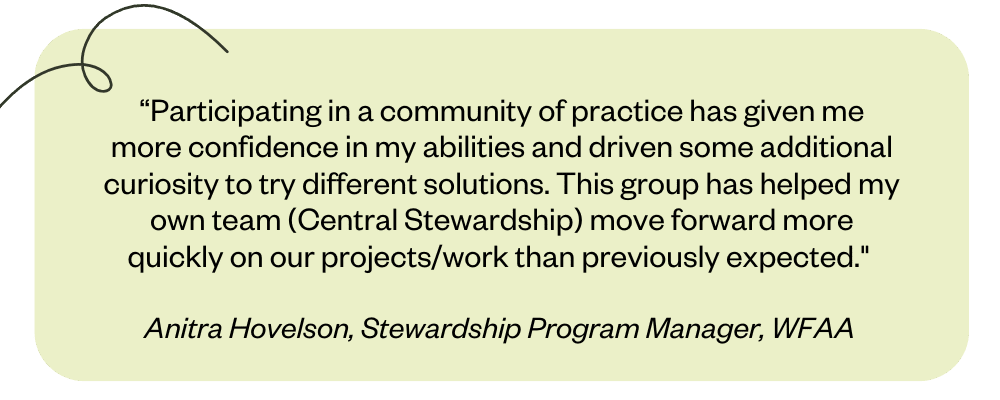
Goal: Drive self-sufficiency across development teams
Observations: During a BI ad-hoc ticket analysis, half the requests in the queue originated from Development teams and Campus partners. If we could get a group in front of these requests, it would benefit both BI and Development.
Tactics:
- Training on using self-service Power BI reports, and Salesforce reports
- Peer forums to exchange reporting strategies
Outcomes:
- 170% increase year-over-year in report requests fulfilled by development power users
- Significant reduction in BI team ticket volume
- Power users recommended three new reports that would offset even more report requests to BI, and informed enhancements to others
Community 3: Analytics Power Users
Goal: Empower “citizen data analysts” to operationalize analytics within their departments (Annual Giving, Digital Marketing, Prospect Development, etc.)
Tactics:
- Standardized job descriptions and training
- Established curated datasets and version control
- Peer reviews and monthly knowledge-sharing forums
Outcomes:
- Improved insights due to the analysis done directly by business department employees
- Faster turnaround for report development and enhancement, compared to wait-time for the central BI report development queue
- Increased analyst confidence and technical depth
Components of Successful Communities
- Leadership Support – Executive buy-in and resource commitment
- Center of Excellence (CoE) – Allocating technical staff to training, facilitation, and culture-building
- Power User Identification & Engagement – Selecting participants with aptitude and curiosity
- Community Infrastructure – Recurring meetings, shared channels, and learning repositories
Lessons Learned
Empower & Partner: Technical teams don’t have to provide all the answers — communities surface new insights.
Start Small, Think Big: Launch with a pilot group and scale success.
Power Users as Insiders: Share early previews and quick wins to build momentum.
Adopt an Abundance Mindset: Communities multiply organizational capacity — the CoE becomes both teacher and learner
Data democratization drives engagement: When users have ownership, adoption follows.
Communities of Practice build culture: Shared learning creates sustainable change.
Analytics maturity is a team sport. Empowered “citizen analysts” expand organizational capacity.
Shift BI from standard reporting to strategic insights. Enable teams to access and build the basics, and reserve your BI experts for complex strategic priorities.
Be the first to read our resources.
The world is changing quickly—and our resources help you stay on top of it all. Sign up to get new insights, success stories, and more, sent right to your inbox.
Explore related resources.
-
Maximizing the grateful patient program: How Hoag automated 95% of its workflow and accelerated major gift pipeline

Case Study Maximizing the grateful patient program: How Hoag automated 95% of its workflow and accelerated major gift pipeline
Hoag Hospital Foundation is a nonprofit regional health system serving Orange County, California, and surrounding communities. Founded in 1952, the...
-
Boise State Athletics delivers record-breaking renewals with Kindsight

Case Study Boise State Athletics delivers record-breaking renewals with Kindsight
Boise State Athletics tapped into the power of Kindsight’s Central Intelligence to reimagine its football season ticket renewal campaign. The...
-
Kettering Health Foundation Increased Grateful Patient Giving 169% with iWave GPP Solution

Case Study Kettering Health Foundation Increased Grateful Patient Giving 169% with iWave GPP Solution
After expanding outreach 139%, Kettering Helalth Foundation achieved 89% more gifts and 169% more total giving from its End-of-Year Grateful...