


Share Article:


Cast your mind back to your college days—you might feel nostalgia, or a strong sense of personal connection that’s lasted well beyond your graduation date.
With alumni fundraising, you can channel this sense of pride and ownership into a lucrative fundraising strategy. It strengthens your institution through community, brings significant fundraising opportunities, and most importantly, sets a new generation of students up for success.
This article will teach you how to launch an alumni fundraising campaign that builds authentic community and generates revenue—including strategies, best practices, and a winning alumni fundraising letter template. Whether you’re a university, high school, or a nonprofit, we’ll show you how to get the most from your alumni fundraising strategy.
What is alumni fundraising?
Alumni fundraising refers to an institution securing donations from its alumni to fund programs, initiatives, and operations. It’s a strategy widely practiced by many universities, medical institutions, high schools, and more.
The most effective alumni fundraising goes beyond asking for donations. Instead, it’s about building strong, enduring relationships and fostering a sense of ownership and pride. Many development teams prioritize alumni fundraising as a key funding strategy.
Why is alumni fundraising important?
Raising funds is always a major goal, but alumni fundraising comes with other benefits—it can bolster an institution’s reputation and legacy, encourage new enrollment, and improve current students’ experiences through funding new programs and facilities. Often, alumni funds are used for the following:
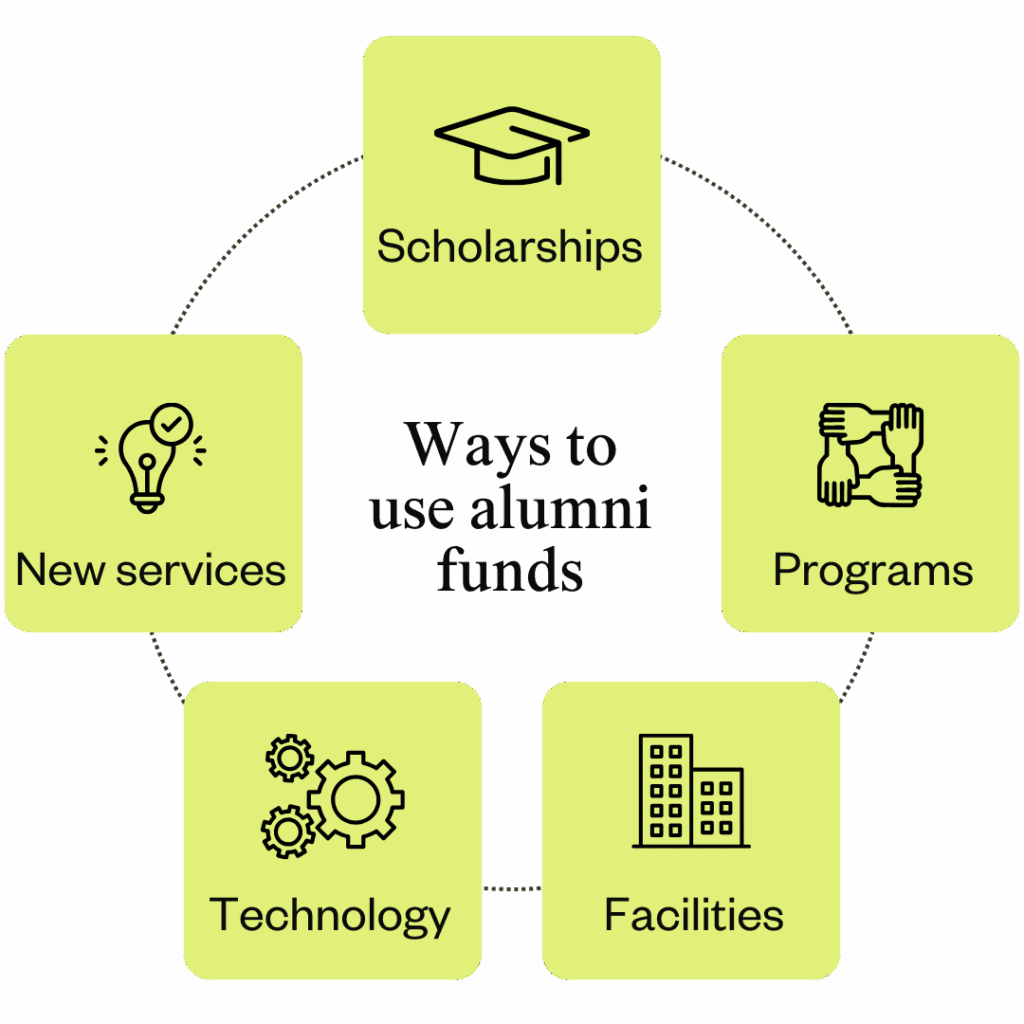
- Scholarships
- Enrichment programs and events
- Facilities
- Technology
- Providing new services
For many educational institutions, alumni gifts are the cornerstone of university fundraising success.
Effective alumni fundraising strategies
Use the strategies outlined below to get started with alumni fundraising, or bolster your existing alumni giving program.
Conduct prospect research
Just like nonprofits conduct prospect research before making donation requests from supporters, it’s important to analyze your alumni base before launching into your giving campaign. Review and segment your alumni based on their interests, along with the three indicators below:
- Philanthropic indicators: This is the evidence that someone has an interest in giving. Indicators might include a history of charitable giving, political contributions, or volunteering for a charitable organization.
- Wealth indicators: Also known as capacity indicators, this shows that someone has the financial means to give. Wealth indicators can include property ownership, business affiliation, or stock ownership.
- History of institution engagement: Whether attending events, mentoring, or proactively staying in touch, your highest priority prospects will demonstrate a history of engagement with your institution as alumni.
Alumni most likely to donate will show all three indicators—make this group your highest priority for prospect development. Create an alumni database, and engage high-priority potential donors with phone calls, event invitations, or volunteer opportunities. Choose a donor prospect research software that makes it easy to organize and analyze alumni data.
It’s still good practice to keep up with all alumni through regular emails, social media updates, or direct mail. Foster strong relationships now, and future fundraising requests down the line are far more likely to be successful.
Personalize your messaging
Once you’ve conducted thorough prospect research, you can tailor your messaging based on your alumni interests.
For example, if someone was very active in your sports program, and you know their employer offers matching giving (we’ve included more information on workplace giving and matching donations below), share how a matching donation will go towards building your new sports park.
Personalized messaging isn’t just about the kinds of asks you make. These small personal touches will help you leave a great impression:
- Use preferred names
- Refer to previous specific donation amounts or contributions
- Refer to any conversations or prior connections, like events they’ve attended or conversations you’ve shared
Remember to keep your alumni database updated, so have the right information on hand when you need it.
Understand alumni motivations for giving
It can feel counterintuitive, but keep your messaging focused on your alumni—not the institution. Fundraising campaigns that speak directly to your alumni are more likely to resonate and lead to donations.
First, you’ll need a clear understanding of the top incentives behind alumni giving:
- Loyalty and Affinity: Graduates often feel a strong sense of nostalgia and connection to their university, and you should tailor your language accordingly. For example, refer to “Your” university, not “The University.”
- Legacy: Former students who have gone on to have prestigious careers may want their name to be associated with the institution. Tap into this motivating factor with plenty of opportunities for alumni donor recognition, such as naming alumni donors on a plaque in your building, or highlighting names on your website or social media.
- Tax benefits: As long as your institution is a registered 501(c)(3), alumni can write off their donations. It shouldn’t be the driving force of your messaging, but highlighting tax benefits can be a persuasive approach.
Encourage workplace giving
Workplace giving can be an underutilized alumni fundraising strategy. Leveraging your alumni’s corporate connections by tapping into workplace giving helps you expand your reach, create a more sustainable revenue stream for your institution, and allows alumni to rally their colleagues for your cause.
Start by gathering the right data. For example, do your alumni work for companies known for their generous workplace giving programs? Don’t worry if you don’t have the relevant data on hand. The right data service providers will fill in the gaps.
From here, you can:
- Highlight matching gifts: Learn which employers offer matching gift programs, and let your alumni know through email campaigns—they might not be aware these programs are offered. Research from Double the Donation shows that well-executed matching giving campaigns have 5 times higher engagement.
- Promote payroll giving: With payroll giving, alumni can contribute to your organization directly from their paychecks—often in just a few clicks. With the right workplace giving tools, you can easily identify which of your alumni donors work for companies with active payroll giving programs. From here, share simple, actionable messaging on the convenience and impact of sustained, payroll giving.
- Target corporate partnerships: Workplace giving can help you build relationships with corporations and tap into new corporate giving programs through your alumni.
- Inform strategic decisions: Alumni employee data can help inform your wider alumni fundraising strategy. If you notice many of your alumni work in one specific industry, for example, you can create more targeted outreach.
Provide as much information as you can about workplace giving opportunities and how to access them upfront. The clearer the path to giving, the more likely your alumni are to follow through.
Where to next? Take a look at these companies that match gifts to higher education.
Can workplace giving actually strengthen alumni relationships?
Discover how to leverage corporate matching gift programs to deepen connections with your alumni community, boost participation in giving campaigns, and enhance overall fundraising efforts

Tailor your asks to financial capacity
When you’re ready to make an ask, don’t risk alienating alumni by asking for too much, or falling short with a low-ball ask.
Instead, use information gathered from wealth screening, along with previous giving history, to make a request that strikes the right balance.
6 ideas for alumni fundraising
Once you’ve nailed your core fundraising strategy, you can focus on creating new, exciting fundraising opportunities.
These six popular alumni fundraising ideas for schools and colleges will deepen engagement and help your institution reach its funding goals.
- Host a giving day
Introduce a sense of urgency into your alumni fundraising campaign with a 24-hour giving campaign. Set your fundraising goal, and create a fundraising page that highlights individual giving amounts. This will help encourage some friendly competition between fellow alumni— according to research from Science Direct, the fundraising gamification tactics like this one significantly increase fundraising amounts.
Involve your staff and current students in your giving day, align your giving campaign with a significant milestone, or launch the campaign in honor of a significant person.
- Launch an annual giving campaign
An annual giving campaign is a type of recurring donation campaign where alumni agree to give a specified dollar amount annually.
Knowing when you’ll receive a donation, and how big that donation will be, helps to stabilize your finances and makes budgeting much easier. Try a text-to-donate campaign, start a membership or pledge program, or tie your annual giving into your wider year-end giving campaign.
- Host a fundraising event
Host special fundraising events just for your alumni. Sell tickets, merchandise, and highlight different opportunities for giving during your event. Try the following:
- Appreciation luncheon
- Silent auction
- Alumni night out
- Private dinner or fundraising gala
- Campus tour
Center your event on community-building. Don’t underestimate how eager alumni can be to get back onto campus or attend a fundraising gala! Or, host a free, virtual event, so alumni can attend from anywhere in the world.
Want more tips for your next event?
Sit down with T. Clay Buck, CFRE, and Samantha Swaim, Strategic Director of Swaim Strategies, as they discuss the trends in special events, how to execute hybrid events, how to center inclusion, equity, and community in events.
- Highlight legacy giving
With legacy giving (also known as planned giving), alumni can leave a contribution to an institution in their will or estate. Because funds donated through legacy giving aren’t missed, donation amounts tend to be higher.
Highlight legacy giving through your alumni communication emails, letters, and website. Share specific examples of how legacy giving has furthered your institution’s work and benefitted your students. Spotlight alumni who have become legacy givers and how their contributions have shaped your institution.
- Use peer-to-peer fundraising
Encourage alumni to fundraise on your behalf with a peer-to-peer campaign. In peer-to-peer fundraising, alumni raise money on behalf of your institution with their own fundraising page. Before you launch your campaign, create a peer-to-peer fundraising resource pack with all the information they’ll need to raise money.
With peer-to-peer fundraising, you’ll increase fundraising and your institution’s reach. This type of fundraising thrives on personal connections and networks, making it ideal to launch alongside workplace giving.
- Launch a direct mail campaign
Direct mail fundraising campaigns bring a personal touch that feels both thoughtful and official. It’s also a great opportunity to include photographs, more detailed information about upcoming events, or alumni volunteer opportunities—unlike social media or email campaigns, you’re less likely to be competing for someone’s immediate attention when they open an envelope from your institution.
The alumni fundraising letter template included below is a great place to start. Just fill in the gaps to reflect your alumni, institution, and programs.
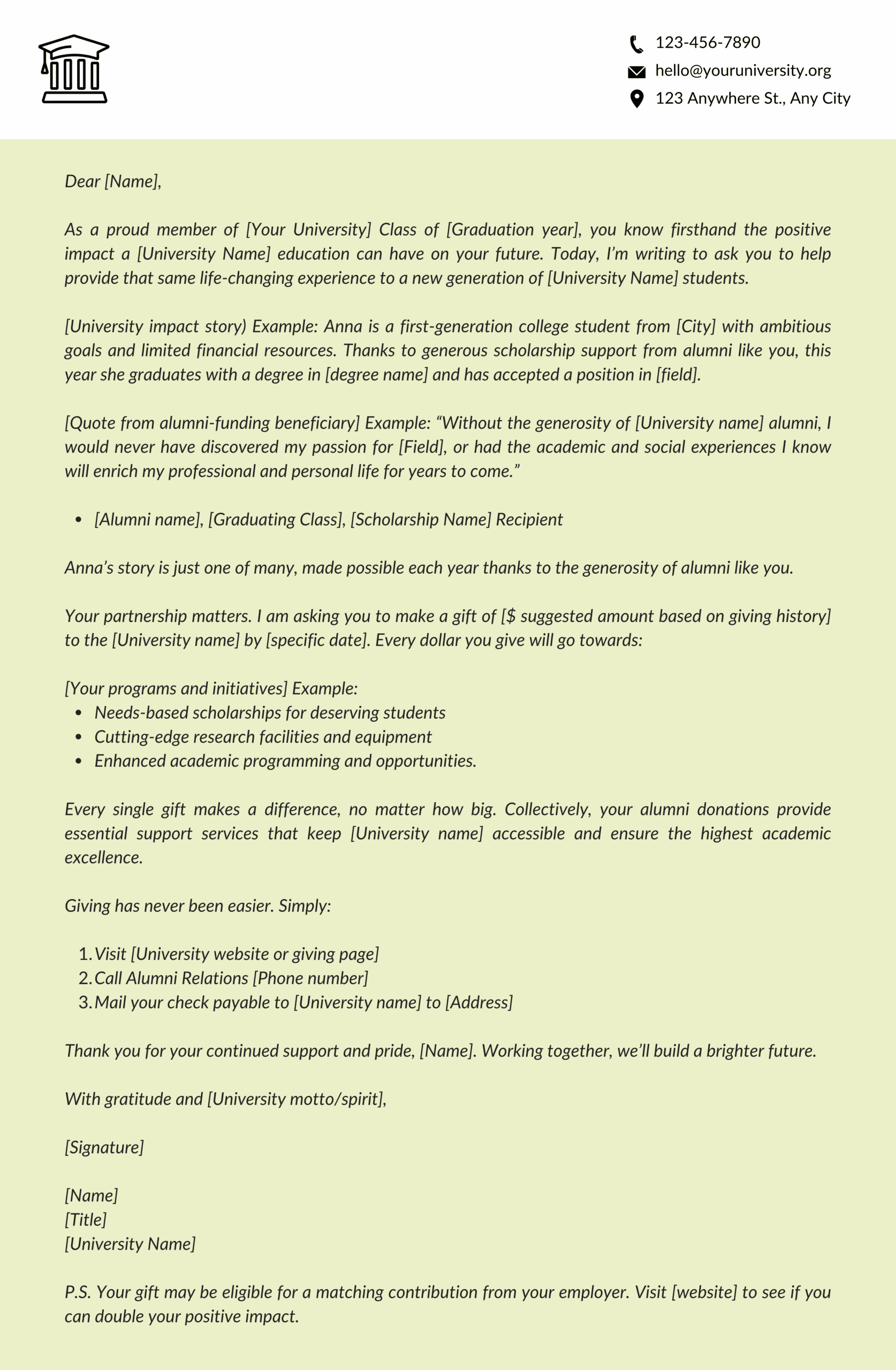
Dear [Name],
As a proud member of [Your University] Class of [Graduation year], you know firsthand the positive impact a [University Name] education can have on your future. Today, I’m writing to ask you to help provide that same life-changing experience to a new generation of [University Name] students.
[University impact story) Example: Anna is a first-generation college student from [City] with ambitious goals and limited financial resources. Thanks to generous scholarship support from alumni like you, this year she graduates with a degree in [degree name] and has accepted a position in [field].
[Quote from alumni-funding beneficiary] Example: “Without the generosity of [University name] alumni, I would never have discovered my passion for [Field], or had the academic and social experiences I know will enrich my professional and personal life for years to come.”
- [Alumni name], [Graduating Class], [Scholarship Name] Recipient
Anna’s story is just one of many, made possible each year thanks to the generosity of alumni like you.
Your partnership matters. I am asking you to make a gift of [$ suggested amount based on giving history] to the [University name] by [specific date]. Every dollar you give will go towards:
[Your programs and initiatives] Example:
- Needs-based scholarships for deserving students
- Cutting-edge research facilities and equipment
- Enhanced academic programming and opportunities.
Every single gift makes a difference, no matter how big. Collectively, your alumni donations provide essential support services that keep [University name] accessible and ensure the highest academic excellence.
Giving has never been easier. Simply:
- Visit [University website or giving page]
- Call Alumni Relations [Phone number]
- Mail your check payable to [University name] to [Address]
Thank you for your continued support and pride, [Name]. Working together, we’ll build a brighter future.
With gratitude and [University motto/spirit],
[Signature]
[Name]
[Title]
[University Name]
P.S. Your gift may be eligible for a matching contribution from your employer. Visit [website] to see if you can double your positive impact.
5 Alumni fundraising best practices
Whichever fundraising idea you choose, incorporate the best practices below to ensure you get the most from your alumni fundraising strategy.
1. Prioritize relationship building
If alumni only hear from you when you’re making an ask, they’re unlikely to give. Instead, keep relationship building at the core of your alumni strategy. Send out surveys to find out how (and how often) alumni want to hear from you—whether that’s through email, phone calls, or direct mail. Respect the wishes of anyone who chooses to opt out of alumni communications.
Don’t just make financial asks. Offer volunteer and mentorship opportunities. Survey your alumni to learn the skills they’d most like to put to use as volunteers. Be patient. Remember, successful fundraising requires thoughtful moves management, and following up—sometimes, over a long period of time.
2. Make timely asks
Keep track of significant anniversaries or reunions—like 5, 10, or 20 years since graduation. This way, you can engage your alumni when your institution is already top of mind. Remember, every year is someone’s significant anniversary. Use your updated alumni records to stay on top of timely asks.
Don’t forget about wider-world financial trends. According to research from Higher Ed Jobs, charitable giving amounts increase when the stock market performs well, for example.
3. Establish connections early
New graduates might not be able to give immediately, but those first few years and months are still a great time to establish a strong relationship.
Keep new grads engaged with alumni newsletters, social media spotlights, and virtual events. This way, when it comes time to make an ask, you’ve already forged a strong connection—and your institution will be top of mind when they have the means give.
4. Involve alumni in your decision-making
Giving your alumni a say in where their fundraising goes is an excellent way to foster a sense of ownership and works to incentivize giving.
Use the approaches below to get your alumni involved in the decision-making process:
- Segment your donors: Offer different fundraising options based on your alumni’s interests. For example, alumni who were heavily involved in the sciences during their time at university may be excited to contribute to the new science wing.
- Conduct a poll: Run a poll on your social media platforms or alumni website to learn where alumni would most like to channel their contributions.
- Give options based on donation amounts: A $50 donation may go towards a scholarship, for example, while a $100 donation may contribute to a new building.
This is especially pertinent for high-ticket donors—if you’ve made a major gift, you’re more likely to have a stake in where that money goes.
5. Thank your donors
No matter the type of fundraiser you’re running and how big or small a donation, nothing is more important than sending a timely, personal thank you to your alumni donors. In fact, it’s a core component of good donor stewardship.
Send them an immediate thank-you note via email as soon as you receive their donation. Follow up with a more personalized thank-you letter or email, sharing the impact of their donation.
Looking for more ways to keep your alumni invested in your mission? Learn more tips, tricks, and best practices for alumni engagement.
Conclusion
Regardless of your institution or prior history of alumni fundraising, with the right strategies, tools, and know-how, you can develop a robust and successful alumni fundraising strategy that yields lasting benefits for your institution.
By implementing thoughtful alumni fundraising strategies outlined above, you can look forward to fostering a culture of giving and generosity that extends far beyond graduation day.

Be the first to read our resources.
The world is changing quickly—and our resources help you stay on top of it all. Sign up to get new insights, success stories, and more, sent right to your inbox.
Explore related resources.
-
Strengthening Alumni Ties: Strategies for Workplace Giving

Post Strengthening Alumni Ties: Strategies for Workplace Giving
Get alumni better engaged with your institution using workplace giving strategies! Explore expert practices to drive a greater impact for your school.
-
How Corporate Philanthropy Benefits Educational Institutions

Post How Corporate Philanthropy Benefits Educational Institutions
Educational institutions play a pivotal role in shaping the future of our society. But with often limited access to the...
-
University Fundraising: tips and best practices for alumni engagement

Post University Fundraising: tips and best practices for alumni engagement
Universities are constantly expanding their departments and campuses to continue shaping the future’s brightest minds. Donations and major gifts are...