


Share Article:


Data and fundraising analytics might not be the most glamorous subject, but it’s an important one. In fact, the latest Global State of Enterprise Analytics report found that 94% of enterprises see data and analytics as key to business growth and digital transformation.
There’s a lot that nonprofit organizations can learn from this mindset. In this article, we’ll unpack what fundraising analytics really mean, explore the main types of data analytics, their uses, and answer some frequently asked questions along the way.
What are fundraising analytics?
The term “fundraising analytics” refers to the process of collecting and using data to analyze and understand the impact of your fundraising. From day-to-day performance to specific campaigns and activities, fundraising analytics help you surface insights and understanding that will help raise funds for your cause.
Why your organization needs fundraising analytics
You can’t build a successful fundraising strategy based on hunches. Information is power, and when you put fundraising analytics to work, you create:

- Clarity: With a complete view of your historical data and current fundraising activity, you can see where your organization stands, which activities are working best, and where there’s space to improve.
- Confidence: By eliminating the guesswork, you can make informed, strategic decisions — ironing out the kinks in your fundraising campaigns, tackling bottlenecks, anticipating donor behavior, and prioritizing activities that deliver.
- Impact: Smarter choices lead to smarter spending. Fundraising analytics help make sure you allocate resources effectively, and that your return on investment grows.
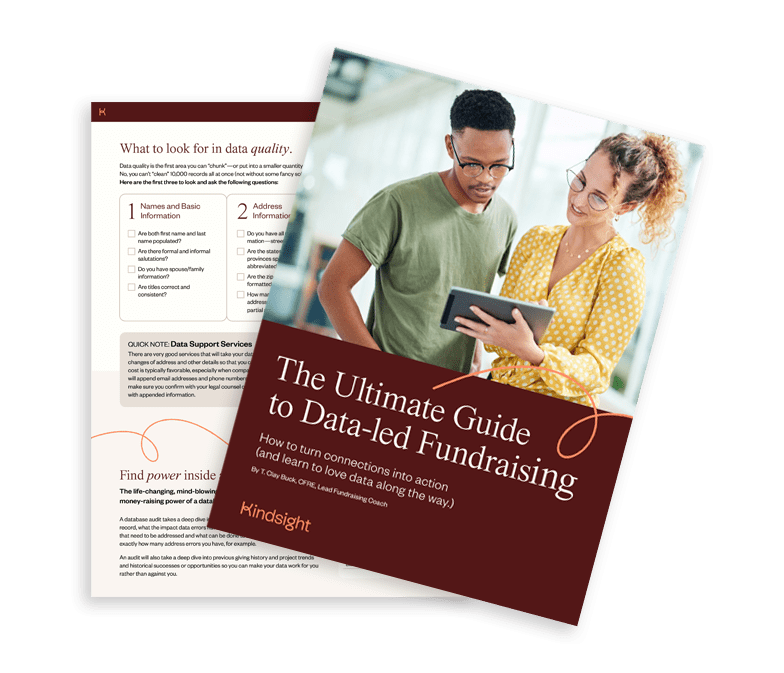
Turn donor data into action.
Learn how to harness donor data to build meaningful connections, personalize outreach, and drive impactful fundraising with our Ultimate Guide to Data-led Fundraising.
The main types of data analytics
The framework behind fundraising analytics isn’t limited to the nonprofit sector. They draw from a universally accepted framework that can be used to support different types of commercial and non-commercial ventures — including yours.
Generally speaking, there are four main types of data analytics you need to be aware of.
1. Descriptive analytics
The foundation for everything that follows, descriptive analytics are designed to answer the question: “What happened?”. By examining historical and current data, you can build an evidence-based picture of past and present fundraising activity — what’s working, where you’ve gained traction, and where there’s room to evolve.
2. Diagnostic analytics
Diagnostic analytics help you uncover the root causes, connections, and trends behind your present situation.
For example, your descriptive analytics might reveal low online donations for a recent digital campaign. When you look at the situation in more detail, your diagnostic analytics might uncover a high bounce rate on your donation page and online donation form — both of which can lead to poor conversion rates.
3. Predictive analytics
As the name suggests, predictive analytics are all about looking forward. The idea is to use the patterns and data they reveal to anticipate donor behavior and forecast future outcomes (such as next year’s income) so that you can plan proactively and raise funds more effectively.
4. Prescriptive analytics
Prescriptive analytics take things further by using your fundraising data and insights to “prescribe” future actions. For example, by determining the most effective messaging for your landing page, the best time to launch future campaigns, fundraising events, or the ideal gift amount for specific groups of donors.
What fundraising metrics should I track?
If you read around the issue of fundraising analytics, you will find list after list of potential fundraising metrics to track. It’s easy to get overwhelmed. Instead, why not try thinking about your metrics in levels?
Start with the top-level (macro) metrics you need to unlock headline descriptive analytics.
For example:
Donation revenue
Your donation revenue is the total amount of money raised over a given period of time, and a clear indicator of overall fundraising performance.
Donor acquisition
Understanding the number of new donors and recurring donors gained every month will help you understand how effectively you’re growing your supporter base.
Donor retention/attrition rates
Tracking the percentage of donors who give again (or don’t) is a vital measure of loyalty, satisfaction, and long-term donor engagement.
Average gift size
The typical donation amount per donor, understanding your average gift size, will help you gauge supporter giving capacity and the effectiveness of different fundraising appeals.
Giving habits
Patterns in how and where donors give — think preferred channels, frequency, or payment methods — can help you understand the giving behaviors of both individual donors and larger groups.
As you start exploring the layers of diagnostic and predictive analytics, you will also need to review micro-level fundraising metrics.
For example:
- Campaign-specific response rates
- Geographic/demographic trends
- Email or social media engagement rates
- Event registrations and event attendance
- Landing page conversion rates
These smaller measures can help you calculate key performance indicators (KPIs) — the strategic metrics that show how effectively your fundraising activities are performing.
Key indicators to track include:
- Lifetime value: This measures the total amount a donor is likely to give over the course of their relationship with your organization. Understanding lifetime value helps you focus on building long-term relationships and retaining supporters, rather than just acquiring new ones.
- The cost of donor acquisition: This tells you how much it costs to bring a new donor on board — including marketing, staff time, and campaign expenses. Comparing acquisition costs with lifetime value helps you determine whether your fundraising efforts are truly sustainable and cost-effective.
- Return on investment: Understanding your ROI helps you compare the amount raised per fundraising activity to the cost of raising it. This helps you identify which campaigns, channels, or strategies deliver the greatest value, so that you can allocate time, energy, and budget accordingly.
What about donor data and donor analytics?
While good fundraising will always deal in data, it’s important to remember that behind every number and statistic is a real person who has made a conscious and purposeful decision to support your cause.
Donor data and donor analytics are designed to help you learn more about these people and what motivates them to give.
A great way to complement your fundraising analytics, you can use donor analytics to boost donor acquisition, improve your donor stewardship, and make sure your supporters receive a gold-star donor journey.
All of this helps improve donor retention rates, build stronger donor relationships, anticipate donor behavior, and increase the overall impact of your fundraising.
How do we collect fundraising analytics?
We live in a world of information. Nowadays, most applications — be it social media, your website, or apps like Eventbrite and MailChimp — offer at least basic analytics. While this is extremely useful, nonprofit organizations often find it difficult to collate and synthesize this information. Especially when you don’t have the right fundraising tools.
That’s where fundraising software like a nonprofit CRM comes in. Imagine it as the hub and your apps are the spokes. Your CRM is a tool to bring all of this information together so that you can analyze and rotate your data, produce custom reports, and start realizing the power that fundraising analytics hold.
But a CRM is not a solution on its own. To really make the most of all it can offer, you need to:
- Establish core KPIs: Don’t try to do everything at once. Define the key metrics that matter most to your organization and make a plan to collect and track the data you need to inform them.
- Set up data collection systems: Ensure all your data sources (including payment systems, your website, and event platforms) feed into your fundraising CRM. Not every solution will meet your needs, so choose wisely.
- Train your team: A CRM is only as good as the information that goes into it. Take time to ensure staff and volunteers know how to use data collection, data entry, and data management systems effectively.
Ready to really dig into data?
Your data deserves strategic management so it can effectively contribute to your fundraising success. Learn how to maximize your data’s potential and make data-inspired decisions.
How can I use my fundraising analytics?
Data is only valuable when you use it. To make sure you make the most of all that your fundraising analytics have to offer, you need a data strategy that will systematize your processes and make it part of your working culture.
You can do this by:
- Adding analytics to standard activity planning: Build data review into your campaign planning, not just evaluation, so insights shape decision-making from the start.
- Transferring historical data: Your fundraising CRM might be new, but your data doesn’t have to be. Work with your CRM provider to clean and transfer historical data across into your new system — you will learn a lot from past trends!
- Integrating analytics across all areas of fundraising: Fundraising analytics aren’t just for individual giving. Apply them to events, trusts, corporate partnerships, and peer-to-peer fundraising to build a complete picture of your performance.
- Creating regular reporting schedules: Establishing consistent reporting cycles, such as quarterly or biannual reviews, will create regular opportunities to review your analytics and refine your fundraising strategies.
- Running special projects for deeper analytics: Consider investing in AI fundraising tools to help your team make the most of predictive and prescriptive analytics, forecast future outcomes, and optimize fundraising strategies.
Constituent lifecycle management using analytics
Constituent lifecycle management is a holistic approach to tracking donor interactions that’s based on fundraising analytics. It adds a fourth dimension that moves beyond traditional metrics like gift frequency and donation amount. To truly anticipate donor behavior, you need to see a donor’s full history, including their specific interests and interactions.
This multidimensional view allows you to send the right message at the right time. You can easily identify which donors to thank for increasing their gift amount (called a lift), which are about to lapse and need a fresh nudge. You will also identify those who have already stopped giving and need a new connection to your mission.
Constituent analytics (a subset of fundraising analytics) organizes data into simple summaries to help nonprofits identify trends and find new supporters. Most organizations have plenty of information but struggle to make sense of it. By identifying “look-alike” prospects who share traits with your best donors, you stop guessing and start reaching out to the people most likely to give. This targeted approach saves your team time and makes every campaign more effective.
A note on data protection
As you collect and analyze fundraising data, it’s vital to protect the privacy of your supporters. Train your team on data collection, data entry, and data management, and be sure to handle personal information in line with current data protection laws and your organization’s privacy policy. Be transparent about your data collection methods, storage, and use — and make sure you have clear consent where required.
Key takeaways
Fundraising analytics aren’t just a nice-to-have. They’re a must-have tool for building smarter, more effective fundraising strategies.
From descriptive and diagnostic analytics to predictive analytics and “prescriptions”, each layer of analysis gives you a clearer picture of your nonprofit’s performance and potential.

Be the first to read our resources.
The world is changing quickly—and our resources help you stay on top of it all. Sign up to get new insights, success stories, and more, sent right to your inbox.
Explore related resources.
-
Understanding donor lifetime value

Post Understanding donor lifetime value
Learn how to calculate donor lifetime value (LTV) and use it to boost retention, guide acquisition, and strengthen your nonprofit's fundraising strategy.
-
How to make your donor funnel work for you

Post How to make your donor funnel work for you
Optimize your donor funnel to boost support, inspire action, and enhance fundraising. Learn strategies to turn prospects into lifelong supporters today!
-
A quick guide to donor segmentation for nonprofits

Post A quick guide to donor segmentation for nonprofits
Donor segmentation allows nonprofits to show the right message to the right people at the right time. Your supporters aren’t...