


Share Article:


Peer to peer fundraising (P2P), or the activation of volunteers to raise funds from their personal networks, is one of the reliable engines for nonprofit donor acquisition and community engagement. In a sector where trust, authenticity, and reach matter more than ever, P2P gives nonprofits a way to mobilize their supporters, expand their visibility, and raise more money—all without dramatically increasing staff workload. For organizations exploring new ways to raise money for charity, P2P stands out as a high-impact method for building community while securing funding.
While every organization’s results vary, it’s widely accepted by nonprofit professionals that P2P consistently outperforms traditional donor acquisition channels in both conversion and reach. For nonprofits looking to diversify revenue, grow their donor pipeline, or simply re-energize their fundraising strategy, these statistics tell a compelling story that every organization should consider as they plan their 2026 fundraising strategy.
Why peer-to-peer fundraising works: The psychology behind the numbers
Peer-to-peer fundraising campaigns work for one simple reason: people give to people. A supporter asking their friends, family, and colleagues to contribute to a cause carries more trust and motivation than even the strongest email campaign.
Peer pressure, a desire to belong, and a personal connection are all important motivators in P2P fundraising. Most fundraisers know that people are more likely to give when asked by a friend rather than an organization and that donors often give bigger amounts when asked by someone they know.
These motivators aren’t just effective in fundraising; they’re also key to inspiring active engagement. In a study of the 2018 midterm elections, Columbia University’s Data Science Institute found: “A text message from a friend increased likelihood to vote by 8.3 percentage points, far exceeding turnout effects from traditional organizing methods.”
Whether you’re raising funds or rallying the community toward a particular goal, peer-to-peer efforts are critical to your success.
Looking for new ways to fundraise?
Keep your cause thriving! Learn these fundraising strategies that keep missions resilient and growing in any financial climate.

Key P2P fundraising statistics
According to annual data compiled by the PeertoPeer Professional Forum, the top 30 P2P fundraising programs collectively increased revenue by 3% in 2024, with 18 out of the top 30 programs reporting an increase in revenue over 2023. These findings documented the third consecutive year of P2P growth since the COVID-19 pandemic.
“Their success came from staying focused on community and relationships while fine-tuning strategies to keep up with shifting donor behaviors,” explained Marcie Maxwell, managing director of the Peer-to-Peer Professional Forum.
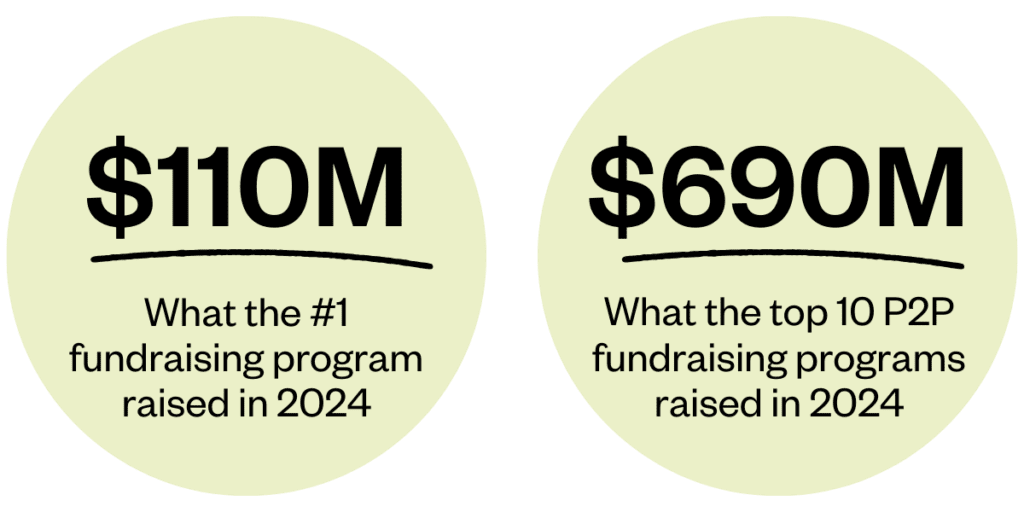
The American Heart Association’s Heart Walk held its place as the #1 P2P fundraising program in the country in 2024, bringing in more than $110,000,000 in 2024. Programs like the Heart Walk consistently raise big dollars through P2P campaigns, with 28 of the top 30 P2P programs of 2024 supporting health-related causes, including both physical and mental health.
Top 10 P2P fundraising programs of 2024 by rank
Combined, the top 10 P2P fundraising programs raised more than $690,000,000 in 2024.
| Rank | Organization | Event | 2024 Gross Fundraising Income |
| 1 | American Heart Association | Heart Walk | $110,000,000 |
| 2 | Alzheimer’s Association | Walk to End Alzheimer’s | $103,003,954 |
| 3 | Pan-Mass Challenge | Pan-Mass Challenge | $87,000,000 |
| 4 | American Heart Association | Kids Heart Challenge | $76,900,000 |
| 5 | The Leukemia & Lymphoma Society | Light the Night | $68,300,000 |
| 6 | American Cancer Society | Relay for Life | $68,300,000 |
| 7 | National Multiple Sclerosis Society | Bike MS | $51,271,019 |
| 8 | American Cancer Society | Making Strides Against Breast Cancer | $47,500,000 |
| 9 | The Leukemia & Lymphoma Society | Student Visionaries of the Year | $44,600,000 |
| 10 | Pelotonia | Pelotonia | $34,567,329 |
Growth over time
The average age of the top 30 P2P programs identified by the Peer-to-Peer Professional Network in 2024 was 28.9 years old. This indicates that the most successful P2P programs take time to become well-established, often running for 25 years or more.
This is not the only indicator of success, however. Of the 30 top programs, two were established in 2014 or later:
- #9: Student Visionaries of the Year, benefitting the Leukemia & Lymphoma Society (2017)
- #15: VeloSano, benefitting the Cleveland Clinic Foundation (2014)
Student Visionaries of the Year is a youth-focused offshoot of the Leukemia & Lymphoma Society’s long-established Visionaries of the Year program (est. 1990). It raised more than $44,000,000 in 2024, an 8.5% increase over 2023, while the original program raised only $33,000,000—a 12.0% drop from 2023.
Founded in 2014, the Cleveland Clinic Foundation’s VeloSano cycling fundraiser is the fastest-growing P2P in the top 30, achieving an astounding 100.9% revenue growth over 2023. While the Peer-to-Peer Professional Network attributes part of the event’s success to new major gifts supporting the program in 2024, its rapid rise to the top 30 shows the power of dedicated community engagement through peer to peer fundraising.
Participation
In 2024, more than 2,500,000 people participated in the top 30 P2P fundraising programs across the nation. Overall, this represented a 3.5% growth in participation.
However, nearly one-third of the top programs saw a decrease in participation last year. These numbers often, but not always, correlated with a decrease in total revenue.
The biggest loss by percentage was the Children’s Miracle Network Dance Marathon, with a 10.2% drop in participation. Comparatively, biggest increase was seen by the Breakthrough T1D Walk, with 20.1% more participants than in 2023. Both organizations saw an increase in revenue, though the increase was less than 1% over the previous year.
How donors learn about causes
In the 2022 Why America Gives report from Classy (now GoFundMe Pro), it was reported that 71% of all donors learn about new causes and giving opportunities through friends and family.
While this position is consistent across all generations, the corresponding data shows some divergence in the trends among younger donors. “Next-Gen Donors” are:
- 4 times more likely to learn about causes from influencers and celebrities outside of their core familial and social circles
- 1.5 times more likely to learn about causes from colleagues at work
- 1.7 times more likely to learn about causes through the media
Importantly, the report indicates younger donors are more likely to get involved. The same report found that younger donors are three times more likely to advocate on behalf of an organization and 2.7 times more likely to activate their networks by hosting a personal fundraising page. They’re also more responsive, with data indicating that next-gen donors are 1.6 times more likely to give after a crisis or news event.
To pinpoint which of these engaged supporters have the highest capacity to lead a campaign, many organizations utilize donor prospect research software to screen their database for individuals with strong philanthropic indicators and influential social networks.
The value and cost of social capital in P2P fundraising
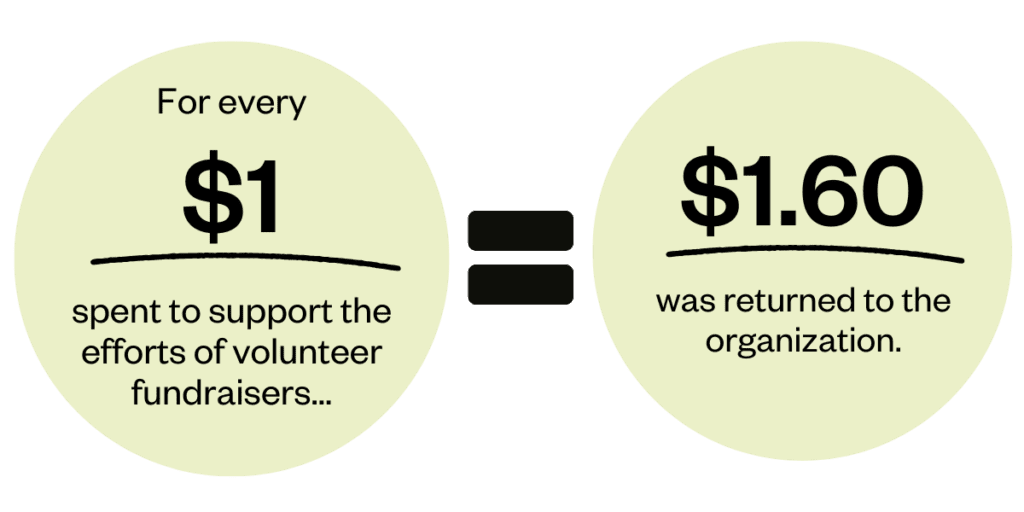
The cornerstone of P2P fundraising is the ability of participants, who are not employees of the organization, to ask their friends, family, colleagues, and acquaintances to support a cause. And it’s effective—a 2017 study found that for every $1 spent to support the efforts of volunteer fundraisers, $1.60 was returned to the organization.
However, the researchers found that social capital has its limits; asking friends and families for donations is perceived to come at a cost, described as “nuisance.”
Many P2P participants are hesitant to utilize their social power, even when they themselves believe in the cause. The authors found that participants were 45% more likely to use social pressure to ask for donations when provided with a gift to offer in exchange. Implementing small incentives like these is just one of many peer-to-peer fundraising tips that can help your supporters feel more confident when reaching out to their networks.
Social pressure is important on the other side of this equation as well. A 2019 report noted that 34% of donors said they were more likely to give if asked in front of other people.
The growth of digital-first P2P fundraising campaigns
In 2022, the Peer-to-Peer Professional Forum released its first Digital-First Peer-to-Peer Fundraising Study, which compiled peer to peer fundraising statistics from digital P2P activities at 44 nonprofit organizations.
The surveyed organizations raised a total of $154.9 million from digital-first P2P fundraising efforts in 2021, an increase of 30% from 2020 ($119.2 million). Comparatively, in-person and hybrid P2P only increased by 3.5% during the same period.
While nearly all of the top P2P fundraising programs in 2024 centered around in-person events such as walks and cycling races, the rapid growth of digital-first fundraising reflects an important trend for nonprofits to consider as they plan their P2P campaign strategy for 2026. If you are looking for inspiration to get started, exploring a variety of peer-to-peer fundraising ideas can help you find a format that resonates with your specific audience.
Additional highlights of the report included:
- Of the 44 organizations included, only 6 (13.6%) reported raising less than $100,000 in revenue from digital-first P2P efforts. 36.3% raised $1,000,000 or more.
- Participation in P2P fundraising efforts increased 132% from 2020 to 2021 while the number of donors to these programs increased by 29%.
While the 2014 Ice Bucket Challenge set the standard for digital-first P2P campaigns with $220 million raised worldwide, the 2022 report noted some notable contenders in 2021:
- $30.9 M for The Ocean Conservancy and The Ocean Clean Up by the “Team Seas” fundraising campaign hosted by YouTube personalities Mr. Beast and Mark Rober.
- $19.5M for The American Cancer Society from activity challenges on Facebook.
- $753,000 for No Kid Hungry as part of the “Stream For No Kid Hungry” event that engaged nearly 400 video gamers to activate from their viewers to give.
- $526,600 for Trans Lifeline through a Twitch fundraiser that led to the creation of the website Peer2Peer.live.
Crowdfunding
Crowdfunding is an increasingly important element of online fundraising, and social media is an important element of its success.
Consider these 2024 statistics compiled by Nonprofit Source:
- 14% of donors worldwide have participated in a peer to peer fundraising campaign by creating a donation page online.
- The nonprofit crowdfunding campaign raises $9,237.55.
- On average, individual fundraisers generate $568 in crowdfunding, with an average donation size of $66.
- Participation in crowdfunding campaigns as a donor or fundraiser is most common with individuals ages 24-35.
- More than half of people who receive an email about a crowdfunding campaign respond by making a donation.
- The likelihood of crowdfunding success increases significantly with every order of magnitude increase in Facebook friends.
While these focus on P2P, you can also view our list of useful fundraising statistics for nonprofits to see how these trends compare to broader giving patterns.
Turning peer to peer fundraising statistics into action
Peer to peer fundraising has been a critical component of nonprofit fundraising for decades, and these statistics indicate that it still holds an important place in every nonprofit’s fundraising strategy for 2026.
The key, as noted by the Peer-to-Peer Professional Forum, is staying connected and agile, centering the community while responding to changes in how they learn about, engage with, and activate their own networks in support of a cause.
By tracking and responding to the trends reflected in peer to peer fundraising statistics, nonprofits can ensure that their P2P fundraising programs stay relevant, active, and an important part of the overall fundraising strategy in 2026.

Be the first to read our resources.
The world is changing quickly—and our resources help you stay on top of it all. Sign up to get new insights, success stories, and more, sent right to your inbox.
Explore related resources.
-
A nonprofit’s guide to peer-to-peer fundraising

Post A nonprofit’s guide to peer-to-peer fundraising
Explore the power of peer-to-peer fundraising and learn strategies to enhance donor engagement and campaign success.
-
Two-thirds of donors were ready to give, but didn’t. Here’s what that means for fundraising.

Post Two-thirds of donors were ready to give, but didn’t. Here’s what that means for fundraising.
Our new survey data reveals 66% of donors wanted to give but stopped due to poor timing. Learn how to fix the "readiness gap."
-
A guide to donation receipts

Post A guide to donation receipts
Learn donation receipt requirements for cash and non-cash gifts, best practices for stewardship, and how to remain IRS-compliant while building donor trust.