

Share Article:


Hoag Hospital Foundation is a nonprofit regional health system serving Orange County, California, and surrounding communities. Founded in 1952, the organization has grown from a single hospital into a broad healthcare network with two acute-care hospitals, 13 health centers, 17 urgent care locations, and a team of more than 1,800 physicians and 10,000 employees working together to advance patient care.
Supporting that mission is the Hoag Hospital Foundation, the organization’s philanthropic arm, which advances world-class healthcare, innovation, and expanded access through donor support. At this scale, fundraising infrastructure serves as a strategic driver- empowering teams to identify opportunities, cultivate meaningful relationships, and connect philanthropy directly to measurable impact. Within this broader advancement strategy, the Foundation’s Grateful Patient Program (GPP) plays a critical role.
The challenge: Streamline a complex, multi-system GPP process
Grateful patient fundraising allows healthcare organizations to connect with patients whose care experiences inspire them to give back. It is foundational to building a sustainable major gift pipeline. However, these programs are operationally demanding, relying heavily on timely patient data, provider participation, accurate record matching, and careful stewardship. When systems are disconnected or workflows are manual, even well-designed programs can lose momentum.
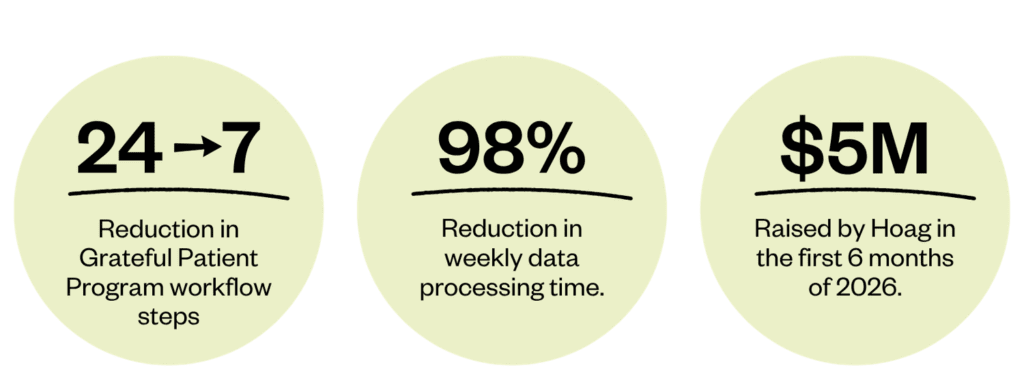
Prior to updating its systems to Ascend, Hoag Hospital Foundation relied on a manual, multi-system Grateful Patient Program workflow. Teams constantly shifted between Power BI, Excel, and Dataloader to manage imports, prospect reviews, and assignments. This disconnected process required approximately 24 manual steps and consumed up to 3 hours per week for data processing alone—and that doesn’t even include the additional effort needed to review prospects, analyze data, and coordinate next actions across teams.
The process exacerbated challenges that are already common in healthcare fundraising environments. Crucial Epic data was available in reporting tools, but did not integrate directly into Ascend. This gap made it difficult to match patient records to existing donors accurately. Contact updates in Epic (their electronic medical record) were not automatically reflected in the CRM, leading to inaccurate and duplicate records, as well as returned mail and bounce-back emails. Instead of focusing on donor strategy and physician collaboration, advancement teams spent their time managing batch processes to keep data aligned.
While Hoag had assigned 1,468 GPP prospects and generated $1.6M in GPP revenue in 2025, they knew they could do more—and that doing more would require a smarter infrastructure to scale their impact and forge truly meaningful connections.
The solution: Layering Kindsight’s GPP module into an already-stabilized CRM
Hoag went live on Ascend in January 2023, establishing its first formal grateful patient program in late 2024 and laying the groundwork for something bigger. In those early days, the workflow was still largely manual, but the right foundation—and a clear vision—were in place. What they needed next was an upgraded, scalable model that could support growth.
To do that, Hoag fundamentally shifted its GPP from a labor-intensive, multi-system process into a data-driven fundraising engine—moving from static, lagging datasets to dynamic, continuously updated patient intelligence. The organization stabilized its CRM on Ascend and layered in Kindsight’s GPP module, shifting prospect discovery from reactive and manual to proactive and system-driven.
The heavy lifting happened between July and November 2025, when Hoag built and completed a series of automations integrating Ascend with its Epic EMR data. Patient data now moves from Epic to Hoag’s data warehouse, is screened with iWave, and is then loaded into Ascend automatically—replacing manual monthly bulk uploads with automated daily data loading. The impact was immediate: staff could prioritize patients as prospects from day one, rather than working from information that was weeks old.
With enhanced security set up within Ascend using new permission sets, field-level security, sharing rules, and custom permissions, all patient data remains HIPAA compliant and available only to staff who need access for necessary business processes as patients move through the pipeline.
A previously manual, multi-system GPP workflow is now executed directly within Salesforce through automated flows and scheduled data jobs that keep patient, physician, visit, and screening data current. Daily automated data loading has replaced the old pattern of manual, monthly bulk uploads, allowing the team to process iWave scores and patient updates continuously instead of in large, delayed batches.
Within Ascend, a streamlined mass action screen flow reduces the number of steps required to update and advance records in the grateful patient pool, so staff can focus on prospect management rather than file prep and imports. Reporting and list-building now happen natively in Salesforce, making it easier to surface and prioritize prospects based on wealth scores, visit activity, and other key attributes. While Epic still feeds data into Hoag’s data warehouse and then into Ascend, the combination of that pipeline with stronger matching and automation has minimized back-and-forth file handling, reduced duplication risk, and increased confidence that teams are working from timely, accurate information.
Beyond prospect identification, it helps surface physician partners: who’s assigned to which development officer, and which patients have been referred to the Foundation by a physician or clinician.
“Instead of navigating multiple systems and spreadsheets, I can now more efficiently manage all operations of the program from within Ascend, from identifying and assigning prospects, tracking physician and development officer partnerships, and reporting on outcomes,” says Rebekah Kurisu, Grateful Patient Program Manager.
The outcome: A highly automated fundraising engine
By building a connected Grateful Patient Program workflow, Hoag transformed a multi-touch workflow into a streamlined, highly automated fundraising solution. Time spent importing patient data has gone from hours a week to minutes, with 95% of the process automated.
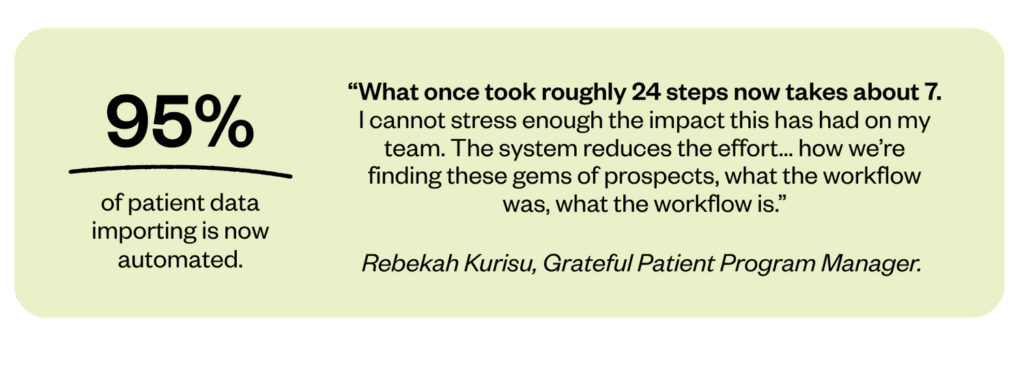
Hoag’s weekly processing time dropped from hours to just 10 to 15 minutes. Batch work that once took about an hour can now be completed in less than five minutes. And because more of the work now happens directly inside Ascend, teams no longer need to jump between systems to identify, assign, and manage GPP prospects. With less effort spent on file preparation and system workarounds, Hoag’s advancement teams can focus more on strategy, qualification, physician alignment, and meaningful donor engagement.
In managing Grateful Patient Programs, complete and accurate patient data is critical, but so is timing. Kindsight research shows that only 25% of donors who experienced a health situation received timely outreach within days or weeks. By moving from monthly bulk uploads to automated daily patient data screening, Hoag can act within that gratitude window, reaching the right people at the right moment rather than weeks too late.
The impact: Increased GPP revenue, pipeline, and more.
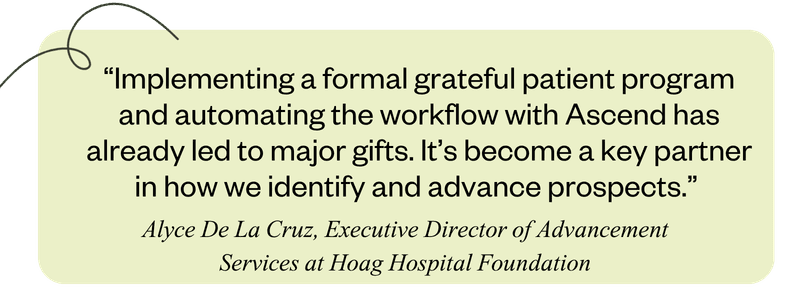
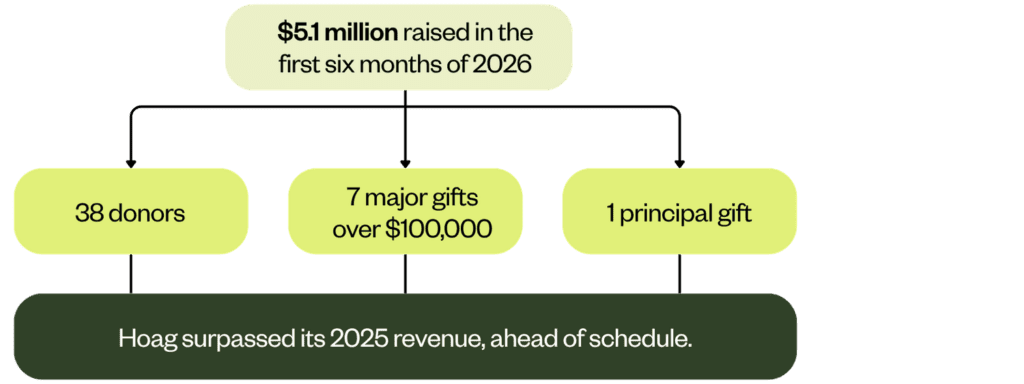
With $5.1 million raised in the first six months of 2026—including 38 donors and 7 major gifts over $100,000, and 1 principal gift—Hoag has surpassed its 2025 revenue, ahead of schedule.
With 12 major gift proposals in the active 2026 pipeline, ranging from $100,000 to $1 million, and 50,000 potential GPP prospects identified, Hoag is creating a scalable foundation for sustained pipeline generation. That momentum was visible early. With the Ascend Grateful Patient module live only for two months, Hoag Hospital Foundation had already locked in a $250,000 gift.
“To start with a $250,000 gift that early is pretty remarkable,” says Charlie Houck.
With stronger infrastructure in place, Hoag can move more quickly from identification to qualification to proposal, while giving teams more confidence in the data behind each decision.
Just as important, Hoag created leverage across Advancement Services, Development, and Gift Services. Teams reclaimed time previously spent on importing files, updating records, and resolving data issues. That time can now be redirected toward higher-value work: identifying the right prospects faster, strengthening physician partnerships, and moving opportunities through the pipeline with more consistency.
When a new donor is identified as a patient, staff can now leverage physician relationships in assigning them to a development officer and better understand where their giving interest may lie. This matching has scaled quickly: within the first six months, over 900 records were created automatically as new prospects, donors, and event attendees were identified as patients.
What’s next for Hoag
Hoag’s journey continues. In early 2026, Hoag went live on Kindsight’s Connect portal, enabling staff to create new giving pages without developer assistance and removing a longstanding bottleneck. Looking ahead, Hoag is planning to launch the authenticated portion of Connect, which will give constituents self-service capabilities for tax receipts and contact information updates—extending efficiency gains beyond the internal team and directly to donors.
Hoag’s experience shows that modernizing healthcare fundraising infrastructure is about far more than efficiency alone. These programs sit at the intersection of healthcare data, relationship management, physician engagement, and philanthropic strategy. They are powerful—but they are also complex. Hoag demonstrates that with the right infrastructure, automation, and commitment in place, that complexity becomes manageable and measurable.
Be the first to read our resources.
The world is changing quickly—and our resources help you stay on top of it all. Sign up to get new insights, success stories, and more, sent right to your inbox.
Explore related resources.
-
Catholic Community Foundation increases giving by 40% using iWave
Case Study Catholic Community Foundation increases giving by 40% using iWave
Catholic Community Foundation, a religious-based nonprofit, seeks awareness and funds to support ministries related to Catholic education, Catholic charities, and...
-
Boise State Athletics delivers record-breaking renewals with Kindsight

Case Study Boise State Athletics delivers record-breaking renewals with Kindsight
Boise State Athletics tapped into the power of Kindsight’s Central Intelligence to reimagine its football season ticket renewal campaign. The...
-
Kettering Health Foundation Increased Grateful Patient Giving 169% with iWave GPP Solution

Case Study Kettering Health Foundation Increased Grateful Patient Giving 169% with iWave GPP Solution
After expanding outreach 139%, Kettering Health Foundation achieved 89% more gifts and 169% more total giving from its End-of-Year Grateful...