


Share Article:


Donation request letters are one of the most classic—and often underrated—tools available to support fundraising for nonprofit organizations. A donation request letter is an important way to connect with current donors and potential donors, communicate the mission, and inspire generosity.
Whether delivered through direct mail, email, or digital platforms, a donation letter should build interest in your work, celebrate accomplishments, highlight ongoing needs, and, most importantly, show supporters how their contributions make a meaningful difference.
In this guide, we’ll explore what donation request letters are, what they should include, and how to use them effectively to support your fundraising goals. You’ll also find best practices, examples, and templates to help you craft compelling nonprofit fundraising letters for your own organization.
What is a donation request letter?
A donation request letter is a written appeal asking for charitable donations, whether financial or in-kind. These letters are a foundational fundraising tool used by organizations to engage supporters and generate donations.
A donation letter helps organizations communicate their mission, share the impact of their work, and invite supporters to participate in a specific fundraising effort. They are commonly used to generate support for an annual giving campaign, fundraising event, capital campaign, program expansion, emergency response effort, and more.
Most of the time, donation request letters follow a standardized format and are sent to a broad donor audience, with only key details personalized. Others are highly customized for individual donors. Generally, the larger the requested gift and the more specific the ask, the more personal and tailored your donation request letter should be.
Types of donation request letters for nonprofits
The tone, level of customization, and content of your letter will likely vary depending on its purpose. Understanding the different types of fundraising appeals can help charitable organizations tailor their messaging to the moment and the audience.
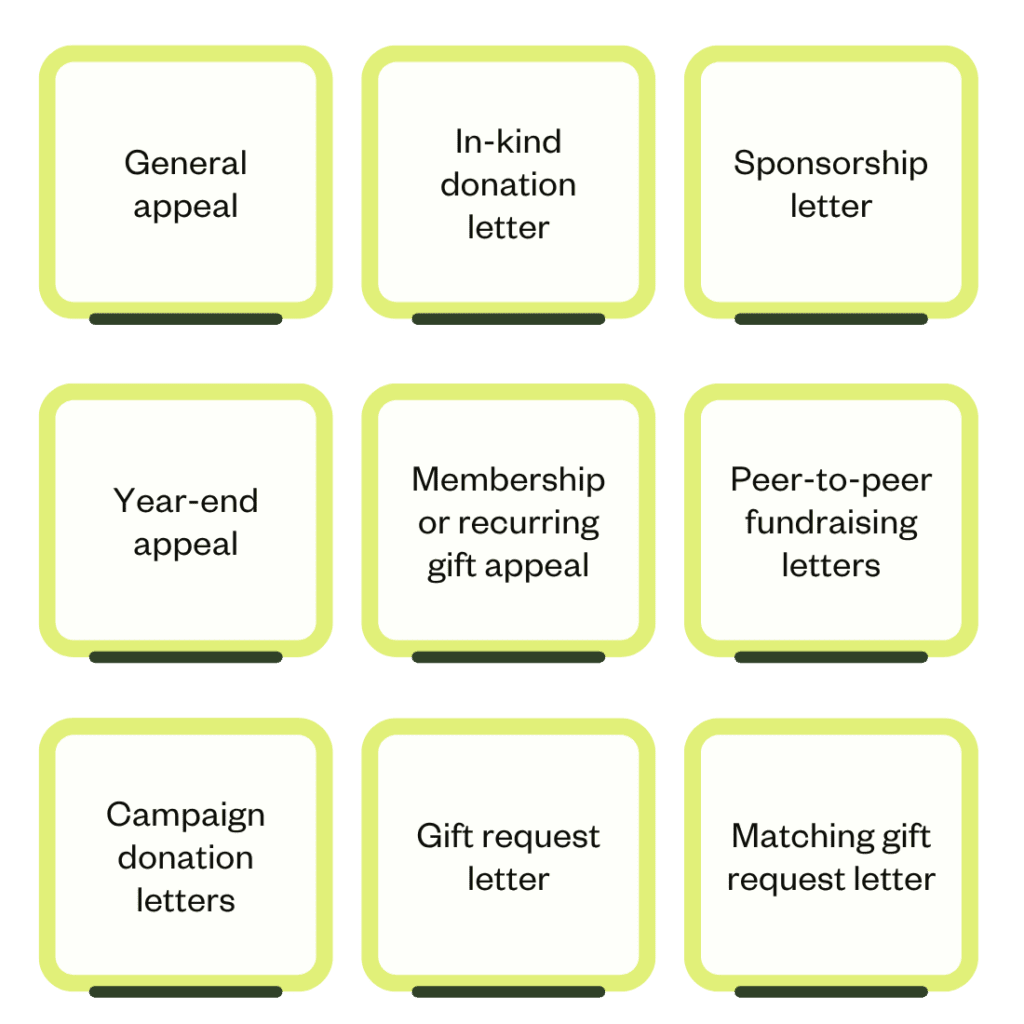
General appeal
A general appeal fundraising letter is typically sent to all donors or prospective donors. It is usually intended to raise money for the annual fund, supporting the organization’s ongoing programs and operations.
In-kind donation letter
These letters request non-monetary donations such as goods, services, or equipment. Organizations may send in-kind donation requests to local businesses or community members who can provide tangible or intangible items needed for programs, an upcoming event, or operations.
Sponsorship letter
Sponsorship letters are often sent to businesses or individuals to secure financial support or in-kind gifts for a specific fundraising event. In return for event materials and services, sponsors may receive benefits such as brand visibility, recognition, or promotional opportunities leading up to the event date. Learning how to write a sponsorship letter can help drive momentum and foundational support for events and other fundraising initiatives.
Year-end appeal
Tax deadlines and the spirit of the holiday season mean that many nonprofits receive up to a third of their annual donations during the last two months of the year. An end-of-year giving letter is a key way to encourage donors to make charitable contributions before December 31.
Year-end Survival Guide
Make the most of the final few weeks of the year, and boost your year-end results!
Membership or recurring gift appeal
These letters encourage supporters to commit to ongoing contributions, such as monthly recurring gift donations or membership-based giving programs. Recurring donors help organizations build predictable revenue and sustain long-term impact.
Peer-to-peer fundraising letters
Peer-to-peer (P2P) appeals may be sent by the organization to recruit fundraisers, or by individual supporters raising money on the nonprofit’s behalf. These letters invite friends, family, and colleagues to contribute to a fundraising campaign connected to a personal milestone, event, or challenge.
Campaign donation letters
A donation request letter for a fundraising campaign focuses on a particular initiative rather than general operations. Examples include capital campaigns, new program launches, or emergency response efforts. These letters should clearly communicate the fundraising goal, timeline, and progress to help create urgency and motivate donors to participate.
Gift request letter
For mid- to top-tier donors with the capacity to give larger gifts, donation request letters should be thoughtfully personalized. These letters connect the donor’s interests to the organization’s needs and outline a specific giving opportunity, which could be a major gift. Because they rely on an existing relationship, a gift request letter is most effective after a major donor has already built a personal connection with the organization.
Matching gift request letter
A matching gift letter encourages donors to check whether their employer offers a charitable matching gift program. If a donor’s company participates, their corporate philanthropy contribution could be doubled or even tripled, significantly increasing the impact of their gift.
How to send a donation request letter
Knowing how a donation request letter will be delivered is key to planning your outreach.
Different channels work best for different audiences and campaigns, so nonprofits often use a mix of methods to reach supporters effectively. While the two most common delivery options are direct mail and email, organizations can also send letters using other creative formats to inspire donors.
Direct mail donation letters
Despite the rise of digital communication, direct mail remains one of the most effective ways to reach supporters. A thoughtfully designed physical letter can capture attention and create a more personal connection with the recipient, which is why many nonprofits continue to rely on direct mail as part of their fundraising strategy.
Direct mail appeals are particularly effective for engaging long-time supporters, reaching older donor audiences, or introducing a new campaign. Because these letters are often sent in large batches, they provide an efficient way to reach many donors at once—but bulk doesn’t have to mean impersonal. Personalizing letters with the recipient’s name and relevant details can help strengthen the connection to your mission.
Email donation letters
Email is one of the fastest and most cost-effective ways to send donation request letters. It also allows organizations to link directly to their website or donation page, making it easy for donors to give with just a few clicks. Because donors often decide whether to open an email based on the subject line alone, a clear and compelling subject line is essential for helping your message reach more supporters.
A donation request email is especially useful for giving days, urgent fundraising needs, and campaign updates that keep donors engaged throughout the year. Modern nonprofit tools—such as a robust CRM and email marketing platform—allow organizations to easily segment donor lists and tailor email messages based on giving history, engagement, or donor capacity.
Many nonprofits combine email with direct mail outreach to reinforce their message and reach donors across multiple channels.
Creative delivery options
While direct mail and email are the most common ways to send donation request letters, they are far from the only options. Many organizations are experimenting with creative approaches that simplify the giving experience while standing out in crowded inboxes and mailboxes.
For example, some nonprofits replace traditional mail packets with postcards that include a QR code linking directly to an online donation page. Others incorporate online donation requests into digital greeting cards or short SMS messages that provide a quick and convenient way for supporters to give.
In an increasingly saturated communication landscape, creative formats and concise messaging can help donation requests stand out, capturing both donors’ attention and generosity.
What to include in a donation request letter
There are several key elements that make donation request letters effective. Each one helps to build the case for your organization—and for your donors to take action.
Your organizational header and contact information: While it may seem obvious, making sure donors know who you are is essential. Including your contact information and using an official header—or even a custom design—adds legitimacy to your donation appeals and gives new donors a place to turn if they have questions. Many organizations also include a tax exemption statement.
A personalized salutation: An effective donation request letter should never begin with “To Whom It May Concern.” Start your letter with a personal greeting that addresses prospective donors by name. If known, use their preferred name and salutation.
A compelling hook or opening: The opening of your letter should immediately establish purpose, build emotional connection, and give the reader a reason to keep reading. If you don’t engage donors in the first few sentences, you risk losing their attention entirely. Powerful openings might include a compelling statistic, a brief story related to your mission, success stories, or a surprising fact about the issue your nonprofit addresses.
Storytelling is one of the most effective ways to capture attention and inspire generosity in nonprofit fundraising letters. Sharing a real story about someone helped by your programs can humanize your work and make your mission feel tangible. This emotional appeal puts a face to your request, and to the impact of donors’ contributions.
Your mission: Your opening should naturally lead into your organization’s mission, briefly explaining what your organization does and why your work matters. Whether you quote your mission statement or summarize it, make sure readers clearly understand who you are and what you do.
The need: You’ve outlined the problem and your mission, but now it’s time to make those ideas concrete. Help the reader understand your organization’s current need. This piece is even more powerful when you can directly translate the need into a number of people served or total impact delivered.
A specific donation ask: The ask is the heart of your message and, unfortunately, where many nonprofit fundraising letters fall apart. Afraid to ask for too much—or too little—from their supporters, some organizations fail to present a compelling request, which is the entire purpose of the letter. Don’t be afraid to suggest a specific amount in your donation letter and tie it to tangible impact, such as $25 for one child’s school supplies. These amounts act as helpful reference points, while allowing donors to ultimately decide how much they want to give.
A clear call to action: Every donation request letter should include a clear call to action that tells donors how to respond to your request. This might include a donation link, a donation card with a pre-addressed return envelope, or instructions for requesting a matching gift from an employer. The easier it is for donors to give, the more likely they are to follow through.
Gratitude: Don’t wait for thank-you letters to show your appreciation; stewardship begins at solicitation. Whether readers are loyal donors or hearing from you for the first time, express genuine appreciation for the community support that makes your mission possible.
Best practices for an effective donation request letter
While every organization’s core messaging will differ, established best practices can help ensure your donation request letters resonate with potential donors and inspire them to give.
Personalize your outreach
Personalization goes beyond inserting a donor’s name into a template. Whenever possible, reference the donor’s past involvement with your organization, such as previous gifts, volunteer work, or events they’ve attended. You could also get your board members involved, adding handwritten notes on the letters to people they know. This personal touch donors that they are known and valued.
Segment your donor lists
Not every donor should receive the same message. Segmenting your donor base on factors such as giving history, engagement level, or interests allows you to tailor your message and donation ask more effectively.
Think about timing
Donation request letters are often most effective when aligned with key moments such as year-end giving, campaign launches, or giving days. For maximum impact, plan your outreach to align with important moments in your fundraising calendar.
Focus on the donor
Strong donation request letters center the donor’s role in creating impact. Rather than focusing only on your organization’s needs, use “you” language to highlight how a donor’s generosity makes your work possible.
Use clear and simple language
Avoid jargon, technical language, or overly complex explanations. A clear, straightforward message helps ensure that readers quickly understand your mission, your need, and how they can help.
Highlight impact
Donors want to know that their contributions matter. Whenever possible, connect donations to tangible outcomes, such as meals provided, scholarships funded, or families served.
Incorporate social proof
Demonstrating that others support your mission can strengthen trust and encourage generosity. This might include mentioning the number of donors who contributed last year, a recent milestone, or a brief testimonial from a supporter.
Consider follow-up outreach
Many successful fundraising campaigns include reminder emails or additional messages for supporters who may have intended to give but have not yet responded.
Follow up with thank-you letters
A donation request letter is only the beginning of the donor relationship. Prompt and thoughtful thank you letters reinforce appreciation, build trust, and encourage future giving. A thank-you letter template is a great way to simplify the acknowledgment process. You can even customize your templates for thank-you letters, creating a standard capital campaign thank-you letter, a general donation thank-you letter, and more.
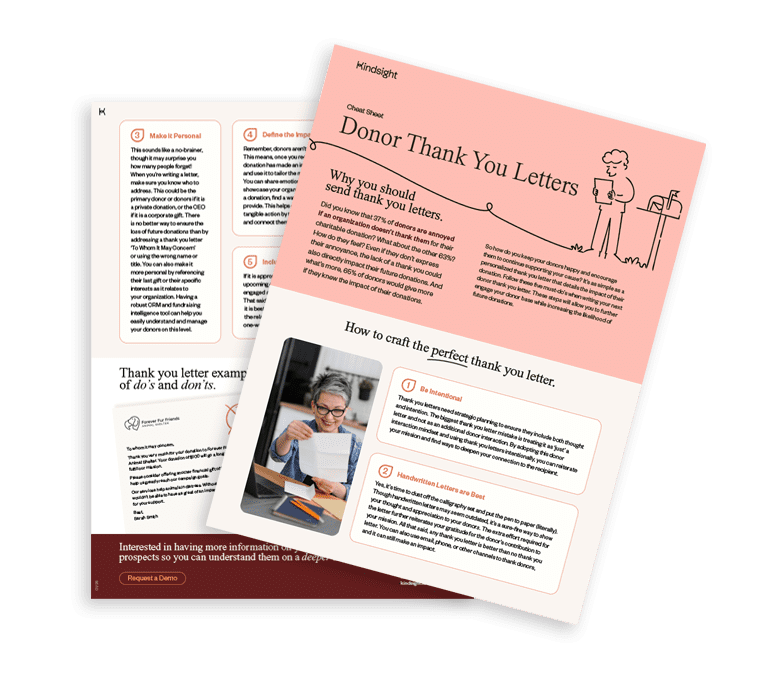
The art of thank-you letters
Learn best practices for expressing gratitude that enhance donor engagement and retention, and inspire future giving.
Fundraising letter templates and samples
Once you understand the elements of an effective donation request letter, it can be helpful to see how those pieces come together in practice. Templates and examples provide a useful framework for building your own appeals.
Donation request letter template
Using a donation request letter template allows nonprofit teams to save time while maintaining consistent messaging across campaigns. Templates provide a starting point that organizations can adapt to different audiences, fundraising goals, and campaigns. They also help to ensure that the letter contains all of the critical elements, such as a compelling opening, a clear explanation of need, a specific donation ask, and a straightforward way for donors to respond.
Basic donation request letter template
Below is a simple donation request letter template, which can be customized for your organization.
Dear [Name],
[Compelling Opening, such as, “Last year, more than [number] people in our community struggled with [issue your nonprofit addresses]. For many, organizations like [Organization Name] are the difference between going without and finding support.”]
At [Organization Name], our mission is to [brief mission statement], working every day to ensure that [describe the change your organization creates].
Right now, we are working to [describe the current need or challenge]. With support from donors like you, we can continue to provide [programs/services or impact] to the people who rely on us.
Your generosity can make a tangible difference. A gift of [$amount] can help [specific impact example—provide meals, fund supplies, support services, etc.].
Would you consider making a gift today to support this work?
You can donate by visiting [donation link] or returning the enclosed donation form.
Thank you for helping make this work possible. Dedicated supporters like you are the reason we can continue serving our community.
Sincerely,
[Name]
[Title]
[Organization Name]
[Organization Contact Information and Tax Exempt Declaration]
Matching Gift Request Letter Template
Dear [Name],
Did you know that your donation to [Organization Name] might be worth twice as much—without costing you anything extra?
Many employers offer matching gift programs, which allow companies to match charitable donations made by their employees. When donors like you submit a matching gift request, your impact can grow even further.
At [Organization Name], we are working to [brief mission statement], helping [community served] through programs like [example program or impact].
If your employer offers a matching gift program, your donation could help us reach even more people who need support.
To check whether your company participates, contact your human resources department or visit [matching gift information link].
Thank you for helping us expand our impact and serve our community.
Sincerely,
[Name]
[Title]
[Organization Name]
[Organization Contact Information and Tax Exempt Declaration]
Donation request letter sample
Reviewing a sample donation request letter can help nonprofit teams understand how successful appeals are structured in practice.
Below is a simplified example. Examples like this illustrate how storytelling and impact-driven messaging create powerful fundraising appeals.
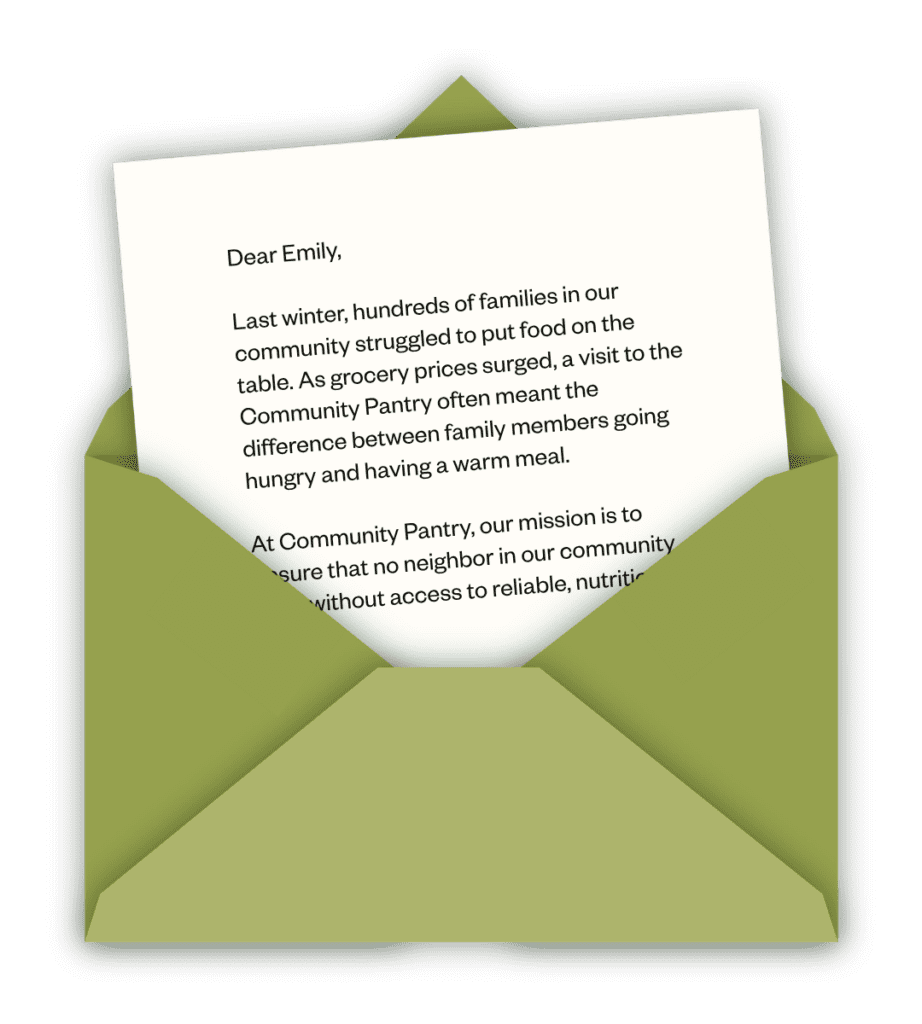
Sample Donation Request Letter
Dear Emily,
Last winter, hundreds of families in our community struggled to put food on the table. As grocery prices surged, a visit to the Community Pantry often meant the difference between family members going hungry and having a warm meal.
At Community Pantry, our mission is to ensure that no neighbor in our community goes without access to reliable, nutritious food. Through our food distribution programs, we work to support families facing difficult financial circumstances.
But the need continues to grow. Over the past year alone, requests for assistance have increased by more than 25 percent.
With the support of donors like you, we can continue expanding our food distribution program and reaching even more families in need. A gift of $50 helps provide groceries for a family of four for an entire week.
Would you consider making a donation today to support this important work?
To make a contribution, you can give online at www.yourlocalcommunitypantry.com/donate or return the enclosed donation form.
Thank you for helping ensure that families in our community have access to the food they need.
With gratitude,
Brock O. Lee
Executive Director
Community Pantry
Using technology for a better donation request letter
Technology plays a critical role in effective donor communication. The way an organization collects, stores, and manages donor data can directly impact the effectiveness of its donation request letters.
A strong nonprofit technology stack—including a fundraising CRM, email marketing platform, and AI tool for nonprofits—helps organizations segment donor lists, personalize outreach, and track engagement over time. These tools allow nonprofits to tailor donation request letters based on donor history, giving patterns, and communication preferences.
Technology also improves the donation experience itself. Integrating donation links, mobile-friendly giving forms, and automated follow-up messages can reduce barriers to giving and make it easier for supporters to respond to fundraising appeals.
By combining thoughtful messaging with the right technology, nonprofit organizations can create effective donation request letters and build stronger relationships with their supporters.
Final thoughts on donation request letters
A compelling donation request letter can strengthen relationships with supporters while helping nonprofit organizations reach their fundraising goals.
Whether delivered through direct mail, email, or digital platforms, well-crafted nonprofit fundraising letters help organizations connect with prospective donors, share meaningful stories, and inspire generosity.
By combining clear messaging, thoughtful storytelling, and strong calls to action, nonprofits can create donation request letters that motivate supporters to give and deepen their connection to the mission.
And when donors are recognized through thoughtful thank-you messages and ongoing stewardship, organizations can build lasting relationships that sustain their work for years to come.

Be the first to read our resources.
The world is changing quickly—and our resources help you stay on top of it all. Sign up to get new insights, success stories, and more, sent right to your inbox.
Explore related resources.
-
Why donation tiers work and how to get them right

Post Why donation tiers work and how to get them right
Discover how to build impactful donation tiers for your nonprofit. Get step-by-step guidance on setting donation levels and proven strategies to engage and inspire your donors.
-
Fundraising statistics every nonprofit should know [2026 Edition]

Post Fundraising statistics every nonprofit should know [2026 Edition]
Nonprofit fundraising statistics reveal key trends in giving. This helps organizations understand donor behavior and optimize their campaigns. Key insights...
-
Leveraging employment metrics to grow matching gifts

Post Leveraging employment metrics to grow matching gifts
Data is king! Learn how educational institutions can use employment data to enhance fundraising outcomes and demonstrate program value to stakeholders.