


Share Article:


The holiday season isn’t just a time to be jolly; it’s also a time for giving. In fact, research shows that 30% of annual giving in the US happens in December. Ten percent of that takes place on the last three days of the year. With so much love, generosity, and kindness in the air, no nonprofit organization can afford to let its year-end campaign fall flat.
In this article, we’re taking a closer look at one of the most pivotal parts of your campaign: the end-of-year giving letter. Read on to find out how this essential fundraising tool works and discover practical tips to write an end-of-year giving letter that taps into the holiday spirit.
What is an end-of-year giving letter?
An end-of-year giving letter is one of the most important pieces of your year-end campaign, and a key feature of the giving season. As the name suggests, it’s designed to land in mid to late December with the aim of inspiring donors to make one final gift before the year wraps up (pun very much intended).
A good year-end appeal letter will do three things:
- Honor and celebrate the generosity and impact of your donors
- Invite them to extend their support in a meaningful way
- Remind them that gifts made before December 31 can be deducted for tax purposes.
But your end-of-year giving letter is about more than just raising money. An important part of the donor journey, it is also a great way to set the stage for future fundraising campaigns — giving existing donors a glimpse of what’s to come and strengthening supporter relationships ready for the year ahead.
Is an end-of-year donation letter the same as an end-of-year appeal?
The short answer is no. The festive season is a busy time for fundraisers, and a successful year-end giving campaign will work across a number of key fundraising moments, including Giving Tuesday, Thanksgiving, Hanukkah, and Christmas. There will be multiple elements to it, one of which is a more traditional end-of-year, direct mail appeal.
It’s important not to confuse this with your giving letter, as they each play very distinct roles:
- An end-of-year, direct mail appeal will have a very clear link to the holidays and often use a festive frame or theme. The appeal will launch earlier in the giving season, focus on an emotional story, and include multiple touchpoints over several weeks (think door drops, emails, social media, and your website). The goal is to engage donors during the holiday season and encourage giving throughout November and December.
- An end-of-year giving letter, on the other hand, is more specifically focused on the December 31 deadline. It’s shorter and doesn’t rely as heavily on seasonal imagery or extended storytelling. Think of your direct mail appeal as the warm-up. Your end-of-year donation letter is the closing act — the final reminder that inspires action.
Feeling overwhelmed by the demands of your year-end campaign?
Don’t panic. Our Year-end Giving Survival Guide will help you through.

How to get started with your end-of-year giving letter
As with any donation request letter, the key to writing a successful end-of-year piece is personalization. It might only be one tool, but by the time you’re ready to send it out, you will likely have several different versions — in fact, you should.
Every donor deserves to be recognized in a way that reflects their relationship with your nonprofit organization. Major donors in particular often require highly personalized — even individualized — letters that will speak directly to their role and impact.
Don’t stop there.
When you’re planning your end-of-year donation letter, it’s important to break your donor pool down into groups and create tailored content that works for each (think giving level, frequency, campaign links, or preferred channel). The aim is to create a flexible framework with a solid core surrounded by editable sections that enable you to connect with every supporter.
It might sound daunting, but with the right technology in place, it’s entirely manageable. A good fundraising CRM can help you organize and analyze donor profiles, as well as build smart segments. AI tools for nonprofits can assist with drafting and refining copy that’s tailored to each audience.
Must-have elements of an effective end-of-year donation letter
We’ve explored what your year-end giving letter is and what it should achieve. Now let’s look at how to write it.
The list below shows the key elements every end-of-year giving letter should include:
A personal salutation
The first and best way to make your year-end giving letter feel personal is to address your donor directly. Avoid blanket greetings like “Dear friend” wherever possible. If you know their name or preferred salutation, use it. Remember: you’re writing to a person, not an ATM.
A great first paragraph
When you’re writing a fundraising letter or any direct mail appeal, you only have a few seconds to grab someone’s attention. So make that first paragraph count. Start with a short, sharp sentence (a hook) to draw people in. Don’t be afraid to get creative and address the reader directly, with a statement or point they can connect to.
A recognition marker
If you can, try to build a recognition marker into your first paragraph by acknowledging your donor and thanking them for their past support. The more specific you can be, the better. Referencing their last donation, giving total, or a recent event they attended will help make your year-end appeal letter feel less mass-produced and more authentic.
Reflection and impact
Donors don’t give “just because”. They give because they want to help advance your institution or nonprofit’s mission. Keep this in mind when developing your draft. Take time to reflect on the year’s achievements and make sure the impact of their support is clear to see. This will help build trust and lay the foundations for your call to action.
A human story
Storytelling is one of the most powerful tools in fundraising. Where data can be alienating, stories turn abstract numbers into impact that donors can feel. Don’t sign off your end-of-year appeal letter without including a short quote, testimonial, or story. It doesn’t have to be as detailed as a full direct mail appeal — but it should be enough to capture someone’s heart.
Time-sensitive framing
Every fundraising campaign needs a sense of urgency, and the great thing about an end-of-year donation letter is that you’ve got one baked in. Be sure to highlight the upcoming deadline and emphasize the dual benefit of giving now: helping your nonprofit achieve its mission, while also allowing individuals to receive a tax deduction.
Clear need and a call to action
Your end-of-year appeal letter should also highlight the ongoing need for your work, and include a clear call to action. Try and avoid being “specifically vague” and asking for a general donation. If you can, your prompt should include a specific gift size and give clear examples of what their year-end gift can help achieve.
This move won’t just help raise money now — it will also sow the seeds for future fundraising campaigns.
A heartfelt sign-off
Always close your year-end giving letter warmly, and with sincerity and gratitude. A simple, authentic expression of thanks will leave donors with a positive final impression that makes them feel recognized and valued as part of your organization.
Final postscript
It might feel like an afterthought, but research shows the postscript is one of the most read parts of any fundraising letter. Use it to add a final, conversational reminder and call to action — reinforcing the urgency of the December 31 deadline.
Top tips to make sure your end-of-year donation letter goes the distance
With so many nonprofit organizations vying for funds, your prospective donors will likely receive more than one request for year-end support. To make sure your letter and ask stand out, we’ve put together some top tips to elevate your content.
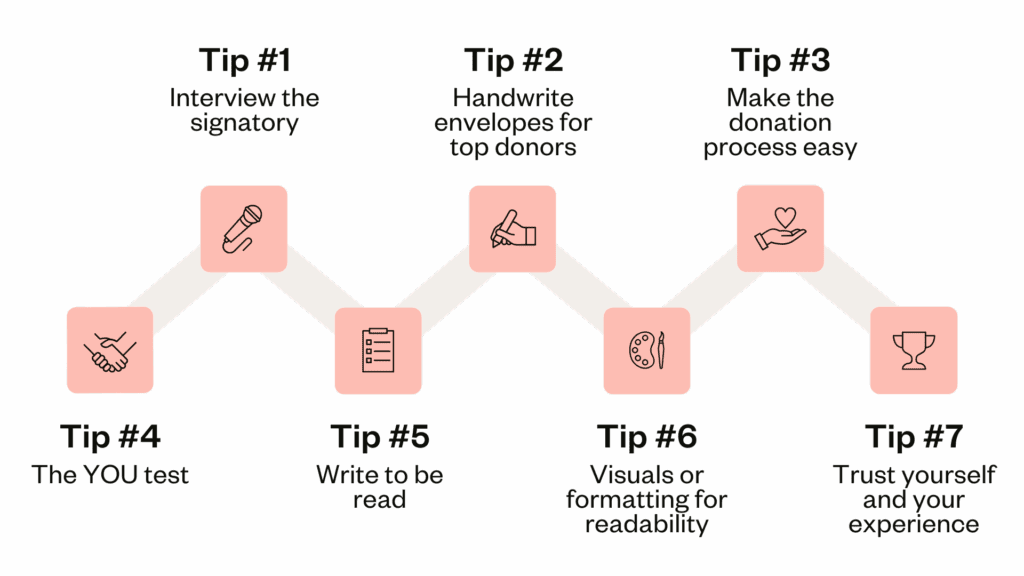
Tip #1: Interview the signatory
Your letter may be drafted by an in-house fundraiser or staff member, but it’s often signed by your CEO or a board member. Put in some time to speak with them directly, ask questions about the year, and capture their reflections. Use key phrases and expressions in your letter (even if it means breaking a few grammar rules) as this will give your letter a more personal, human feel.
Tip #2: Handwrite envelopes for top donors
We all know that hand-written signatures in blue ink help add a valid, personal touch. So why not take this one step further? For your most high-end supporters, set aside time to handwrite the envelopes. Even if you only do this for 20 people, the effort shows genuine care and will make your end-of-year giving letter stand out immediately.
Tip #3: Make the donation process easy
A year-end appeal letter doesn’t just ask for money, it makes giving effortless. Alongside a clear call to action, be sure to include a return slip for card and check payments, and don’t forget to add a link to your donation page or online donation form. That way you can capture generosity in the moment and remove any friction from the giving process.
Tip #4: The YOU test
A lot of nonprofit organizations fall into the trap of talking about themselves. But fundraising appeals work best when the donor feels seen. After you’ve drafted your letter, run a search for “we” versus “you”. If “we” crops up too many times, switch the focus and reframe your key messages to make sure you’re highlighting the donors’ role instead.
For example, instead of writing: “This year, we reached 100,000 people with life-saving care,” try, “Your support has helped deliver life-saving care to 100,000 people”. It’s a small change, but an important one that will help make sure your donors feel part of the story.
Tip #5: Write to be read
When you write about your programs every day, it’s easy to slip into jargon, veer into long sentences, or make assumptions about people’s experiences and knowledge. Before you finalize your draft end-of-year letter, take a step back — ask someone outside your department to read it, and make sure they understand it.
Tip #6: Visuals or formatting for readability
An end-of-year giving letter might not be as jazzy as a full direct mail appeal, but that doesn’t mean you can let your presentation standards drop. A good piece of writing is like a good meal: if it looks good, people will want to read it. So keep your layout clean, simple, and easy to scan. Add a photo or two, a pull-quote, or impact statement that will bring your work — and the donor’s role in it — to life.
Tip #7: Trust yourself and your experience
It’s important to remember that all of the above are guidelines, not rules. The most important thing about your end-of-year giving letter is that it comes from the heart, and speaks to the needs and motivations of your donors. You know them, and you know from past fundraising appeals what works and what doesn’t. Use these insights to craft a letter that captures people’s hearts and minds.
Fitting your end-of-year giving letter within your wider fundraising strategy
To be successful, your end-of-year giving letter should be an integral part of your broader end-of-year strategy. Make sure you start planning early. Map out your strategic arc (being sure to include key dates like Giving Tuesday) and plan your communications so that your year-end letter lands as part of a sequence.
While your letter serves a distinct purpose, it should still echo broader campaign visuals, branding, and key messages. It should also be supported by multiple channels, including digital reminders and countdowns, particularly in the final few days of the month. When different communication channels amplify each other, your end-of-year letter becomes a show-stopping finale that turns awareness into action.
Need a little inspiration? Check out our year-end giving campaign ideas blog.
And finally: make a plan for January
Congratulations! You’ve made it through the holiday season. But that doesn’t mean work on your end-of-year giving letter comes to an end. Take time in January to recognize and thank your donors for their support. It’s also important to review letter response rates against your fundraising goals and key performance indicators.
Get together with your team to compile a list of lessons learned while the activity and impact are still fresh in your mind. Be sure to carry them forward so that you can build an even stronger case for the year ahead.
End-of-year giving letter template
<First and last name>
<Street address>
<City>
<State>
<ZIP code>
December 12, 2025
Dear Nick, (always address the person directly)
- Draw people in with a catchy first sentence and hook
“It’s not often I’m lost for words, but today might be one of those times.”

- Add a recognition marker
Take care to recognise the donor personally and thank them for their donation. If you can, reference their last donation or giving amount.
- Reflect on your impact (remember to make it about the donor and the impact THEY helped to achieve)
Share some headline achievements for the year. Don’t go into too much detail — keep the tone light and breezy.
- Add depth with a story or quote
Use storytelling techniques to reinforce the impact of the work their support helped achieve.

- Use time-sensitive framing
Remember you’re on a deadline. Be sure to reinforce this throughout your letter.
- Include a clear need and call to action (if you can, tell them specifically what their donation will help to achieve)
Talk about your future plans, and add a clear ask.
- Sign-off
Keep it warm, personal and sincere (A handwritten signature in blue ink has a ring of authenticity to it.)
“With thanks once again, and wishing you all the best for the year ahead.”

- P.S. Don’t forget your postscript
Use it to add a final, conversational reminder and call to action — reinforcing the urgency of the December 31 deadline.

Be the first to read our resources.
The world is changing quickly—and our resources help you stay on top of it all. Sign up to get new insights, success stories, and more, sent right to your inbox.
Explore related resources.
-
15 Year-End Giving Campaign Ideas

Post 15 Year-End Giving Campaign Ideas
Turn year-end generosity into action with 15 giving campaign ideas. From countdowns to matching gifts, these strategies will help your nonprofit make a lasting impact.
-
Unrestricted grants for nonprofits: How they work, where to find them, and how to apply

Post Unrestricted grants for nonprofits: How they work, where to find them, and how to apply
Secure flexible funding with unrestricted grants for nonprofits. Learn how they work, where to find opportunities, and how to apply successfully.
-
How to use nonprofit data visualization to tell your story

Post How to use nonprofit data visualization to tell your story
Learn best practices in nonprofit data visualization to transform complex data into an engaging, accessible story that rallies donor support.