


Share Article:


Imagine knowing that for every three people you successfully engage, there are six more standing right outside your door, wallet in hand, waiting to be invited in—but they never hear the knock.
This isn’t a hypothetical scenario. It is the current reality for fundraising organizations.
For years, we’ve operated under the assumption that the biggest barrier to fundraising is donor willingness. We worry about donor fatigue. We worry about economic uncertainty. We worry that people just don’t care enough. But the data tells a different, more optimistic story.
This month, Kindsight asked 512 qualified donors across the United States about donor engagement, their willingness to give, and the importance of timing. From occasional givers to frequent philanthropists, these respondents provided a clear window into how donors perceive—and react to—fundraising outreach today.
Here’s what they said.
The readiness gap: What donors told us
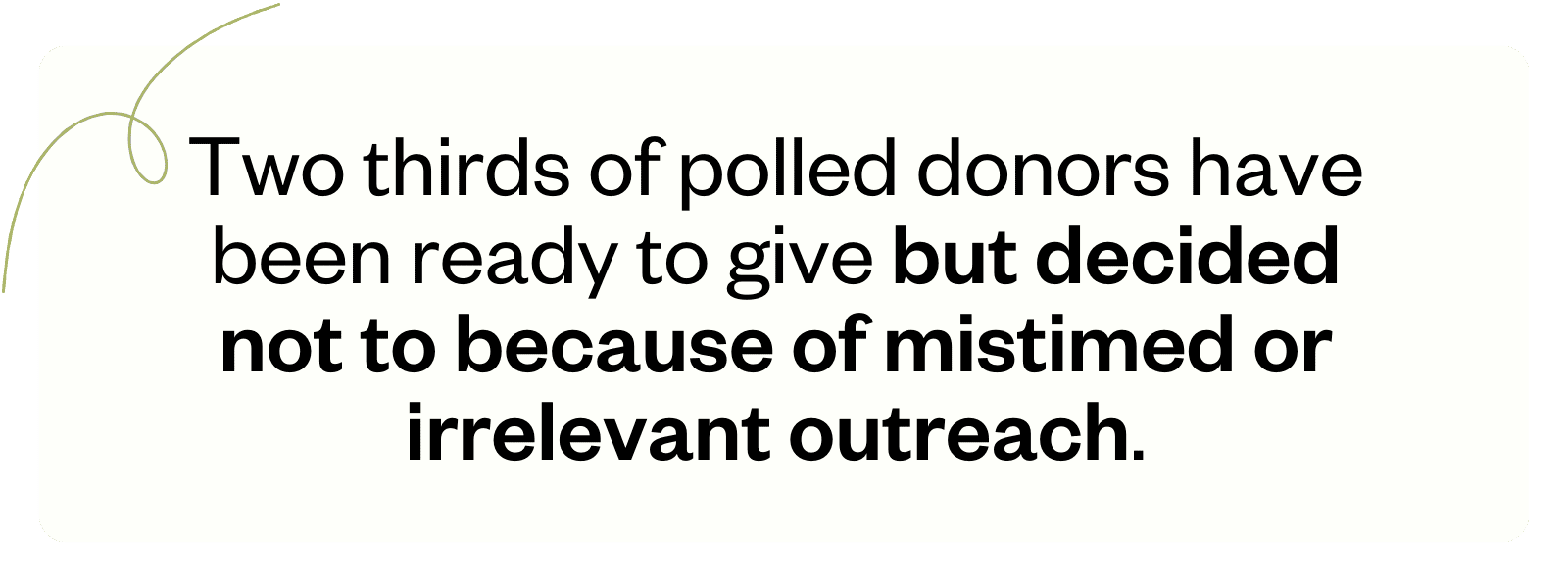
The headline finding of this research might transform fundraising outreach as we know it: 66% of active donors say they have been ready to give to a cause but chose not to because the outreach was mistimed, irrelevant, or disconnected from their moment of intent.
In other words, two-thirds of donors have experienced a “readiness gap.” They had the capacity and the inclination to support a cause, but something about the interaction stopped them cold.

When we asked these donors why they didn’t complete their gift despite being ready, their answers pointed directly to a breakdown in communication and trust.
- 37% weren’t sure where their money would go. Transparency remains the bedrock of trust. When a donor is ready to act but can’t see the path from their dollar to impact, they hesitate.
- 16% found the request generic or impersonal. In an era of hyper-personalization, a “Dear Friend” letter sent to a long-time supporter signals a lack of care.
- 15% felt the timing was wrong. The request arrived too early, too late, or felt completely disconnected from what was happening in their lives.
- 14% felt overwhelmed by too many requests. Volume is not a substitute for precision.
The impact of these missed moments isn’t temporary. When asked if these experiences made them less likely to donate in the future, the average response score was 55 out of 100. This suggests that missing the moment doesn’t just cost you a single gift—it causes moderate, cumulative damage to the long-term donor relationship.
This data reveals that our current “spray and pray” tactics could actually be working against us. By prioritizing volume over relevance, we aren’t just missing gifts; we are training our most valuable supporters to tune us out.
The revenue opportunity hiding in plain sight
It is easy to look at missed opportunities and feel discouraged. However, the flip side of this data is incredibly encouraging. If we can close the readiness gap, the potential for increased revenue is substantial.
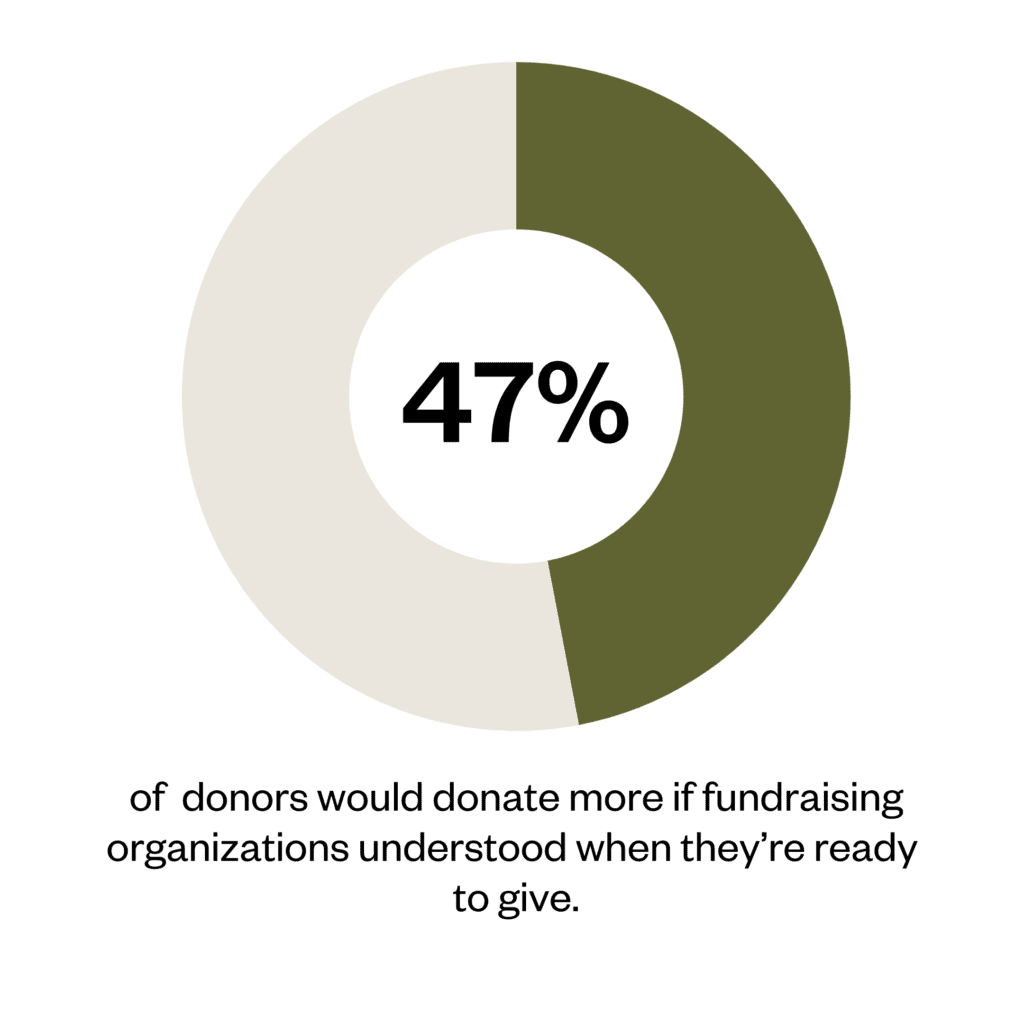
We asked donors: “Would you donate more if organizations understood when you’re ready?”
Nearly half—47%—said yes. Let that sink in. Nearly half of your donor file is telling you that they have more to give, and the key to unlocking that capacity is simply understanding their timeline.
Crucially, this isn’t about shifting money from one charity to another. This is about incremental giving. Among those who said they would give more:
- 58% would give “modestly more.”
- 39% would give “moderately more.”
- 3% would give “substantially more.”
This shatters the myth of the “tapped out” donor. Your supporters are not ATMs with a fixed withdrawal limit; they are partners who want to invest when the time is right. When you align your ask with their life events and readiness signals, you aren’t pestering them—you are facilitating their desire to do good.
How donors actually experience fundraising outreach
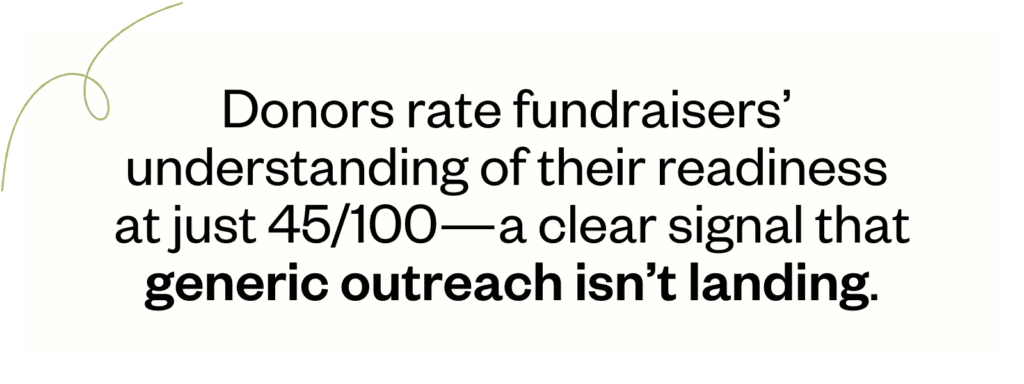
We’re uncovering a stark difference between how fundraising organizations think they are communicating and how donors perceive it. We asked respondents to rate how well charitable organizations understand when they are ready to give. The average score? 45 out of 100.
In other words, donors perceive our timing as below average. They feel like we are guessing—and often guessing wrong. This perception gap is fueled by outreach that feels robotic rather than relational.
When we analyzed open-ended responses about how fundraising organizations could improve, three themes were consistent and loud:
- Transparency is non-negotiable. Donors want to know the “how” and “why” of their gift. As one respondent put it, “Share real stories that show the difference being made, be open about how funds are used.”
- Authenticity beats formality. Donors are craving genuine connection. They want to hear from humans, not institutions. One donor advised, “Be less formal and much more natural with how they approach communications.”
- Respect their history. Nothing kills readiness faster than asking a loyal donor for a first-time gift amount or ignoring their past support. “Remember how much and when the person has donated,” one respondent urged.
The frustration is palpable. Donors want to be seen as individuals with unique lives, not just rows in a database segment. So many fundraising organizations have incredible impact stories to tell. But when outreach ignores donor context—blasting them during tax season or asking for another gift days after a donation—it makes them feel like the organization cares more about its own goals than the donor’s experience.
The healthcare signal
Nowhere is the importance of timing more critical—or more frequently missed—than in healthcare philanthropy. Our study found that healthcare organizations are the most supported cause, with 49% of respondents directing their giving to this sector. This makes sense; health is personal, emotional, and urgent.
However, despite healthcare giving being tied directly to specific life events (a diagnosis, a recovery, a grateful patient experience), the outreach is profoundly out of sync.
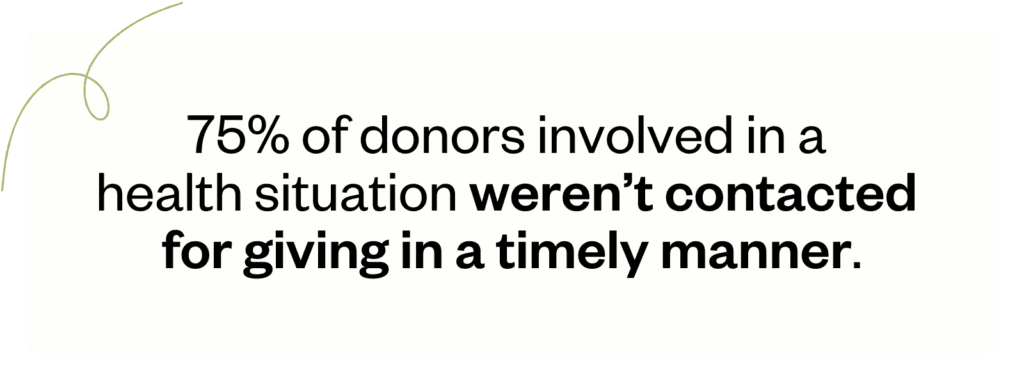
Among donors who experienced a health situation involving themselves or a loved one:
- 28% were never contacted by the healthcare organization
- 25% don’t recall being contacted
- 22% were contacted after a month or more
- 17% were contacted within weeks
- 8% were contacted within days
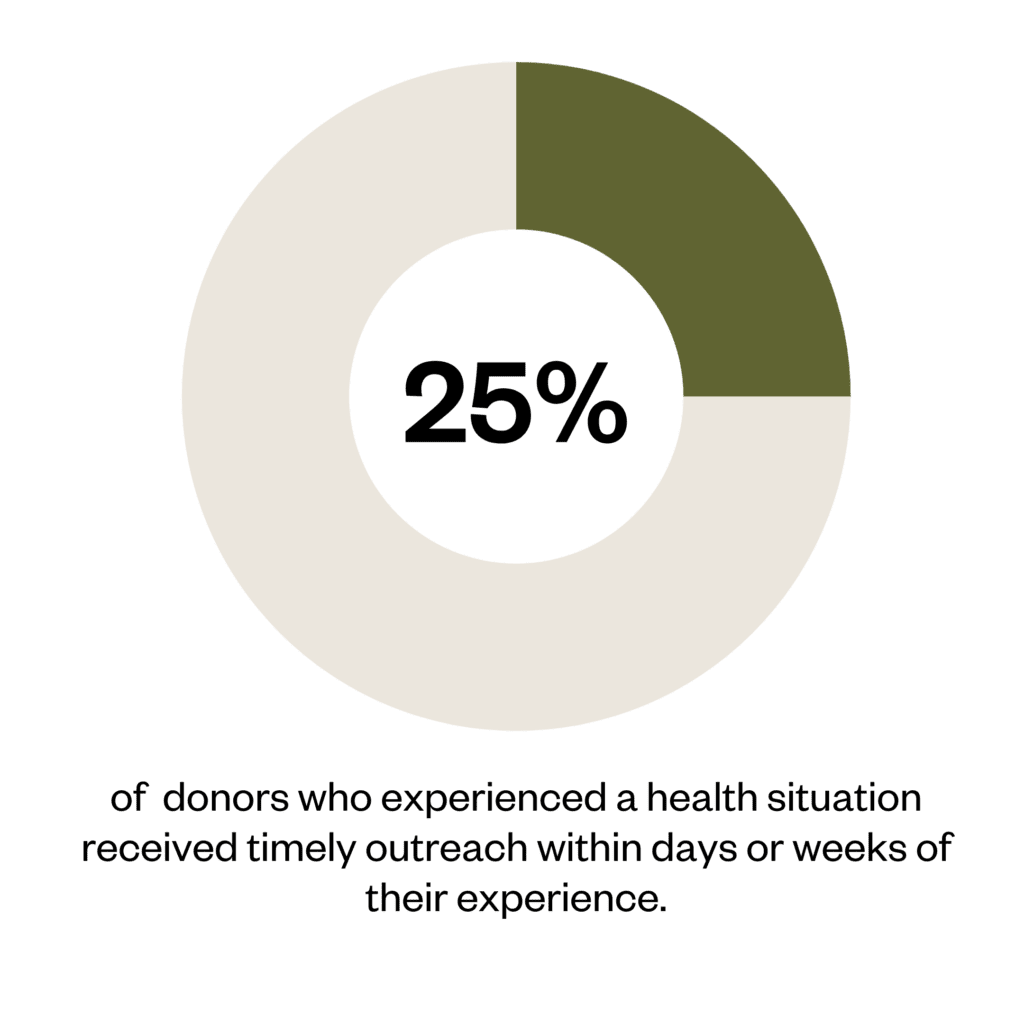
You read that right: only 25% received timely outreach within days or weeks of their experience.
This is a massive missed opportunity for grateful patient programs. When a patient or family member has a positive outcome, the gratitude is often immediate. But that feeling has a half-life. If you wait months to reach out—or never reach out at all—that emotional momentum fades.
Healthcare donors are telling us that they want to express gratitude, but the systems aren’t in place to receive it. By tightening the loop between care and connection, healthcare foundations can honor the patient’s journey while securing vital support.
What this means for fundraisers: Practical takeaways
The data is clear: the old playbook of “more volume, more frequency” is broken. To capture the 66% of donors who are ready but waiting, we need to shift our strategy from volume to precision.
Here are three actionable steps you can take today to close the readiness gap:
1. Prioritize timing over frequency
We can worry less about how often we email and start worrying about when. The “right time” isn’t just “End of Year.” It’s when a donor has had a meaningful interaction with you, when they’ve hit a milestone, or when they are showing digital signals of interest. Use your data to identify these triggers. A single, well-timed personal note is worth more than ten generic blasts.
2. Radical transparency is your best hook
Since 37% of ready donors walked away because they didn’t know where the money would go, make impact the centerpiece of every ask. Don’t just ask for $50; tell them exactly what that $50 achieves. Specificity builds trust, and trust converts readiness into action.
3. Personalization must go beyond the name tag
“Dear [First Name]” is no longer enough. True personalization means acknowledging the relationship. If they gave last month, start your next email by saying, “Thank you for your gift in January.” If they are a long-time volunteer, mention that service. Show them that you know who they are. The data shows that acknowledging past support is a top driver of donation decisions.
A (brief) Kindsight perspective
At Kindsight, we conducted this research because we believe the future of fundraising isn’t about shouting louder; it’s about listening better. We built our platform to solve exactly this problem—to help organizations move beyond static lists and understand the dynamic signals that indicate when a donor is ready to engage. You can learn more here.
Final thoughts
This gap between donor readiness and organizational action represents a significant loss—but more importantly, a massive opportunity. By understanding the “when” and “why” behind these missed connections, fundraisers can unlock a new level of support that has been hiding in plain sight.
The generosity is out there. The donors are ready. It’s time we met them in the moment.

Be the first to read our resources.
The world is changing quickly—and our resources help you stay on top of it all. Sign up to get new insights, success stories, and more, sent right to your inbox.
Explore related resources.
-
How to create an effective nonprofit social media strategy

Post How to create an effective nonprofit social media strategy
Learn the 8 steps to a better nonprofit social media strategy. Reach more donors, recruit volunteers, and grow your community in 2026.
-
How to plan a fundraising gala

Post How to plan a fundraising gala
Learn about different gala types, budgeting, tips for success, and 8 steps to boost donor engagement and revenue.
-
Client Innovator Spotlight: Sok Tng, Pomona College

Post Client Innovator Spotlight: Sok Tng, Pomona College
For Sok Tng, prospect research is both a discipline and a craft—one rooted in precision, curiosity, and a commitment to...