


Share Article:


Short-term fundraising goals are important, but focusing only on the short term without considering your long-term success can stop your organization’s mission from reaching its full potential. When you start focusing on the bigger picture with a nonprofit sustainability plan, you’ll also discover benefits like a happier, less-stressed team, enduring donor relationships, and a more financially resilient organization.
This guide shares exactly what nonprofit financial sustainability looks like, why it’s so important, and 6 simple steps to more sustainable fundraising.
What is nonprofit financial sustainability?
Nonprofit financial sustainability is the process of ensuring your nonprofit is financially viable for the long term. It means you have reliable income streams to keep operations afloat, instead of relying on short-term financial pushes. It’s a way to mitigate financial risks and a vehicle for strategic growth.
Financially stable nonprofit organizations tend to share these key indicators:
- Stronger major donor relationships
- Diverse funding sources
- Clear understanding of overheads
- Mission and community alignment
- Regular, transparent financial reporting and oversight
- 6-12 months of reserve funds set aside
Nonprofit sustainability: A WISE approach to fundraising
While financial stability is an essential, solid foundation, financial stewardship is just one aspect of nonprofit sustainability. It’s also about creating a more holistic approach to your fundraising campaigns that takes your team’s capacity and wider nonprofit goals into account.
It can help to think of nonprofit sustainability as a WISE approach to fundraising:
- You’re considering the success of the Whole fundraising ecosystem, including staff members, donors, and other community members.
- Your fundraising strategies are Iterative, meaning you plan for the long-term, but you evolve and adapt your strategies based on what you learn along the way.
- Your fundraising strategies focus on building long-term value over quick wins—one of the strongest indicators of nonprofit Sustainability.
- You track nonprofit KPIs and base your approach on real Evidence and data, but you use this data to guide you, rather than fully determine your decision-making.
Learn more about how to move beyond short-term thinking in your nonprofit fundraising.
Why you need a nonprofit sustainability plan
From taking the pressure off your team to improving donor relationships, the benefits of a nonprofit sustainability plan are far-reaching:

- Prevents staff burnout: Sustainability isn’t just about getting your nonprofit’s finances in order—it’s also about cultivating a culture of support, and giving your team time to pause and strategize, so they don’t feel rushed to meet the next goal.
- Provides a cushion in times of uncertainty: Cuts to government funding in 2025 left many nonprofit organizations scrambling to find other funding opportunities. A nonprofit sustainability plan acts as a safety net when grants fall through, government priorities shift, or the economic climate causes donations to drop.
- Gives you time to build donor relationships: Building long-term relationships with major donors takes time, especially if you’re looking to secure major gifts. A nonprofit sustainability plan takes this into account instead of focusing solely on short-term gains.
- Takes pressure off your donors: Too many end-of-year pushes or urgent fundraising appeals can lead to donor fatigue. A sustainability plan means you’ll be able to focus on smaller, more achievable goals and put less pressure on your supporters.
- Supports nonprofit growth: When you can anticipate your revenue year to year, it’s much easier to build your annual budget, launch new programs, and ensure nonprofit scalability for your organization.
Build a nonprofit that can weather any storm
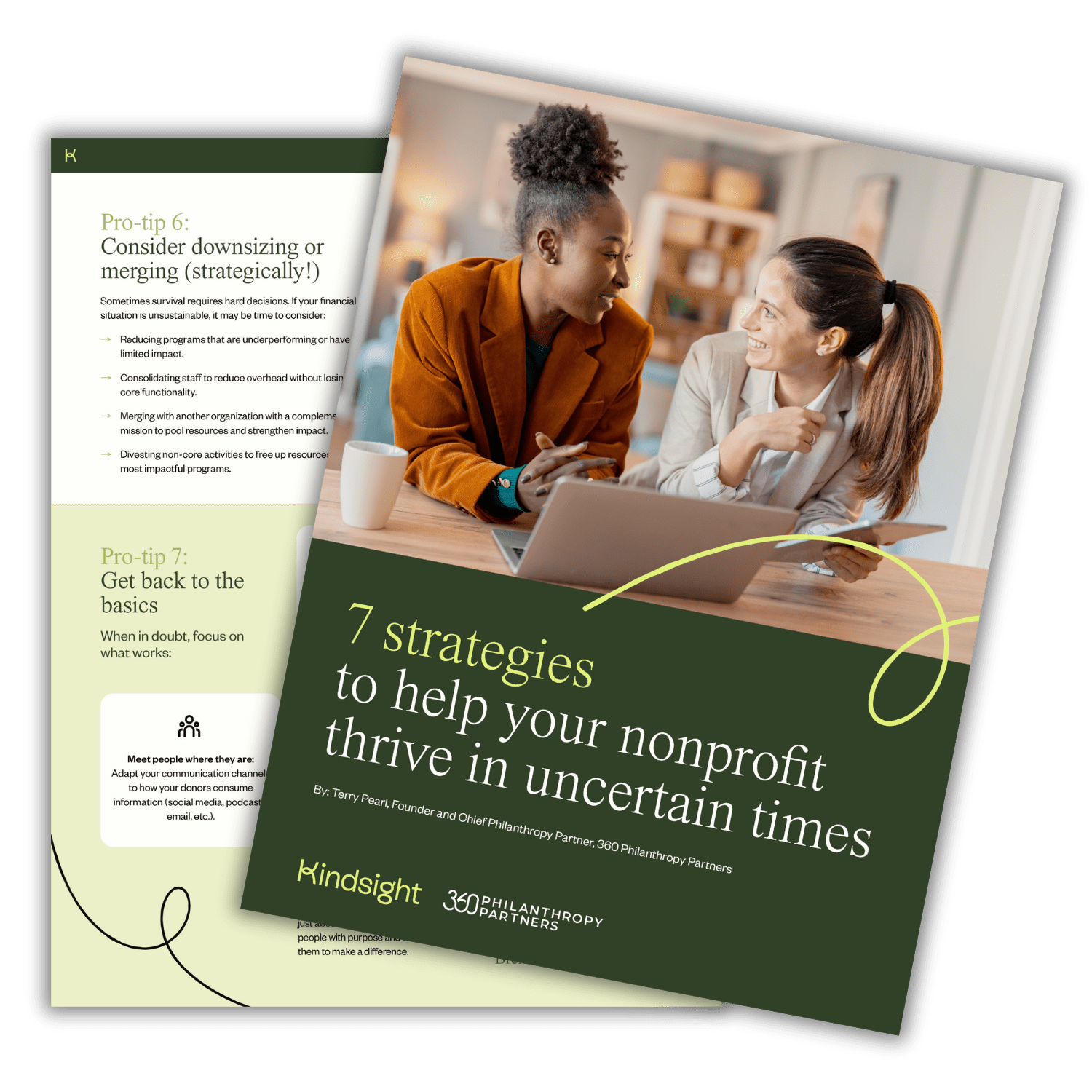
Funding shifts and economic uncertainty don’t have to throw your plans off course. Get seven expert strategies to help you strengthen donor relationships, diversify your income, and come out of uncertain times stronger.
Challenges with nonprofit financial sustainability
Nonprofit sustainability often comes with challenges—there’s a reason that the end-of-year fundraising push is so often an annual event! But when you understand some of the most common barriers to nonprofit financial sustainability, they’ll be much easier to mitigate:
- Relying on one or two funding sources: Overreliance on just a few funding sources is common. But even small steps to diversify into one or two other sustainable revenue streams have a major positive impact on your overall financial health.
- Leadership turnover: Changes in leadership, such as a new executive director or board chair, can change the direction of your organization or cause you to pivot from your long-term plan.
- Short-term goals take precedence: Campaign-specific goals are important, especially when you have real funding deadlines to meet. You may need to make small shifts at first, considering how your usual short-term goals fit into the bigger picture. But don’t worry—even these subtle shifts in perspective add up.
- Reserve funds losing value to inflation: If your funds are sitting in a low-interest account, you may find the 6 months’ worth of operating expenses you put aside has dwindled significantly. Maximize your reserve funds by moving them to safe, liquid accounts with higher interest rates, such as Insured Cash Sweep accounts (ICS) or Money Market Accounts (MMAs). An investment advisor can help you choose the right option.
How to create a nonprofit sustainability plan: 6 steps to long-term strategic planning
1. Define your values
Start by getting clear on what your goals are and the impact you want your organization to have. Even if you think you have a strong idea of your organization’s mission, get your key board members, leaders, and other stakeholders together to define your core values.
This way, even as your fundraising methods adapt and evolve, your “Why” will always stay rooted in your real fundraising mission.
2. Identify your funding sources
Next, identify all your past and present revenue streams, along with revenue streams you’re aware of but haven’t yet tapped into. This might include previous major donors, corporate partners, or grant institutions—exploring grants you haven’t applied for before is a great place to start. Think of this as your resource map, which will help guide you as you work on diversifying your revenue stream (more on this below).
Then, break down just your current funding sources, and review your operating costs—this includes staff salaries, marketing, administrative expenses, and program costs. Subtract your operating expenses from your overall fundraising sources to identify any potential funding gaps.
3. Change your framing
Sometimes, short-term fundraising mindsets stem from board member pressure.
To get your leadership team onside, share information on donor meeting quality, communication response rates, and multi-year giving patterns, along with your usual fundraising metrics, at your next board meeting.
Shift away from questions like, “How can we raise $10,000 by the end of the year?”, to bigger-picture questions, like:
- How can we create a campaign that gets donors excited?
- How can we keep our supporters coming back from one year to the next?
- How can we use this campaign to strengthen donor relationships?
Remember, building a strong nonprofit culture is about forming strong relationships with your supporters. It’s also about uniting your leadership team behind a common goal. Including your team in these conversations before you initiate a new strategy is a great way to achieve this.
4. Diversify your revenue
While exact numbers vary, a common rule of thumb is to make sure that no single source accounts for more than 20 to 30% of your income. This way, if you lose one, two, or even three funding streams, you’ll have others to fall back on.
Here’s a list of diversified revenue streams to consider tapping into:
- Monthly giving programs
- Individual donors
- Corporate sponsorships
- Grants (including foundation, corporate, government, and program-specific grants)
- Fundraising endowments
- Major gifts
- Planned giving
- Fundraising events
- Annual giving campaigns
- Giving days
- Seasonal campaigns (including end-of-year campaigns and GivingTuesday)
Even starting small with just one or two new revenue sources can go a long way to shore up your organization’s sustainability if a funding stream dries up unexpectedly.
5. Get clear on your fundraising plans
Create a fundraising calendar for the year, and include detailed plans for when you’ll need to start prepping for events, writing grant proposals or major gift appeals, and planning giving days. Incorporate any existing funding sources into your plan, along with new sources you’ve identified as potential new sustainable revenue streams.
Refer back to your organizational values—make sure every entry on your calendar aligns with your wider goals and mission.
6. Monitor, track, and adapt
Planning for the long term doesn’t mean you “set and forget” your strategy. Instead, it’s about tracking progress with detailed, transparent reporting and adapting your approach as your nonprofit grows.
Choose a few key performance indicators to track over time. If you’re looking to expand programs but you need more funding, track your fundraising efficiency ratio. If you’re looking to build up your support base, track your donor acquisition.
Metric tracking is an ongoing process, so anticipate monthly and yearly report updates. Sometimes trends like an increased donor lifetime value or increased donor retention take time to emerge.
While this KPI/data framework can reveal a lot about your organization’s overall financial health and sustainability, remember, a WISE, long-term approach to fundraising is one that uses Evidence to inform, rather than dictate decision-making.
Don’t skip the qualitative questions, like:
- Are we seeing small improvements over time?
- What have we learned to apply to our next fundraising cycle?
- How have our relationships with donors changed? (Even if we can’t measure success in dollars yet)
- What unexpected challenges or benefits have we uncovered?
Key components of a nonprofit sustainability plan
Every nonprofit sustainability plan should incorporate these five key components:
- Reserve fund: Ideally, every nonprofit organization should put aside 6 to 12 months’ worth of operating costs in a high-liquidity account. Don’t worry if this feels like a stretch right now—everyone has to start somewhere. Even just 1 to 2 months of operating costs can tide you over during a rough financial patch.
- Transparent financial practices and reporting: Track your revenue and expenses, in-kind donations, and restricted funds carefully, and share regular reports with your board and donors. In the US, most tax-exempt organizations must also file an annual IRS Form 990, 990-EZ, or 990-N, depending on their size, while registered charities in Canada file the T3010 with the CRA.
- Strong governance structure: Minimize the potential friction of a team member leaving by having a plan in place for their succession. Retain your talent by investing in professional development inside your organization, fostering a positive workplace culture, and offering competitive salaries. And when considering the cost of hiring, investing in your team now can pay off in the long run.
- The right technology: A fundraising CRM connects all your donor data, automates repetitive tasks, and makes it easier to track your success.
- Mission and community alignment: Finally, you’ll want to ensure your organization’s vision for long-term growth aligns with your community’s interests and values. If your supporters see you’re doing work they really care about, they’re more likely to stay engaged through events, recurring giving programs, or major gifts.
Financial sustainability for nonprofit organizations isn’t built in a day. While it can be hard to break out of the push towards short-term goals, even small changes to how you think about and execute your fundraising strategy will move your nonprofit’s sustainability journey forward. With the strategies in this guide, you’ll be well-positioned to face the unexpected and make it out the other side even stronger than before.

Be the first to read our resources.
The world is changing quickly—and our resources help you stay on top of it all. Sign up to get new insights, success stories, and more, sent right to your inbox.
Explore related resources.
-
Understanding nonprofit burnout and how to prevent it

Post Understanding nonprofit burnout and how to prevent it
Learn what causes nonprofit burnout, how to spot the signs early, and how leaders and fundraisers can prevent it and protect their team and mission.
-
The essentials of donor databases for nonprofits
Post The essentials of donor databases for nonprofits
Discover key CRM features, explore top software options, and find the right solution to boost your fundraising.
-
KindCon Partner Spotlight: Driving real impact with Attain Partners

Post KindCon Partner Spotlight: Driving real impact with Attain Partners
Learn how to calculate the most important fundraising metrics, boost retention, and turn data into real donor growth.