
Share Article:


Data is never going to be a glamorous subject, but it is an important one. The heart and soul of good fundraising, understanding your donor data is key to achieving long-term growth.
It’s why donor databases for nonprofits are so important. But moving from manual systems to specialist software is a big step. This article will help you prepare by exploring the role and potential of donor databases for nonprofits, highlighting key features to consider, and outlining steps to help you find the right solution.
What is a donor database?
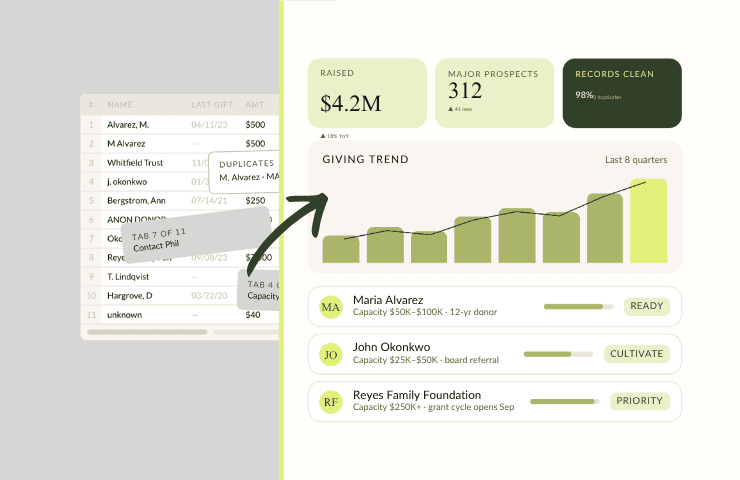
A donor database is a system to store, manage, and analyze donor information. It serves as a central hub for your donor data and insights — helping you build stronger relationships and use this information to drive fundraising progress.
Is it the same as Constituent Relationship Management (CRM)?
In most cases, yes. At its simplest, a donor database is a spreadsheet or Excel document. But these manual systems will only get you so far, with many nonprofit organizations choosing to invest in specialist Constituent Relationship Management (CRM) software instead.
These systems are designed to manage relationships and data at scale, with nonprofit CRMs offering bespoke fundraising and donor management support.
The benefits of using specialist donor database software
Donor databases for nonprofits aren’t a luxury. They are an essential tool that helps your team:
Save time
Manual systems might work at first, but large-scale data processing can quickly drain your team’s time and morale. A specialist solution will do the heavy lifting by automating repetitive tasks so your team can focus on high-value activities.
Build deeper donor relationships
Donor databases for nonprofits are there to help you understand your donors and spot key trends — giving you the information you need to boost donor engagement and improve donor retention rates.
Raise money
With more time and a better understanding of current and potential donors, you’ll be in a stronger position to grow your income and take your fundraising to the next level.
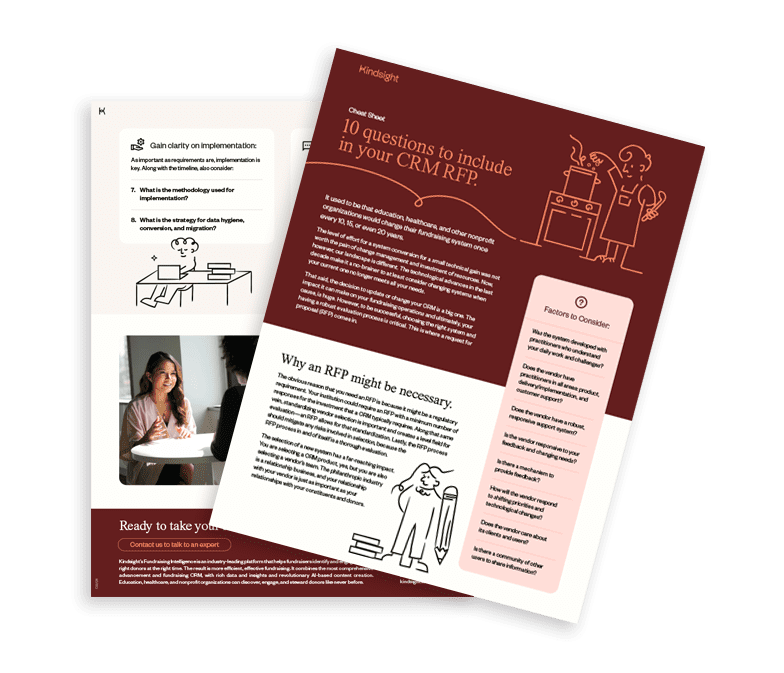
Putting out a CRM RFP, and not sure where to begin?
Learn the essential questions you should include when preparing your RFP.
Key features to look out for: The essentials
Search the term “donor database software” or “nonprofit CRM solutions” and you’ll find a world of different options, each boasting the latest and greatest tools and features.
Before you start looking at the fun stuff, make sure your chosen donor management system covers the basics. This means looking for features that make it easy to:
Build complete donor profiles
Good donor database software keeps all donor data in one place and makes interactions easy to track. This “bird’s-eye view” of donor profiles helps you get to know your donors and build data-driven fundraising strategies.
So what does this look like in practice? Look for a system that pulls biographical, demographic, giving, and relationship data onto a single record, rather than spreading it across linked modules you have to click through. The details held in that profile matter more than the headline claim. Can a record hold multiple concurrent addresses, including seasonal ones, and keep the history of superseded ones? Are addresses validated as they’re entered, or is the database only as accurate as your busiest colleague on a Friday afternoon? The practical test for any vendor is whether a gift officer preparing for a meeting can get full context from one screen, or has to assemble it from four.
Import donor data from different portals
A database is only as useful as the information inside it. Look for a system that makes it easy to bring in data from other tools, such as online fundraising tools (like your website and email marketing platforms) and accounting software.
Automate workflows
Manual processes take time. A good CRM will automate repetitive tasks, streamline your donation process and data logging, and support related activities like sending thank-you emails and tax receipts.
One thing worth clarifying with any vendor: which parts of the acknowledgment chain are native and which run through systems you already own.
Make better decisions
Data is only valuable if you can use it. Look for a solution that makes it easy to analyze donor information with out-of-the-box reporting templates and simple customization tools.
Key features to look out for: Fundraising tools
Once you’ve got the basics covered, it’s time to look for tools that will help you level up your fundraising, such as:
Lifecycle management tools
A good donor management platform supports every stage of the donor journey, from prospect research to pipeline management, major donor, and legacy giving programs. By tracking interactions and centralizing donor data, you can manage relationships more effectively and start moving donors up the giving pyramid.
In Ascend, for example, this is the Prospect Management module — portfolio planning, moves management, and pipeline tracking — sitting alongside advanced gift processing, so one record carries both the relationship history and the full gift lifecycle from intake through to reporting.
Donor segments and personalization
Fundraising is not one-size-fits-all. A good donor management system makes it easy to segment donors and create targeted communications based on their interests, motivations, or needs.
What separates genuinely targeted outreach from a basic mail merge is segmenting donors by involvement, philanthropic interests, volunteer history, and demographic attributes—not just past giving history. To execute this effectively, you need a system that pairs these rich segments with automated workflows to trigger personalized touchpoints and route follow-ups to the right team member at the exact right moment. Ascend delivers all of this in one platform.
Campaign and event management
Managing fundraising campaigns and events can be hard without the right tools. Don’t struggle alone. The right software can help you plan, deliver, and track campaigns, as well as manage event ticketing, registration, and follow-up.
Key features to look out for: A little extra sparkle
Advances in AI and other technologies are unlocking new ways to strengthen and grow your fundraising.
Here are a few features worth exploring:
Predictive and generative AI
Some donor databases for nonprofits use AI to analyze donor data and support decision-making. These tools help you decide next steps, recommend ask amounts, group donors, and personalize outreach more efficiently.
When comparing AI features generally, the useful question is whether insights surface where the work happens or in a separate dashboard nobody opens. You want an AI tool designed to sit inside the fundraiser’s existing workflow rather than alongside it: summarizing donor profiles, drafting email and call templates, tidying up contact reports, and suggesting next steps from data already in the CRM. Kindsight Intelligence, the AI layer in Ascend, delivers all of this right where you work.
Grateful patient tools
For healthcare nonprofits, fundraising often begins with the patient experience. With compliance built in, grateful patient tools help you identify and engage individuals who may wish to support your work following their care.
A powerful Grateful Patient program should be HIPAA-compliant and built directly into the same biographical, gift, and prospect records the rest of your team already uses, ensuring patient prospects don’t live in a parallel system. It needs to track medical encounters, service lines, treating physicians, and patient referrals, allowing a foundation to segment by care experience rather than by giving history alone—the difference between a generic appeal and a letter that acknowledges why someone feels grateful in the first place. Ascend’s Grateful Patient module delivers all of this seamlessly.
Mobile and web access
Fundraising doesn’t always happen behind a desk. Mobile and web access make it easy for your team to stay engaged, log, and access donor information on the go.
Check what mobile access actually covers, though. Read-only access to records is common; the capability that changes behavior is filing a contact report from your phone, because a visit logged in the car park is worth considerably more than one written up three days later, or not at all. Ascend’s contact reporting is built for mobile use for exactly this reason.
Read our blog exploring essential nonprofit CRM features to go even deeper into the topic.
A note on data validation and compliance
With so much data and personal information available, you must comply with legal and ethical standards. Prioritize solutions with built-in safeguards and regulatory features to protect data and ensure responsible use.
For healthcare foundations in particular, this means asking about role-based access controls, HIPAA compliance, and de-duplication at the point of data ingestion — compliance is as much about record accuracy as it is about access. Ascend covers all three, and its Salesforce foundation means the underlying platform’s security certifications carry through.
Don’t forget to factor in ease of use
Even the best donor management software will fall short if your team doesn’t use it consistently. Look for a solution that’s intuitive and easy to use and make sure you invest in training and onboarding. Clear processes, internal champions, and leadership buy-in will help ensure effective donor database management from day one.
This deserves more weight than it usually gets in enterprise evaluations, where adoption tends to fail on complexity rather than capability. It’s also worth asking vendors what onboarding actually includes and whether there’s an active customer community — peer practice-sharing does a lot of quiet work in the first year.
What are the best donor management software solutions for nonprofits?
Good question! The truth is that when it comes to choosing your donor management platform, there is no single “best” solution — only the one that works for you.
The right choice will match your goals, processes, and budget, while supporting fundraising growth. To give you an idea of different options available, we’ve highlighted three popular tools for organizations at different stages of development:
1. Ascend by Kindsight
We have mentioned Ascend a few times in this article already to illustrate what certain features look like in practice. We’d be remiss if we didn’t include it here as well!
Built on Salesforce, Ascend is a scalable, highly customizable donor management CRM designed for higher education, healthcare, advancement teams, and large nonprofits. It drives complex fundraising campaigns through advanced analytics, donor segmentation, and automated engagement. The platform streamlines prospect management, gift processing, and batch workflows while offering seamless third-party data integrations and full web/mobile access. For healthcare institutions, it also features a HIPAA-compliant Grateful Patient module to maximize fundraising impact.
2. Little Green Light CRM
Designed by fundraisers, for fundraisers, Little Green Light CRM is a good choice for smaller nonprofit organizations looking to level up their fundraising. It covers all the essentials, including customizable dashboards, batch processing, donor management, and online donation forms that sync directly with your database (processing fees apply).
3. Bloomerang
Bloomerang supports nonprofits of all shapes and sizes, with a particular focus on those getting ready to scale. Its core CRM is part of a broader Giving Platform, which also includes Bloomerang Fundraising and Bloomerang Volunteer. Together, they offer a powerful suite of tools that covers everything from day-to-day fundraising to donor and volunteer management.
4. Blackbaud (Raiser’s Edge NXT)
Blackbaud Raiser’s Edge NXT is used by mid- to large-scale organizations with complex fundraising needs. While it can be less intuitive than donor management systems, it offers a wide range of tools, including AI-driven insights, to support data-led fundraising.
On the hunt for a new database? Check out our blog on the 14 best nonprofit CRM solutions.
How to choose the right donor database for your nonprofit
With so many donor databases for nonprofits to choose from, finding the right one can feel overwhelming at first. But if you know how to structure your search, it gets much easier.
Here are four tips to get you started:
1. Understand your needs
Your CRM needs to align with your organizational strategy, goals, and activities. Look at your fundraising plan and work with your team to identify the tools, donor management features, and automations that will help everyone work more effectively.
2. Find product features that fit
Once you’ve defined a wish list of features, start researching different solutions. Don’t force a system to fit. Focus on your needs and choose a product that your team (and senior management!) can buy into.
3. Explore different quotes
Every CRM comes with a price tag. Treat it as an investment rather than an expense, and take the time to understand donor management software costs and the return it can deliver.
4. Talk to people and read reviews
With around 1.5 million charitable organizations in the US, you’re not alone in your search for the right donor management system. Don’t hesitate to connect with peers, ask questions, and read trusted reviews (like those on G2). Real user experiences will always paint a clearer picture than any marketing brochure.
Frequently Asked Questions
Of course, investing in donor database software is about more than the product itself. It’s a process, and it’s only natural to have questions about what this shift will mean for your team.
We’ve answered some of the most common ones to help get you started.
How do we know if we need a new donor management platform?
If your team is relying on spreadsheets and spending hours updating donor profiles manually, it’s probably time for a change. Don’t stay with manual systems because you’re afraid to take the leap. Investing in donor management software solutions is a natural part of organizational growth.
Do we need a donor database or specialist constituent relationship management?
A donor database is a system used to store, manage, and analyze information about your supporters. While this can be as simple as a spreadsheet, most nonprofit organizations use specialist software to handle the complexity of modern fundraising.
How long does it take to get donor databases for nonprofits up and running?
Timelines can vary depending on your organization’s size, data complexity, and internal capacity. For some, it may take a few weeks. For others, several months. Good planning, clean data, and clear processes will help ensure a successful CRM implementation.
Is a donor management software solution worth the investment?
The right donor database for nonprofits can save time, reduce errors, and unlock new fundraising opportunities. For this reason, many organizations see the potential return as well worth the upfront investment.
What are the biggest mistakes to avoid when choosing a nonprofit CRM?
Choosing the wrong donor database software can create more problems than it solves. Common pitfalls include not involving your team, underestimating implementation time, or picking a system that doesn’t align with your needs.
You can avoid this by taking the time to do background research, understand your priorities, and work with your team to find a solution that meets your exact needs. Trust us, it’s out there!

Be the first to read our resources.
The world is changing quickly—and our resources help you stay on top of it all. Sign up to get new insights, success stories, and more, sent right to your inbox.
Explore related resources.
-
Understanding nonprofit burnout and how to prevent it

Post Understanding nonprofit burnout and how to prevent it
Learn what causes nonprofit burnout, how to spot the signs early, and how leaders and fundraisers can prevent it and protect their team and mission.
-
Dreamforce 2026: The AI takeaways advancement leaders should know
Post Dreamforce 2026: The AI takeaways advancement leaders should know
AIforce was the big reveal at Dreamforce 2026. Here's what it means for advancement leaders, plus five questions to bring into your AI strategy.
-
KindCon Partner Spotlight: Turning Data Into Impact with BWF Zuri
Post KindCon Partner Spotlight: Turning Data Into Impact with BWF Zuri
Learn how to calculate the most important fundraising metrics, boost retention, and turn data into real donor growth.