


Share Article:


You don’t need the biggest advancement office to run a great Giving Day. You need to know who’s in your database, how much to ask for, and how to personalize your outreach.
Giving Days are an incredible opportunity for institutions of all sizes to maximize fundraising revenue, acquire new donors, and create a vibrant sense of community rallied around giving back. But where Giving Days can really create a lasting impact is in the pre- and post-Giving Day work. It’s about applying a data-driven approach to one of your institution’s largest opportunities of the year.
That’s where donor intelligence comes in. And if there’s one thing we know at Kindsight, it’s donor data. For more than 30 years, iWave by Kindsight has helped advancement teams of every size find their best prospects, drawing on our proprietary VeriGift, the industry’s largest verified charitable giving database, and 44+ licensed, premium data sources.
When it comes to giving days, our clients are using that industry-leading data to answer three questions: Who should we call? How much should we ask for? And what do we do with all these new donors afterward? Below, we break down how to use donor intelligence before, during, and after Giving Day to raise more, find new major donors, and build relationships that last well beyond 24 hours.
*Donor intelligence is the practice of using data to understand each supporter’s capacity, affinity, and likelihood to give, so your team knows who to prioritize and what to ask for.
Triage and prioritize your records
Most schools already have a rich database: thousands of alumni, parents, ticket buyers, and community members. No team, no matter the size, can research every record by hand—there just aren’t enough hours.
The way through is to stop treating it as a research problem and start treating it as a triage problem. Donor intelligence, including prospect research and wealth screening, lets you look at your entire database at once, not just the 50 names everyone already knows. To sort those records in a useful way, look at three signals for each one:
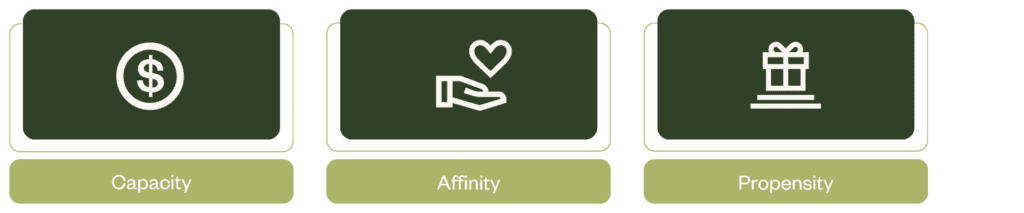
- Capacity: what someone could give, based on wealth indicators
- Affinity: the causes they already support and at what level
- Likelihood to give (propensity): their overall philanthropic history
Put those three together, and an undifferentiated list becomes a ranked one. Before you send a single Giving Day email, you know which names deserve a personal phone call, which are a good fit for a peer-to-peer ask, and which are best served by the general campaign. Your team’s limited hours go toward the relationships most likely to convert, not whoever happens to answer the phone.
Look past your own giving history
Your CRM tells you what someone has given to you. It doesn’t tell you how wealthy they are or how generous they are elsewhere. Donor intelligence fills in the rest of the picture: the causes they support, real estate and business holdings, board memberships, and life events that signal new capacity, like the sale of a business.
That’s where the surprises show up:
- A parent who has only ever given $50 to your annual fund might be a major donor to three other causes. They just haven’t been asked at the right level.
- An alum who looks quiet in your database might be one of your most philanthropically active supporters, just not with you… yet.
- A season ticket holder who has never made a gift might be giving $100,000 a year to your local hospital. Rather than asking them to support the team, you might invite them to support your nursing program.
Screening also helps with data hygiene. Appending missing emails, addresses, and updated contact details means the information you already have is actually accurate. For small teams especially, that combination of hidden capacity and cleaner data is often where the biggest untapped Giving Day opportunity sits.
In iWave, all of these signals come together in a single donor profile, including verified gifts to other organizations from the VeriGift charitable giving database, so you can see the full scope of someone’s generosity rather than just the slice your institution has seen.
Run several campaigns in one Giving Day
Once you know the capacity, affinity, and giving patterns of your audience, you can stop using a cookie-cutter, one-size-fits-all approach. Instead, run several campaigns in parallel, each matched to what you know about that group:
| Segment | Who they are | The ask |
| Leadership donors | A handful of high-capacity, high-affinity supporters | A personal ask before the day, at a specific amount, tied to a fund they care about |
| Matching gift donors | Major donors who may want to unlock others’ generosity | Invite them to fund a match or challenge goal that fuels the day |
| Loyal small-dollar donors | Your reliable annual fund base | The general email and social push, focused on impact |
| Lapsed donors with new capacity | Past givers who now show stronger wealth indicators | A “we’d love to have you back” message, not the generic appeal |
| New prospects | New parents and ticket buyers who haven’t given yet | A first-gift invitation, with a special offer or a team-specific page |
You can take this a step further by matching people to the part of campus they care about most. If someone gives to healthcare causes, add them to your nursing campaign. If they support theatre and the arts, invite them to give to your fine arts program. People are more likely to make a larger gift when they know it benefits the team, department, or program they personally identify with.
That’s the real shift. Instead of one message trying to work for everyone, you match the ask, the amount, and the channel to each segment, which is a far better use of your team’s outreach time than a single mass appeal.
The tools can do a lot of the heavy lifting here. In iWave, you can build each segment by filtering your screening results by iWave Score, estimated capacity, and giving interests, then export the lists into your email, call, and peer-to-peer workflows. For larger databases, Kindsight’s custom predictive modeling can match donors to the programs they’re most likely to support at scale. And on the giving side, platforms like eTeamSponsor let each team or department have its own goal and donation page to tell its story.
Treat Giving Day as a discovery event
The dollars raised on Giving Day matter. But the lasting value is in what you learn. Giving Day is one of the few moments a school gets a burst of engagement from its entire community at once, including people who have never given before.
Who showed up? Who gave for the first time? Who gave to a peer-to-peer page for a friend, teammate, or faculty member? Screen those names after the day, and you’ll often find major gift or planned giving prospects sitting inside a pile of small first-time gifts. Here’s what that looks like in practice.
A $15 gift that pointed to $1.1 million in capacity. Missouri Baptist University’s initial campaign raised $530,000 toward a $4 million goal for a new cheer stunt facility. One of the donors was a player’s grandmother who gave $15. When her record was screened, her iWave score flagged her as a “hidden gem” with an estimated $1.1 million in capacity: a major gift prospect hiding in plain sight.
A $12,500 campaign with more than $150 million in capacity. Another school’s Giving Day campaign raised $12,500. On the surface, a modest result. But when that group of donors was screened, it revealed more than $150 million in combined giving capacity, a pipeline the school didn’t know it had.
From $5,000 to $350,000 with one phone call. During Dakota State University’s Giving Day, the team watched gifts roll in on a live scoreboard. An out-of-state dad, living across the country, made a $5,000 gift. A follow-up phone call to learn more about him turned into a $350,000 donation for a state-of-the-art locker room.
The common thread: the goal of Giving Day is to grow your number of donors. Once you have those new donors, the next step is getting to know them. Treat Giving Day as a pipeline-building exercise, not a one-day transaction.
How many hidden gems are there in last year’s Giving Day donor list?
See who in your database is hiding in plain sight.
Follow the donor intelligence playbook
Before the day
- Clean your data. Merge duplicates and update contact fields in your CRM before you export records.
- Run a screen. Screen your full database, not just your top donors, to score capacity, affinity, and likelihood to give.
- Segment. Separate high-capacity prospects from your general community, and match people to the departments, teams, and causes they care about.
- Line up your matches. Identify major donors who may want to fund a matching gift or challenge goal.
On the day
- Personal outreach for top prospects. Route high-capacity profiles to direct, personal, or peer-led leadership asks.
- Automated outreach for everyone else. Direct broader segments to impact-driven digital campaigns, team and department pages, and peer-to-peer tools.
After the day
- Screen your new donors. Run every first-time Giving Day donor back through your prospect research tool, ideally within a week, while the gift is still fresh.
- Build the pipeline. Move newly uncovered high-capacity donors into year-round cultivation.
- Steward everyone. Thank donors quickly, report back on impact, and follow up on matching gifts.
Trade guesswork for a plan
The biggest difference donor intelligence makes is time reclaimed, not just dollars raised. Many teams spend the weeks before Giving Day on manual list-building and guesswork: who do we call, who do we email, how much do we ask for? Donor intelligence answers those questions up front without the manual effort.
With those answers in hand, your Giving Day technology (campaign pages, peer-to-peer tools, matching gifts, and automated thank-yous) can work from a smart plan instead of a spray-and-pray list. Together, donor intelligence and the right Giving Day tools let a two- or three-person team run a campaign that looks and performs like it came from a much bigger shop.
If we could give one final piece of advice, it would be this: don’t use a one-size-fits-all approach. Your database is full of supporters with different capacities who are passionate about different causes. Get to know them, so you can segment properly, make the right ask, and engage each of them in a personal way, on Giving Day and beyond.
Be the first to read our resources.
The world is changing quickly—and our resources help you stay on top of it all. Sign up to get new insights, success stories, and more, sent right to your inbox.
Explore related resources.
-
KindCon Partner Spotlight: Turning Data Into Impact with BWF Zuri
Post KindCon Partner Spotlight: Turning Data Into Impact with BWF Zuri
Learn how to calculate the most important fundraising metrics, boost retention, and turn data into real donor growth.
-
The essentials of donor databases for nonprofits
Post The essentials of donor databases for nonprofits
Discover key CRM features, explore top software options, and find the right solution to boost your fundraising.
-
KindCon Partner Spotlight: Elevating event impact and eliminating data silos with Blackthorn
Post KindCon Partner Spotlight: Elevating event impact and eliminating data silos with Blackthorn
Learn how to calculate the most important fundraising metrics, boost retention, and turn data into real donor growth.