


Share Article:


Fundraising cycles are key parts of any fundraiser’s toolkit. Structured and methodical, they help bring structure, process, and predictability to complex fundraising systems.
But there’s a catch. As great as they are, fundraising cycles are designed to circle around to the same point — when what fundraisers really need is forward movement. In this article, we’ll take a closer look at the six steps of a traditional fundraising cycle and how you can use them to trigger an upward spiral of growth.
What is a fundraising cycle?
The term “fundraising cycle” describes a continuous, multi-stage process used by nonprofit organizations to grow their income generation activity. Rooted in relationship-based fundraising techniques, it consists of five or six stages and covers the whole fundraising process — from prospect research to recognition and stewardship.
While the term is most often applied to individual and major gift donors, this is not exclusive. A fundraising cycle is highly adaptive and can (and should) be used to nurture relationships with corporates, trusts, and even institutions.
How is it different from a donor cultivation cycle?
There is a lot of overlap between your fundraising cycle and your donor cultivation cycle — so much so that the terms are often used interchangeably. But there is a subtle, important difference: while the donor cultivation cycle focuses on nurturing donor relationships, the fundraising cycle is broader, has more steps, and a deeper link to your organizational strategy.
Foundational stages of your fundraising cycle
Before we look at the six stages of the fundraising cycle, it’s important to understand the foundations behind them. This is the scaffolding you will need to build a system that not only supports growth, but drives it.
Strategic planning
Every organization’s income mix looks different. Some rely on individual donors, while others draw more from corporate partnerships or foundations. There is no single “right” model — what matters is having a clear strategy behind it. A strong fundraising strategy sets out how you plan to grow each income stream over the short, medium, and long term. The six stages of your fundraising cycle should all feed into that plan and evolve with your organizational goals.
Donor profiling
Good fundraising doesn’t come from bold, generic asks. It grows from campaigns and activities tailored to the needs, motivations, and giving preferences of people who have a clear interest in your cause. Donor profiling helps you speak to them. It turns a vague audience into defined, human profiles — outlining who your potential donors are, what drives them, and how they prefer to engage. With these insights, you can design more relevant activities, build stronger connections, and inspire more support.
A commitment to data
Data is the backbone of every fundraising activity. This means making sure you have the systems and processes to collect, analyze, and use the insights you generate. With the right foundations in place, you can see what’s working, where the opportunities lie, and where the pain points are — and evolve your activities accordingly.
The six stages of the fundraising cycle
Once you’ve laid the groundwork, it’s time to think about your fundraising cycle. We’ve outlined each of the six stages below:
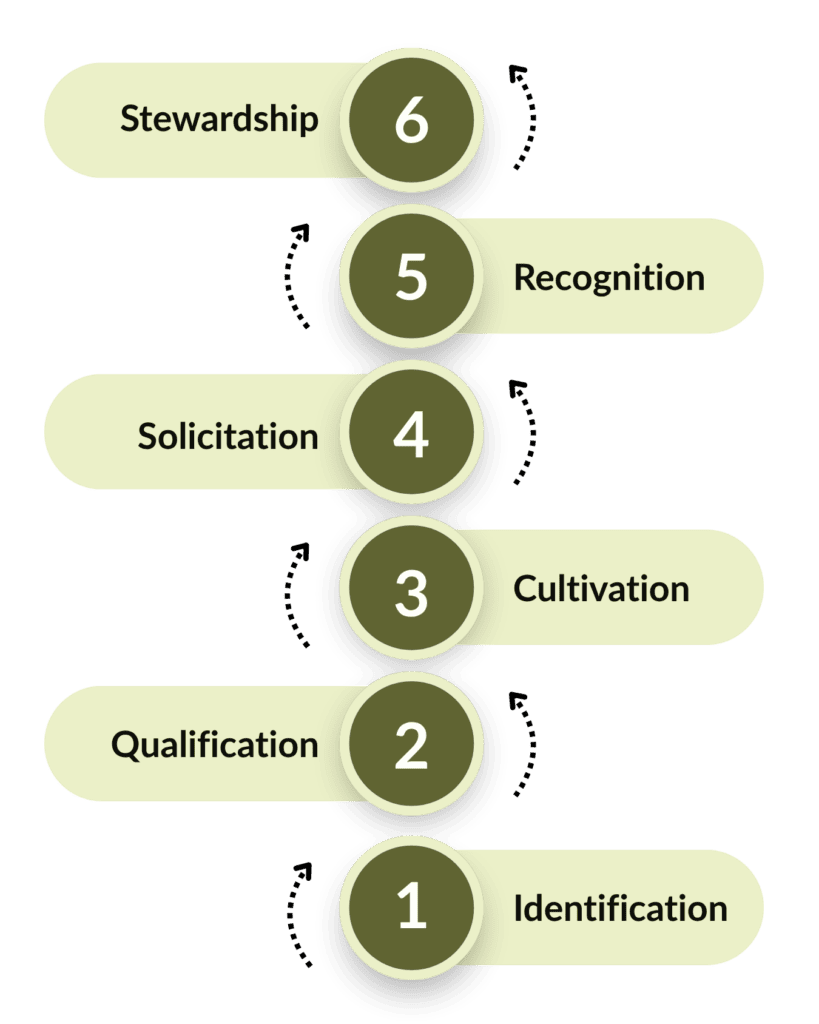
Stage 1. Identification stage
Traditional fundraising cycles start with the identification stage. That is, the stage at which you start building a long-list of potential donors. With 1 in 2 members of the public giving $100 or more to charity, there’s a clear market. But where to start? The best way to conduct prospect research is to be systematic and identify potential donors by working through different channels in turn.
Starting with:
- Your current network: Your best donors could be hiding in plain sight. Start by looking through your current database and closing the gaps. Are there lapsed donors you could bring back into the fold, current donors with the potential to give more, or board members and connections with giving capacity?
- Volunteers and event attendees: They might not have given cash, but time is a gift like any other. It’s also a great indication of interest. If people have taken the time to show up, then they already have an interest and connection with your work. It’s up to you to use it.
- Service users: It might feel counterintuitive to raise money from people who have accessed your services. But who better to understand the impact of your work than those who have benefited from it? For healthcare organizations, grateful patient tools can help you identify people who might be willing to give, while alumni networks for educational institutions are a great source of potential new donors.
Of course, you can also use cold acquisition tools like direct mail, telephone fundraising, and face-to-face fundraising campaigns to help build your prospect list. Just make sure they’re targeted toward your donor profiles so that you get the best-possible return.
Top tip: As you’re building your list, segment potential donors into groups (think major donors, regular givers, and potential legacy gifts). Wealth screening tools and fundraising intelligence tools will help you analyze large datasets so that you can find out more about your donors’ capacity to give.
Stage 2. Qualification stage
By the time Stage 1 of your fundraising cycle is complete, you should have a pretty large list of prospects. The qualification stage is a continuation of this, and will help you prioritize and plan your approach.
To identify top prospects, many organizations develop a scoring system. The Kindsight Score, for example, uses a rating based on a prospect’s propensity (likelihood to give), affinity (connection to your cause), and capacity (ability to give). The higher the score, the hotter the prospect. You can use this process to structure your outreach and make sure you invest your time and resources into the people who are most likely to give.
Top tip: Use your donor profiles to help create your scoring criteria. Having a clear idea of what your ideal donor looks like is a great way to start shaping your donor qualification strategy.
Stage 3. Cultivation stage
The cultivation stage is where you sow and grow the seeds of your relationship. It’s tempting to dive straight in with an ask — or even a second ask if someone’s already given once. But no donor likes to be treated like an ATM. Creating space to get to know potential donors (and your donors to get to know you) will help build the trust you need for long-term relationships. For high-value donors, the cultivation stage will also help you gauge the type and nature of ask that will work best.
Three ways to help cultivate relationships are:
- Sharing stories and impact updates without a hard ask: This shows donors that you want to get to know and engage with them, not just ask for money.
- Creating engagement opportunities: These could be event invitations, volunteer opportunities, one-to-one meetings, or even a behind-the-scenes tour. Meeting in person — especially outside a fundraising context — reduces pressure and allows conversations to flow.
- Building active online communities: Social media isn’t just about clicks, it’s about community. Use it to engage donors and encourage donor feedback through polls, online events, and posts that inspire people to share, follow and tag.
Top tip: Personalize your communications whenever you can. Specialist databases and fundraising CRMs like Ascend make it easy to both create and customize communications, as well as donor engagement and past giving history.
Stage 4. Solicitation stage
The solicitation stage is when you make “the ask”. This can come in many forms. For lower-level supporters, it might be a well-timed giving campaign with a personalized call to action (predictive modeling can help with this). For major givers, it could be the result of months, or even years of stewardship and building relationships, leading to a highly bespoke ask.
Top tip: Don’t rush it. A well-timed, well-judged ask makes all the difference, so make sure you’ve got the groundwork in place before soliciting donors.
Stage 5. Recognition stage
Making the ask is the first step. It’s how you follow up that will turn your fundraising cycle into an upward spiral. Make sure you acknowledge someone’s gift quickly. And not just with a receipt. There’s a saying in fundraising that donors who receive a thank-you within 48 hours are four times more likely to give again. Whether or not the exact number can be proven, the principle is solid. So take the time to create and share a thoughtful, personal thank you letter. You will be surprised at the difference a little recognition makes.
Top tip: Thank you letters are great, but why not add a hand-signature, send a personalized postcard, or make a phone call? Lots of organizations also show their appreciation by publicly recognizing support on social media, or through more formal donor recognition platforms (e.g. donor walls) for top-tier supporters.
Stage 6. Stewardship and donor retention stage
This final stage is the point at which your cycle pivots. Now you’ve brought new donors into the fold, the task is to keep them there by stewarding their donor journey and moving them up the giving pyramid. For lower-level givers, this might mean converting one-off donations into regular, recurring gifts. For major donors, it could be the start of a process leading toward a second, or maybe even a legacy gift.
Don’t get complacent. The cost of recruitment will always be higher than the cost of retention, so invest in your current relationships to make sure you realize the potential of every donor.
Top tip: Defining donor journeys for different groups of donors can help bring structure to this process and give you a clear roadmap of actions to follow.
Turning your fundraising cycle into an upward spiral
Of course, turning your fundraising cycle into an upward spiral isn’t a one-off activity. It’s the result of intentional, continuous efforts to grow and evolve over time.
Here are five extra tips to help you keep the process moving:
Tip #1. Use your data
Build in time to review key data sets and look at what the numbers are telling you. Are there any trends or patterns you can capitalize on to grow your fundraising? Or can you spot any weak points and use your insights to fix them?
Tip #2. Don’t be afraid to test different techniques
When targets are high and the pressure is on, sticking with tried-and-tested solutions can feel like the safe, sensible choice. It’s okay to be creative and take a few risks, as long as you do it in a measured way. Split A/B testing, for example, can be a great way to see how donors respond to different types of messages and ideas, and you can use this information to refine and tighten your campaigns and fundraising approach.
Tip #3. Keep it personal
We’ve said it before and we’ll say it again: personalization is everything. The closer people feel to your work, the stronger their bond with you will be. Use their first names. Use yours. Share real stories from real people and make sure the impact of your donors’ support feels so close they could touch it.
Tip #4. Know what you’re looking for
As much as every fundraiser would love a 100 per cent donor retention rate, the truth is that some donors will always disengage. The key is to keep this number as low as possible. Look for warning signs and set alerts that trigger a reactivation journey (for example, non-response to two campaigns, or ignoring e-newsletters). You can also set alerts that signal when someone might be gearing up to give more, for example by increasing their average gift size.
Tip #5. Say “yes” to specialist tools
Don’t feel like you have to go it alone. There are lots of tools out there to help you manage and analyze your data. Fundraising CRMs, wealth screening tools, predictive modeling, and donor portals all help you surface, understand, and use your fundraising data.
Frequently asked questions
How long does a fundraising cycle take?
There is no fixed timeline. For some organizations, a full fundraising cycle might take a few months; for major donor programs, it can take years. What matters isn’t speed, but progression.
Where should you focus first if you’re starting from scratch?
Start with what you already have. Your existing supporters are your strongest foundation. Building from warm connections is usually more effective than jumping straight into cold acquisition.
Can you skip stages of the fundraising cycle?
It’s tempting — especially when you need money fast — but skipping stages of the fundraising cycle (particularly cultivation or stewardship) can weaken results. Each stage builds the foundation for the next, so cutting corners can limit long-term growth.
What’s the biggest mistake organizations make?
Trying to appeal to everyone. Casting the net too wide can dilute your message and stretch your resources thin. The most effective fundraising programs focus on the right people with the right message, instead of chasing every possible opportunity.
How do you know if your cycle is working?
Look beyond total income. Track key metrics like donor retention rates, upgrade rates, and engagement levels. If donors are staying longer, giving more, and interacting more often, your spiral is moving in the right direction — even if progress feels slow!
>
Be the first to read our resources.
The world is changing quickly—and our resources help you stay on top of it all. Sign up to get new insights, success stories, and more, sent right to your inbox.
Explore related resources.
-
Nonprofit email marketing: Strategy, tips, and real-life email examples

Post Nonprofit email marketing: Strategy, tips, and real-life email examples
Empower your mission with our nonprofit email marketing guide. Discover strategies, best practices, and real-life examples to boost donor engagement!
-
Your guide to donor recognition

Post Your guide to donor recognition
Keep supporters invested in your amazing mission! Discover why donor recognition matters and explore four simple steps to build lasting relationships.
-
How to create an effective nonprofit social media strategy

Post How to create an effective nonprofit social media strategy
Learn the 8 steps to a better nonprofit social media strategy. Reach more donors, recruit volunteers, and grow your community in 2026.