


Share Article:


Most nonprofit leaders understand the value of email marketing, but there’s not always enough time or resources to give it the attention it fully deserves. We’re here to show you how to create a nonprofit email marketing strategy that aligns with your goals, with tools and steps that feel achievable.
In this guide:
- Why email marketing matters
- How to create an email marketing strategy
- Tools and best practice tips you need for successful campaigns
Why email marketing is important for nonprofits
Email marketing is a powerful way to engage supporters, drive donations, and tell the story of your nonprofit’s mission and goals.
Some of the main benefits of email marketing for nonprofits include:
- It’s easier to reach your subscribers: You’re not at the mercy of an algorithm—instead, your content is delivered straight to your donors’ inboxes.
- Personalization is possible: Write to your subscribers by name and include key details like the amount they’ve donated, which programs they support, and more.
- You own the data: Unlike social media, you have direct access to your supporters and can reach them directly at any time.
- You can run tests and analyze data: Understand what works and what doesn’t in terms of sending times, call-to-action links, and email subject lines.
- You can reach new audiences: By promoting your email signup across your website and other marketing channels, you can attract new subscribers at any time.
- It can be scheduled: Email campaigns are often designed and scheduled in advance, so your team can focus on other marketing efforts live—like social media or in-person events.
- It’s another way to connect with donors: Nurturing donor relationships over time is crucial, and email gives you another avenue to do this alongside your other stewardship efforts.
Email marketing gives you a more direct connection to your supporters than other channels, allowing you to build relationships and drive fundraising efforts from loyal fans.
Types of emails to send as a nonprofit
There are lots of different types of emails to send as a nonprofit—from automatic donation receipts to multi-email campaigns. Only 45% of nonprofits send a monthly newsletter, so for many organizations, there’s plenty of room to introduce or do more with email marketing.
Popular types of emails to send include:
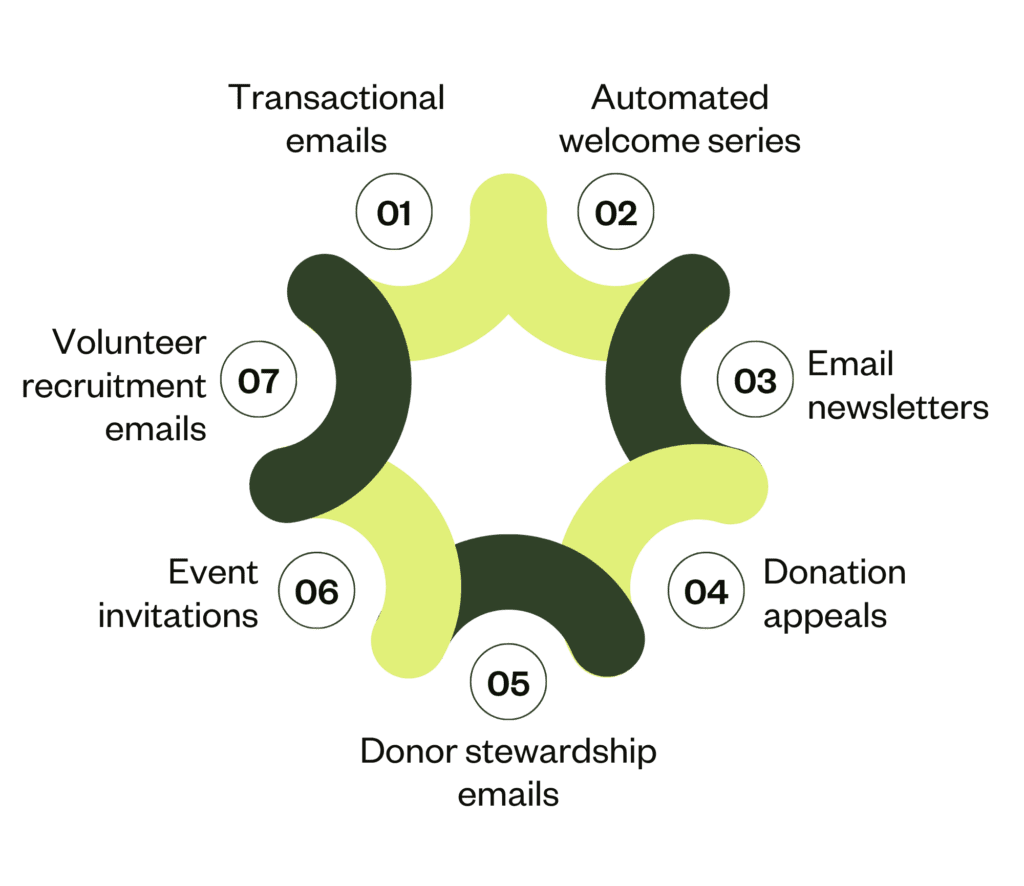
- Transactional emails: Automated emails like donation receipts, thank-you messages, and ticket purchase confirmations.
- Automated welcome series: A series of emails that introduces new donors to the organization’s mission and programs.
- Email newsletters: Regular updates on what’s happening, impact stories, and how to get involved. For even more ideas, see our guide on how to optimize your nonprofit newsletter.
- Donation appeals: Requests for funding for specific campaigns, programs, or fundraising days like Giving Tuesday, designed to engage supporters. For an in-depth walkthrough, explore our guide on how to build an effective fundraising email campaign.
- Donor stewardship emails: Emails that express gratitude towards donors for their donations and continued support, with the aim of building relationships. Sending thank-you emails is important, as 57% of donors prefer to be thanked in this way.
- Event invitations: Invitations, reminders, and thank you messages related to events.
- Volunteer recruitment emails: Email outreach about upcoming volunteer opportunities.
Many nonprofits choose to send a monthly or quarterly newsletter for storytelling, consistency, and regular updates, with appeal and event emails before, during, and after key dates.
How to create a nonprofit email marketing strategy
To make an impact with email marketing, you need a strategy tailored to your goals and target audience. Follow these steps to create (or update) your email marketing strategy.
1. Define your goals
Your email marketing strategy should align with your wider organizational goals. Before you choose a template and start writing, decide what your goals are.
Popular email marketing goals include:
- Attract new monthly newsletter subscribers
- Convert subscribers into volunteers
- Turn one-time donors into monthly donors
- Drive donations for a specific fundraising campaign
- Raise awareness of your organization
- Attract corporate sponsors
Once you’re clear on what you want email marketing to achieve, you can start to plan campaigns that get you closer to your goal.
2. Choose your email marketing software
Many fundraising CRMs have email tools built in, but not all of these are equipped to handle email marketing campaigns or newsletters. You’ll want software designed for email marketing, that integrated with your CRM.
Look for an email marketing platform that aligns with your budget and resources, then see which works best for you with a demo or free trial. Email marketing software is typically priced depending on how many subscribers you have, so if you’re just starting out you can often send emails for free or at a low cost.
If you already have email marketing software, use this time to re-familiarize yourself with it. Explore new-to-you features, refresh your templates, and look for ways to streamline workflows.
⭐ Not sure which email marketing software to choose? Keep reading to find a list of the best email marketing tools for nonprofit organizations and how to find the right software for you.
3. Build an email list
To stay in touch with your supporters you’ll need to build an email list. Most email software will give you multiple ways to do this with standalone signup forms, pop ups, and simple forms that you can add to your website.
To build your list faster, try:
- Importing existing subscribers: If you have an existing supporter base, ask if you can add them to your mailing list.
- Removing friction: Limit the required fields to only the essentials, like first name and email address.
- Offering a free bonus: Encourage people to sign up with the promise of receiving a free guide, a discount on your products, or another meaningful bonus.
- Telling a compelling story: Explain why your email list is the place to be through storytelling, photos, videos, and impact stories.
- Digital advertising: Run a digital campaign to a dedicated landing page for your email list signup page.
Don’t worry if your list doesn’t grow significantly at first. It’s better to grow a careful, considered, and targeted list over time than a large list of subscribers that aren’t aligned with your mission.
4. Segment your audience
The best nonprofit email marketing campaigns are those that your donors feel truly connected with, so split your email list into groups or segments based on interests, donor behavior, and engagement. This is known as donor segmentation.
You can build a list based on any demographics, but here are some common groups:
- New supporters or donors
- Supporters who have recently made a donation
- Repeat donors
- Previous event attendees
- Donors based in [location]
- Major donors
- Corporate sponsors and partners
- Supporters interested in capital projects
- Donors that signed up from social media
- Volunteers
- Supporters who haven’t engaged with the last [number] email fundraising campaigns
- Your most engaged supporters
Align your donor segments with your donor personas to create even more specific and impactful content.
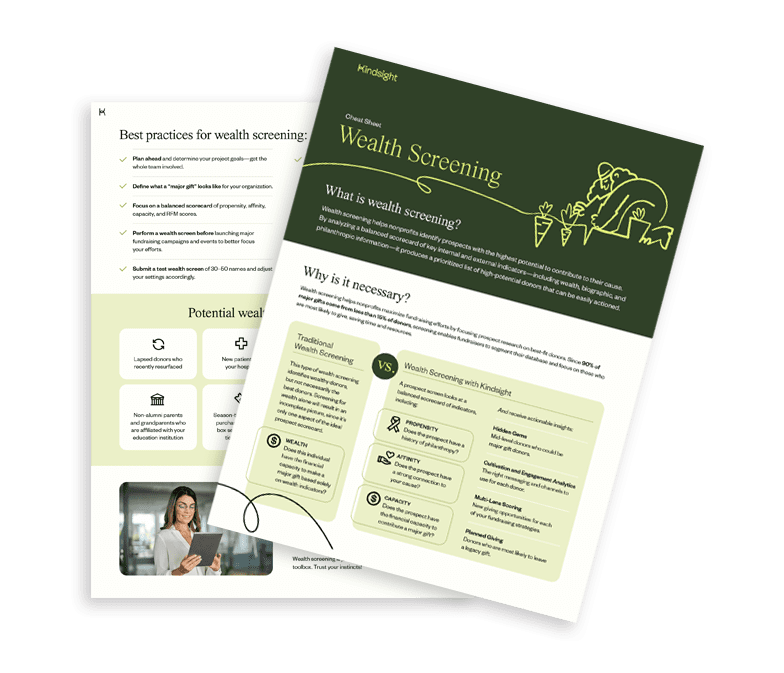
Need to segment your donors?
Wealth screening can help you understand your donors so you can target the right people at the right time.
5. Plan your content
The best email content is planned in advance and designed to help you further your goal(s). Choose a specific goal and audience segment, then plan your campaign.
When planning your campaign, consider:
- Audience segment
- Reason for email
- Type of email
- Template or design
- Subject line(s)
- Main email copy
- Call to action
- Buttons or links
- Images and video content
- Send date
It’s a good idea to keep all your email campaign ideas and notes in one place—whether that’s a spreadsheet or a tool designed for marketing campaign management.
6. Schedule and send
When you’re happy with your email or series of emails, all that’s left is to hit send or schedule. Most email marketing tools allow you to schedule your email for your preferred date and time, and some can even use analytics to automatically suggest the best time to send.
⭐ Tip: Always send a test email to yourself and/or a colleague before you send to your entire database for one final chance to catch typos and broken links.
7. Review analytics
Keep an eye on your email analytics after you send your campaign. It’s useful to review analytics shortly after sending to check for any potential email deliverability issues, and it’s best practice to check in on analytics over time to track campaign performance and identify trends.
The best email marketing platforms for nonprofits
The best email marketing software for your nonprofit is the one that helps you achieve your goals in the most efficient way. Here are some of the most popular choices for nonprofits in 2026:
1. Ascend
Best for personalized, data-backed donor communications
Ascend is Kindsight’s fundraising CRM, which includes built-in email tools like personalized emails, automation, and advanced analytics—as well as integrations with Salesforce Marketing Cloud for more in-depth nonprofit email marketing campaigns. Ascend combines the power of donor data with the ability to create personalized donor experiences.
2. Brevo
Best for integrated marketing campaigns
Brevo is a customer platform that nonprofits can use for email marketing and more—including SMS, WhatsApp, and live chat. It’s an attractive option for nonprofits that want to build consistent email habits and experiment with other types of marketing in one place.
3. MailerLite
Best for drag-and-drop email templates
Mailerlite combines email marketing tools with a website builder, landing pages, signup forms, and digital products. The email marketing feature includes a drag-and-drop editor with content blocks and a library of templates—ideal for teams that want an easy to use email marketing platform.
4. Mailchimp
Best for AI-powered email marketing
Mailchimp is historically known as an email provider, but the platform now also offers SMS, AI-powered marketing, and content creation—making it a popular option for nonprofits that want to combine creativity and automation.
5. Constant Contact
Best for combined email and social media marketing
Constant Contact is an email marketing platform that nonprofits can also use for AI content generation, event marketing, ecommerce marketing, and social media marketing. This email marketing service could be a good match for nonprofits that sell online or want to invest more in social media.
How to choose the right nonprofit email marketing software
Every nonprofit has unique needs, resources, and goals, which is why it’s important to choose the right email marketing platform.
Here’s what to consider as you compare options:
- Features and functionality: Does the software do everything you need it to? Can you customize emails, use list segmentation, and analyze results?
- Customization options: Can you create your own email designs or are you limited to a template library? Can you adjust colors, add your logo, and make everything match your brand?
- Pricing: Is the software within budget? Does the price change depending on how many subscribers you have? Are there hidden costs to consider?
- User experience: Is it an easy to use tool, or will team members find it challenging without support?
- Automations: Can you create automated workflows to move subscribers through an email series?
- List size limitations: Are you limited to a certain number of email subscribers before you need to upgrade your plan?
- Data import and export: Is it easy to move data to and from the software, if you decide to move to another tool in the future?
- Customer support: What support options are available, and is the support highly rated?
Alongside your own research, look at real user reviews to understand what your experience might be like—this can be especially helpful in uncovering potential issues around billing, technical issues, and customer support.
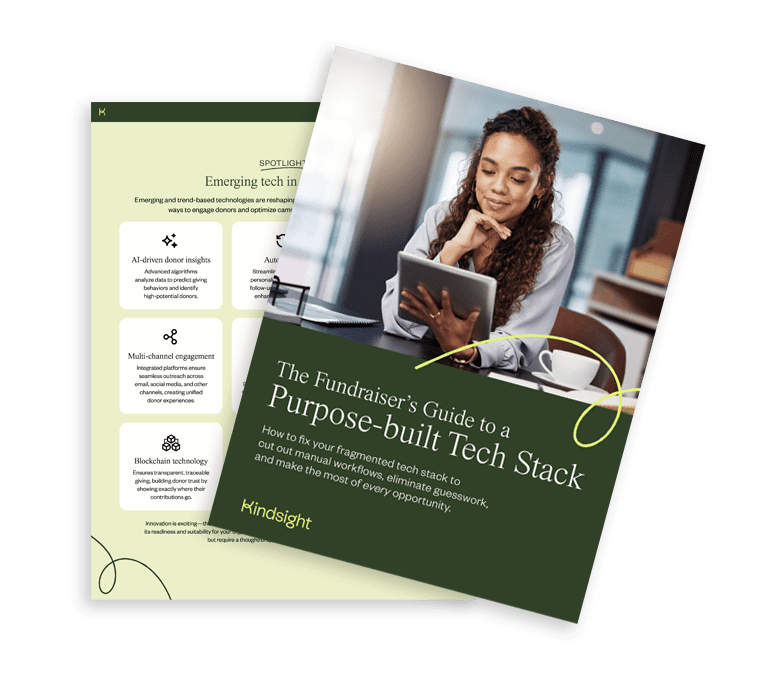
Which fundraising tools are right for you?
Tailor your tech stack to your unique organization. Learn which tools are built with nonprofit work processes in mind.
Nonprofit email marketing best practices
A well-planned strategy and the right software can help, but to really make the most of your campaigns try these nonprofit email marketing best practices:
- Group your audience by demographics and interests: Create audience segments so you can run targeted campaigns.
- Use templates: Save time by using built-in email templates and customize them to match your brand.
- Create compelling content with storytelling: Encourage your supporters to give with heartwarming stories and meaningful impact stories.
- Send emails at the right time: Analyze your emails for the best send time and adopt this schedule.
- Personalize your emails: Include the supporter’s name and any other information that feels relevant.
- Test different subject lines: Try several options and then roll out the one that performs the best—most email marketing software allows you to do run A/B testing. Although it’s popular with direct-to-consumer retail brands, only 35% of nonprofits use emojis in subject lines. Experiment whether your supporters prefer an emoji in your headlines or not.
- Monitor campaign performance: Check your analytics to see what works and adjust your future campaigns based on data and trends.
- Use automation: Create automated welcome emails and let AI take care of manual tasks so you can create better supporter experiences.
- Prioritize mobile responsiveness: Design emails that work just as well on mobile devices as they do on desktop.
- Stay compliant with legislation: Learn how to comply with the CAN-SPAM Act, and research whether any other laws apply if sending emails to international donors.
Use these strategies to help you turn average email marketing ideas into high-performing campaigns that motivate donors to give.
5 Examples of nonprofit email marketing in action
There’s a lot to learn from seasoned nonprofit email marketers. Explore these nonprofit email marketing examples for ideas, inspiration, and tactics you can use for your next campaign.
1. Email newsletter
This email bulletin from The Tracksmith Foundation is a strong example of a first newsletter, with an introduction to the organization from its executive director. The newsletter continues with features on recent articles, products, and a call to action.
Tactic to try: Add a personal greeting from your executive director or a board member at the start of your newsletters to drive engagement.
2. Donation appeal email
Charity Water’s year-end donation appeal email has plenty of elements that make it powerful. With emotive language, an impactful image, and data-backed claims, the content stands out—and that’s before you consider the bonus impact of the donation matching offer.
Tactic to try: Using figures to illustrate the real-world impact of donating.
3. Giving Tuesday campaign email
This Giving Tuesday email campaign from Patagonia combines strong visuals, a clear message, and social proof to create a compelling reason for donors to give to their nonprofit partner, the Conservation Lands Foundation. It’s also a great example of cause marketing in action.
Tactic to try: Highlight donors and sponsors that have already contributed to add social proof.
4. Welcome or awareness email
Rare Beauty’s informative email about their Rare Impact campaign gets the message across in a clear way while highlighting the fund’s mission and vision. Readers are invited to learn more, or to make an individual donation towards the fund.
Tactic to try: Welcome new subscribers with a heartfelt introduction to your mission.
5. Personal impact email
This personal impact snapshot email from the American Red Cross is a wonderful example of how you can illustrate the difference that the recipient has made. It’s a unique way to use the donor data that you have, and it’s easy to create a version based on the different ways that someone can support your organization—like repeat donations or volunteer hours.
Tactic to try: Go beyond basic personalization and use donor data to illustrate impact.
Connect with donors through email marketing and personalized moments
Email marketing allows you to reach donors right in their inbox with tailored campaigns that speak to their unique relationship with you. Use this guide to craft a strategy that drives your work forward by sharing story-led updates, compelling appeal messages, and heartfelt donor stewardship emails.
As you start to plan your email campaigns, consider adding the right software to your toolkit. Kindsight’s tools for nonprofits can help you identify potential donors, nurture long-term relationships, and create seamless giving experiences.
Nonprofit email marketing FAQs
What are some key strategies for nonprofit email marketing?
Key strategies for nonprofit email marketing include donor segmentation, personalized email messaging, story-driven content, and optimized email subject lines.
How do I choose the best nonprofit email marketing software?
To find the best nonprofit email marketing software, consider your goals, needs, resources, and budget. Look for software that’s easy to use, affordable, and has all the features you need—including email templates, automation, and email analytics.
What’s the role of a CRM in nonprofit email marketing?
In email marketing, the CRM is the central database that holds all your donor data, including names, email addresses, donation history, and previous engagement. Your nonprofit CRM should allow you to create donor segments and subscriber lists, then either send emails natively or integrate with another tool for email marketing.
What’s the best free nonprofit email marketing software?
Email marketing software for nonprofits with a free plan include Mailchimp, Brevo, and Mailerlite. These platforms all offer a free plan with limited features, analytics, and a maximum number of subscribers or emails sent per month.
How do I get started with email marketing for nonprofits?
To get started with email marketing, follow our step-by-step guide above. Build an email list, create donor segments, plan and create your content, then schedule or send.

Be the first to read our resources.
The world is changing quickly—and our resources help you stay on top of it all. Sign up to get new insights, success stories, and more, sent right to your inbox.
Explore related resources.
-
Understanding nonprofit burnout and how to prevent it

Post Understanding nonprofit burnout and how to prevent it
Learn what causes nonprofit burnout, how to spot the signs early, and how leaders and fundraisers can prevent it and protect their team and mission.
-
How to turn your fundraising cycle into an upward spiral

Post How to turn your fundraising cycle into an upward spiral
Discover the six stages of the fundraising cycle and how nonprofit fundraisers can turn routine cycles into an upward spiral of donor growth.
-
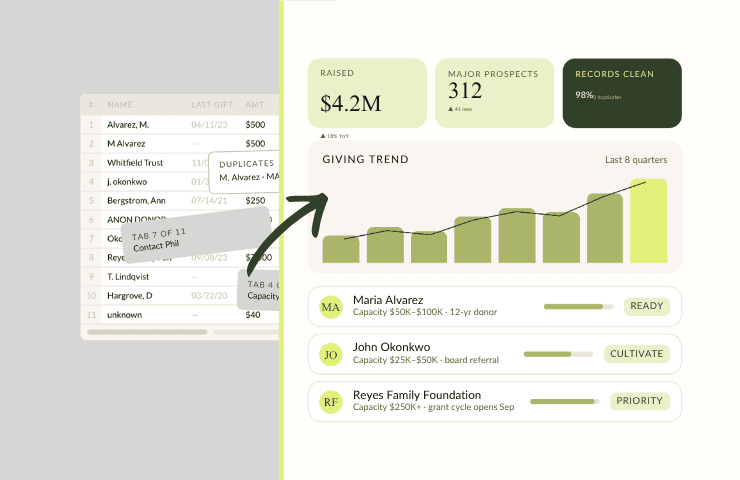
The essentials of donor databases for nonprofits
Post The essentials of donor databases for nonprofits
Discover key CRM features, explore top software options, and find the right solution to boost your fundraising.