


Share Article:


Planning a successful fundraising event is no small task. It requires a dedicated team of staff and volunteers, clear goals, careful coordination, and thoughtful follow-up.
Whether you’re planning your first event or refining a long-standing fundraiser, a fundraising event planning template helps you go from idea to execution while ensuring your efforts are intentional, efficient, and aligned with your broader development goals.
What is a fundraising event planning template?
A fundraising event planning template is a structured framework to guide your organization through every stage of organizing, executing, and evaluating a fundraising event. It provides a centralized place to document key details for your event and, more importantly, helps to connect your efforts to your organization’s strategic objectives.
An event planning template is more than a to-do list. It creates consistency and supports transparency, allowing you to document goals, budgets, timelines, deadlines, staffing needs, and follow-up plans in one place. Over time, your templates become a source for real-time updates as well as a living record of what works, what doesn’t, and how your events evolve to better raise funds for your organization.
A good planning template for nonprofit fundraising events will include:
- Event purpose and fundraising goal
- Audience definition and engagement strategy
- Budget projections and financial controls
- Sponsorship planning
- Marketing and communications timelines
- Task assignments and accountability
- Donor experience considerations
- Post-event stewardship and evaluation metrics
Want to dig deeper on events?
Learn about the trends in special events, the importance of hybrid events and how to execute them, and how to center community in events.
When should you use an event planning template for your fundraising event?
A fundraising event planning template is helpful whether you’re planning a fundraising event for the first time or you’re an experienced fundraising event manager. If your team has ever said, “We raised money, but I don’t know if it was worth it,” or “It worked, but it was exhausting,” a template is a must for your next fundraising event project.
Templates are also helpful for:
- Progress reporting
- Identifying how and when to engage volunteers
- Assigning roles and responsibilities
- Ensuring continuity in planning
Planning templates are useful for every type of fundraising event project, from virtual fundraising events to peer-to-peer fundraising programs to luncheons and galas.
What’s included in a fundraising event planning template?
An effective planning template for fundraising events balances strategic planning with operational logistics. The strategy defines the event’s purpose and desired outcomes, while operations ensure the logistics, systems, and people deliver that experience effectively.
Strategic elements, from event name to audience definition
- Event overview, objectives, and goals: Name your event and define your fundraising target, engagement goals, and any secondary objectives tied to stewardship, cultivation, or education.
- Audience definition: Identify your target audience, noting specific groups or individuals you want to attend, including donors, prospects, sponsors, and community partners.
- Budget planning: Determine your anticipated expenses, revenue targets, and how you expect to hit them (silent auctions, sponsorship, live appeal, etc). Include contingency plans if anything costs more than expected, including how decisions are made when you go over budget.
- Roles and responsibilities: Assign overall ownership of the event as well as the different tasks needed to make the event successful. Track staff, volunteers, and vendors, including contact information and deliverables.
- Timeline: Work backward from your event date to define planning milestones, marketing schedules, and outreach timelines.
- Marketing and promotion: Outline your event marketing campaign strategy, incorporating email campaigns, social media outreach, direct invitations, and any media or community engagement.
- Sponsorship strategy: Define sponsorship levels, benefits, prospect lists, and outreach tracking. See how to ask for sponsorship for your fundraising event and how to write a sponsorship letter for tips!
- Post-event activity: Identify key activities needed to close out the event, including stewardship, donor relations, attendee follow-up, and a post-event evaluation plan to capture feedback from staff, volunteers, and even attendees.
Planning your strategy first sets the stage for the overall event, giving it direction and alignment before you even consider details like tablecloths and music.
Operational elements, from space planning to volunteer coordination
- Expense and income tracking: Track your expenses, revenue, and sponsorship income as they come in, comparing your actual numbers to your projections.
- Venue and space planning: Note every detail of the space or location, including contacts, contract information, capacity limits, room layout, and when you have access for setup, breakdown, and the event itself.
- Vendor management: Identify vendors needed for catering, audio-visual, rentals, photography and videography, and decor. Track who is providing what, when, and how to contact them.
- Registration and guest flow: Define your platforms for ticket sales or registration, check-in process, walk-up procedures, and overall guest experience from arrival to departure.
- Run of show: Create a detailed event schedule outlining timing, transitions, speakers, entertainment, and fundraising moments.
- Donation infrastructure: Document how donations will be collected (whether you use an online donation software or take cash and checks), how gifts will be tracked, and how donor data will flow into your CRM.
- Staff and volunteer coordination: Assign roles, confirm schedules, define communication plans, and establish expectations for dress and conduct.
- Supplies and materials: Identify all materials needed, from signage and programs to power cords and basic office supplies.
- Contingency planning: Even with the best planning, some things are simply out of your control. Prepare for all potential issues, including bad weather, medical emergencies, technology failures, and other risks.
- Breakdown and closeout: Plan vendor departures and payments, equipment returns, recording and depositing donations, financial reconciliation, and final venue walkthroughs, including who will stay to see it through.
These event details are the heart of a well-executed event, and help to shape the experience of the event for your guests, staff, and volunteers.
How to plan your next fundraising event project
A fundraising event planning template is most effective when paired with a clear event timeline, often starting three to four months before your event. Large or complex events may require more lead time, but will follow the same chronological steps from start to finish.
Fundraising event timeline
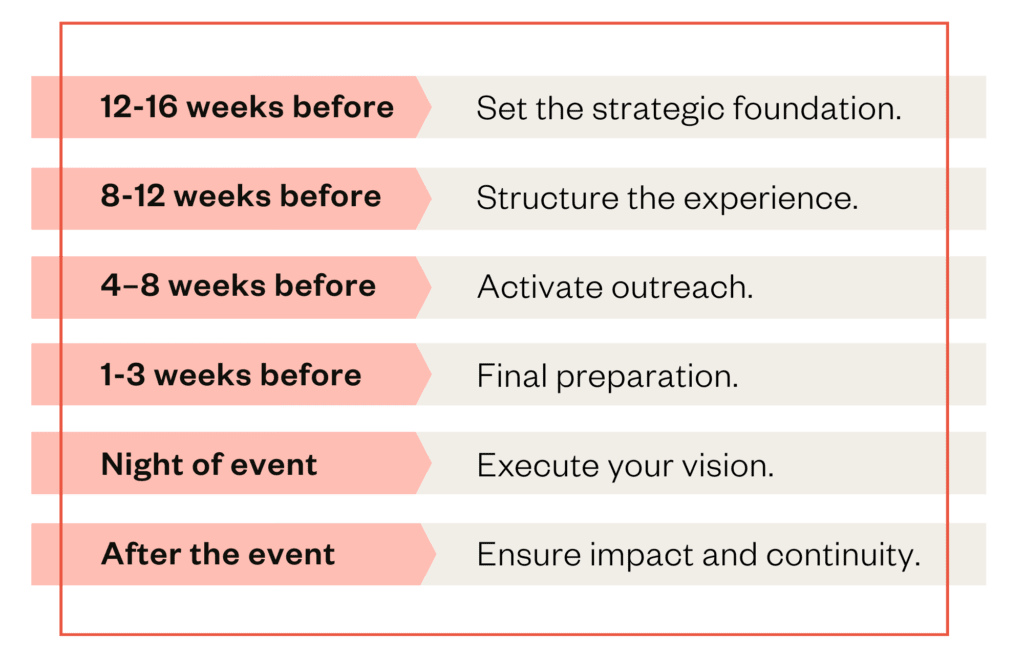
- 12-16 weeks before: set the strategic foundation for your event. Your earliest event planning conversations should launch with high-level, establishing the event name, purpose, goals, format, audience, and budget. Assign an event owner, identify potential venues, set deadlines, and draft a preliminary run of show to guide future planning.
- 8-12 weeks before: structure the experience and build momentum. Once you lay the strategic groundwork for your event, your planning starts to build momentum. Now is the time to finalize messaging, sponsorship strategy, and donation approach. Secure the location, contract vendors and entertainment, select your registration platform, and outline your donation infrastructure.
- 4–8 weeks before: activate outreach. One to two months before the event, your sponsor and donor outreach should be well underway, with sponsorship sales coming in. Sponsorships and lead gifts help to create momentum for the event and encourage other people to join. At the same time, open registration, confirm room layout, test giving tools, and refine the run of show.
- 1-3 weeks before the event: final preparation. The last few weeks are the perfect time to put the finishing touches on your event. Finalize appeal language, stewardship plans, vendor schedules, volunteer assignments, materials, and contingency plans. Conduct technical checks and rehearsals.
- Night of event: execute your vision. It’s finally time to see all of your hard work come to fruition. Use your template as a command center to guide execution, manage logistics, and protect the donor experience.
- After the event: ensure impact and continuity. The work doesn’t stop when the final guest leaves, and a successful event doesn’t just depend on what happens in the room. Your post-event work closes out the current event while building relationships with donors, attendees, vendors to help support future events. Send thank-yous within 48 hours (known as the “golden window”), process gifts, close vendor payments, evaluate ROI, and document lessons learned.
An event planning template helps you align your strategy and operations to this timeline, ensuring that every element of your event planning process happens right on time.
Tips for using an event planning template
Here are some tips to use a planning template effectively for your next fundraising event:
- Treat it as a strategic document, not a task list
- Customize your template for each event.
- Assign a single owner to manage and update the template throughout planning.
- Integrate key template tasks and outreach with your CRM.
- Track donor movement, not just revenue, to get a high-level overview of your prospects.
- Review and refine the template after every event.
Common fundraising event pitfalls and how to avoid them
Planning a successful fundraising event isn’t easy. Here are some of the most common mistakes that fundraising managers and event planners make, and how to avoid them, using your fundraising event planning template as a guide:
| Pitfall | How to Avoid It |
| Lack of clear goals and objectives. | Define success before planning begins, with SMART goals. Not only will clear goals guide your planning and align your team, but they’re critical in communicating the event’s purpose to prospective sponsors and donors. |
| Forgetting about the donor experience. | Table placement, extension cords, and catering are all critical for a well-planned event. But consider your donor experience beyond the logistics. How does the space and the structure make them feel from the moment they walk through the door? |
| Neglecting to plan for after the event. | Stewardship is a critical element of event planning, because it sets your organization up for future fundraising and event success. Build stewardship into your template from the beginning, treating it as a central part of the event, not an afterthought. |
| Underestimating costs. | The costs of an event can easily start to creep beyond the initial budget. Include a contingency buffer for unexpected expenses—and determine how to make decisions when compromise is needed. |
| Underestimating the risks. | Bad weather, medical emergencies, and technical issues can all happen. Make sure you and your team are prepared for the worst. |
| Treating each event as a one-time occurrence. | Whether you have one successful event under your belt or hundreds, there’s no reason to reinvent the wheel every time. Templates help to create institutional memory, supporting consistency and streamlining the processes of your events. |
| Not capturing attendee and donor information at the event. | Your attendees and donors are key to a successful fundraising event—and to the success of your organization in general. Don’t just collect their money, but make sure you get contact information as well, then get that information off of an Excel spreadsheet and into your fundraising CRM for effective stewardship and future cultivation. |
Fundraising event planning template (PDF)
To support your planning, we’ve created a free Fundraising Event Planning Template (PDF) that helps your team move from concept to execution with clarity and confidence.
This template is designed to:
- Align events with your organizational fundraising strategy
- Centralize planning in one place
- Improve accountability
- Strengthen donor stewardship
- Make events repeatable and scalable
How to use this template
To use the Fundraising Event Planning Template effectively:
- Work through each section, checking off or writing the details of your event.
- Share the full template or pieces with your events committee, area leads, etc.
- Refer to the template for progress reporting, day-of-event operations, and post-event evaluations.
[Download the Fundraising Event Planning Template (PDF)]
FAQs
What makes a planning template effective for fundraising events?
A fundraising event planning template not only helps you coordinate the logistics of the event, but also connects its execution to donor engagement, data, and long-term strategy.
Can small nonprofits use a fundraising event planning template?
Absolutely. A template is especially valuable when resources are limited, helping your organization to stay on track and align efforts with your organizational goals.
Should every event use the same template?
While the core of a fundraising event planning template will likely be the same for every event, customization is key based on your event type and goals. Consistency improves efficiency and reporting.
Is a fundraising event planning template better than project management software?
An event planning template and project management software should complement each other. The template defines strategy and helps you envision the tasks necessary to execute your event; your software helps to transparently manage those tasks. Many organizations also use their CRM as another essential tool for event planning.

Be the first to read our resources.
The world is changing quickly—and our resources help you stay on top of it all. Sign up to get new insights, success stories, and more, sent right to your inbox.
Explore related resources.
-
Understanding nonprofit burnout and how to prevent it

Post Understanding nonprofit burnout and how to prevent it
Learn what causes nonprofit burnout, how to spot the signs early, and how leaders and fundraisers can prevent it and protect their team and mission.
-
The essentials of donor databases for nonprofits
Post The essentials of donor databases for nonprofits
Discover key CRM features, explore top software options, and find the right solution to boost your fundraising.
-
KindCon Partner Spotlight: Driving real impact with Attain Partners

Post KindCon Partner Spotlight: Driving real impact with Attain Partners
Learn how to calculate the most important fundraising metrics, boost retention, and turn data into real donor growth.