


Share Article:


Peer-to-peer fundraisers and crowdfunding both involve raising money for a good cause, and using the power of people to make it happen—just in slightly different ways. But when it comes to peer-to-peer fundraising vs. crowdfunding, is there a clear winner? Which one should you choose?
Dive into the world of crowdfunding campaigns and peer-to-peer fundraisers and learn what they are, how they work, and when to choose one over the other.
What is peer-to-peer fundraising, and how does it work?
Peer-to-peer fundraisers allow individuals and teams to collect donations from their personal connections on behalf of a nonprofit organization. Instead of sharing a generic campaign page and asking friends to donate, donors can instead create and share their own personalized page.
For a P2P campaign, you’ll set up a main campaign hub page, then invite others to establish their own fundraising pages. Donors can then customize their personal fundraising page and use it to fundraise for you.
Donations made to a peer-to-peer fundraising page all end up with you eventually, but this type of fundraising campaign allows you to easily see who has raised what. Some organizations host team fundraisers in this format, which is a great way to use people’s competitive spirit to raise money for a good cause.
To decide which supporters would be a good fit to raise funds for you, use donor prospect research software. It helps remove the guesswork and allows you to easily identify the best donors for any opportunity.
How nonprofits use peer-to-peer fundraising
This type of fundraiser gives nonprofits easier access to their supporters’ personal networks—opening up the route to more donations towards their fundraising goal. Nonprofits typically use peer-to-peer campaigns to raise money for a specific fundraising event, project, or program.
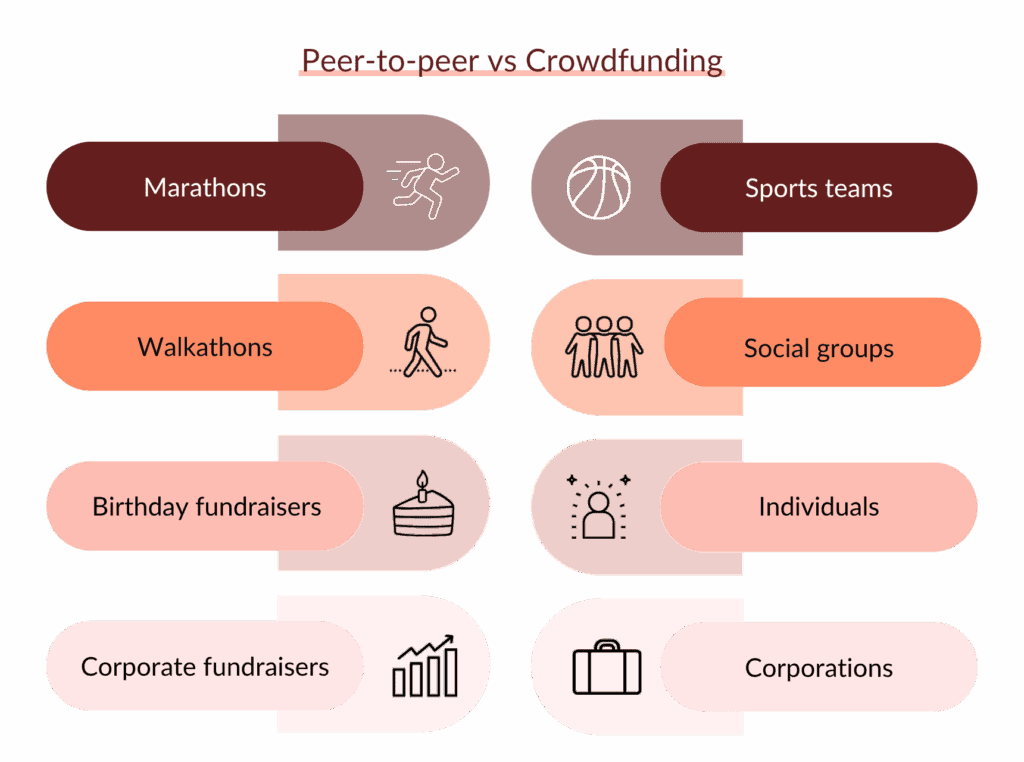
Peer-to-peer fundraising is a popular way to raise money for:
- Marathons
- Walkathons
- Birthday fundraisers
- Corporate fundraisers
Different groups of people organize and take part in P2P fundraisers, but they’re commonly used by:
- Sports teams
- Social groups
- Individuals
- Corporations
These peer-to-peer fundraising ideas are successful because your donors can tell their own personal stories, then invite their friends, family members, and coworkers to give to a cause they care about. Lean into this emotional side and consider our best peer-to-peer fundraising tips if you decide to plan a campaign.
What is crowdfunding?
Crowdfunding is similar to peer-to-peer fundraisers, but with this campaign type you run the entire operation and there’s just one single donation page. Instead of relying on your donors to spread the word and raise money, your target is to “viral” and attract a large enough crowd of donors that you can reach your fundraising goal.
Crowdfunded campaigns involve a beneficiary (that’s you), a deadline, and a target. To be successful, you need to raise enough money to hit your goal before the time runs out—so it’s down to your fundraising team to create interest and motivate donors to give to your online crowdfunding page.
To encourage people to give, crowdfunding campaigns usually offer rewards or perks to donors that scale as the donation size grows—like exclusive apparel or VIP event tickets. When you compare peer-to-peer fundraising vs. crowdfunding in this regard, you’ll need to set aside a larger budget for incentives and marketing.
How nonprofits use crowdfunding
Most of us are familiar with crowdfunding for individuals or startups, but they can also be a useful vehicle for nonprofit fundraising too. Managed correctly, a crowdfunding campaign can help nonprofits reach a bigger audience—leading to not just financial contributions but ongoing support.
Crowdfunding campaigns are popular for:
- Capital projects
- Nonprofit merch or special editions
- Annual fundraisers
- Major environmental or social projects
Campaigns like this are typically run by:
- Community groups
- Universities or colleges
- National or international nonprofit organizations
- Humanitarian aid organizations
Crowdfunding campaigns work best when used to raise a lot of money quickly—for example to support disaster relief or the building of a new school. Large nonprofits tend to see more success with crowdfunding thanks to name recognition, but they can also be used by local organizations to raise funds for their community.
5 key differences between crowdfunding campaigns and peer-to-peer fundraisers
If you want to raise money at scale, it’s definitely worth considering crowdfunding or peer-to-peer campaigns. But what’s the difference between the two? Here are some of the major ways these two fundraising methods differ.
1. Fundraising from individuals vs. networks
Crowdfunding involves raising small donations from lots of individuals, which can be challenging if you don’t already have a group of loyal supporters. You’ll need to rely on your name, reputation, campaign, and ability to promote it effectively.
Compare this to peer-to-peer fundraising, where you essentially onboard individual fundraisers or teams to raise money on your behalf. They then tap into their own personal networks, giving you access to warmer potential donors.
2. One-off vs. ongoing campaigns
If you’re planning a one-off or time-limited fundraising campaign, crowdfunding offers an attractive way to raise funds quickly. People are used to seeing crowdfunding campaigns for urgent needs, so they’re familiar with making a small contribution straight away.
Peer-to-peer fundraisers are better for longer-term efforts. If you set up an initial campaign hub, you could allow people to sign up to fundraise for you throughout the year—making it easy for people to launch a birthday or anniversary fundraiser that benefits you.
3. Pressure to meet a target vs. desire to raise any amount
Crowdfunding campaigns have a financial target to hit and a deadline to match, and the funding relies on it. If you don’t reach your goal before the deadline ends, you don’t get to access the funds—which can create a lot of extra pressure.
With peer-to-peer fundraising, there’s no hard fundraising deadline or target. You can set one, but you’re not left with zero funds if you aren’t able to meet or exceed your goal. When comparing peer-to-peer fundraising vs. crowdfunding, P2P wins if you want a lower risk option.
4. Collecting donations in one place vs. many
Your crowdfunding campaign has one online donation page, and that’s where you’ll direct everyone to make a contribution. You don’t need to figure out how to set up a hub or guide others on how to create their own donation pages.
Peer-to-peer fundraising campaigns allow donors to set up their own individual fundraising pages, so they can raise awareness and funds. All contributions end up with you eventually, but it means there are multiple touchpoints where potential donors can find out about you and make a donation.
5. Promoting one campaign vs. asking others to promote on your behalf
As the sole promoter of the crowdfunder, you have complete control (and responsibility) for getting the message out to as many people as possible. For some nonprofits, this is a positive, as they can make sure all the messaging matches their values and goals.
With a peer-to-peer fundraiser, you rely on others to promote your cause for you. This means you can reduce the time and energy spent on promotion, but it should instead be directed to supporting your donors so they can make their donation pages as engaging as possible.
How to choose between the two
Peer-to-peer fundraising and crowdfunding are both useful in their own way, but there’s likely to be one that’s a better match for your needs right now. To find the right option, ask yourself these questions:
- What’s our fundraising goal?
- Do we need to solicit donations for a specific project?
- How urgent is the need?
- Is our community engaged and ready to raise funds for us?
- Do we have enough resources in-house to host a crowdfunding campaign?
- Can we support donors to raise funds on our behalf?
- Do we want to be in complete control of the campaign?
- Do we have an online platform we can use for peer-to-peer campaigns?
- Is there a crowdfunding platform we are happy to use?
The answers will help you to figure out whether it’s crowdfunding or peer-to-peer that’s the best fit for your campaign.
Choose peer-to-peer fundraising if you:
- Have a large or engaged audience of supporters
- Can invest resources in supporting your donors to fundraise for you
- Want to create a team competition
- Are raising funds for an ongoing campaign
Choose crowdfunding if you:
- Don’t have a pre-existing base of donors or volunteers you can count on
- Want to retain more control over your fundraising efforts
- Prefer to raise funds from individuals and major donors
- Are raising funds for a one-off, urgent, or capital project
In general, crowdfunding can be high risk and high reward, while peer-to-peer fundraising could be a long-term vehicle for smaller donations.
Successful online fundraising relies on good relationships
When you compare peer-to-peer fundraising vs. crowdfunding, it’s clear that both have their strengths, but there’ll be one that’s a better match for this specific campaign. Weigh up the benefits of both, and consider if your team is ready to roll out a viral-ready crowdfunder or manage a more steady P2P fundraiser.
Whatever your fundraising strategy and campaign choice, strong donor relationships will make or break your campaign. Focus on donor stewardship from the start to build relationships you can rely on in the future, and invest in tools like our fundraising CRM to make donor engagement effortless.
Looking for alternative ways to fundraise?
Our ebook shows you how to step outside the box and use alternative ways to fundraise when traditional methods aren’t giving you the outcomes you need.

Be the first to read our resources.
The world is changing quickly—and our resources help you stay on top of it all. Sign up to get new insights, success stories, and more, sent right to your inbox.
Explore related resources.
-
How to create an effective nonprofit social media strategy

Post How to create an effective nonprofit social media strategy
Learn the 8 steps to a better nonprofit social media strategy. Reach more donors, recruit volunteers, and grow your community in 2026.
-
40 peer-to-peer fundraising ideas to energize your supporters and expand your impact

Post 40 peer-to-peer fundraising ideas to energize your supporters and expand your impact
Peer-to-peer (P2P) fundraising is one of the most effective ways to activate your community and expand your nonprofit’s reach. By...
-
13 essential peer-to-peer fundraising tips

Post 13 essential peer-to-peer fundraising tips
Learn actionable peer-to-peer fundraising tips to engage supporters, amplify your reach, and achieve your nonprofit's goals.