


Share Article:


As every nonprofit knows, major gift fundraising isn’t easy—and the work that goes into getting it right takes time.
Fortunately, a good prospect management strategy saves you time and effort in the long run. It’s a strategic way to lay the groundwork for human-centric relationship building, so you can channel your efforts where they matter most.
Below, we’ll explore the three phases of prospect development—along with the best practices and strategies to maximize your chance of winning those all-important high-ticket donations, at every stage of the prospect management pipeline.
What is prospect management?
Prospect management is the process of planning and tracking relationships with your most significant donors—from identifying likely candidates, to securing a major gift, to practicing effective donor stewardship and retaining support after a large gift is given.
Prospect management can be broken down even further into these three steps:

- Prospect research: Determining your most likely candidates for major giving based on wealth, philanthropic, and affinity indicators.
- Portfolio management: Organizing your data, determining, and recording next steps.
- Relationship management: Recording updates, or “moves” (any interaction that takes you one step closer to securing your major gift), and nurturing relationships (this is known as moves management).
Typically, prospect management is owned by your nonprofit’s Chief Development Officer or other development professionals within your nonprofit.
What does it take to go from prospect to major donor?
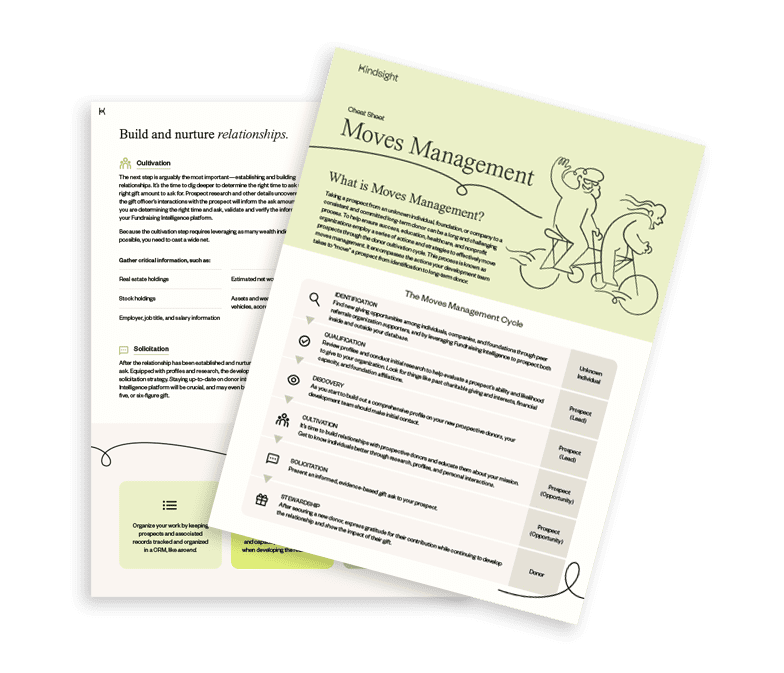
Our guide shows you the strategies and tactics you need to effectively move prospects through the donor cultivation cycle.
Why is prospect management important?
Tempted to play it by ear when it comes to securing high-ticket donors? We get it. But when you’ve researched your prospect’s interests and capacity ahead of time, you’ll be far more likely to succeed.
With proper prospect management, your ask will be based on data and a strong foundation—not just a hunch that the timing is right. Plus, you can make a more thoughtful, personalized ask based on what you’ve learned about your prospect’s priorities.
With a sound prospect management strategy in place, you can look forward to:
- Optimizing your existing supporter relationships
- Allocating your time and resources more effectively
- Discovering new potential donors
- Crafting tailored high-ticket donor communications that resonate and succeed
- Keeping accountable to your goals
Stage one: Prospect research
Thorough prospect research is at the core of any strong prospect management strategy. During this stage, you’ll be identifying your potential major donors. This process can be expedited with robust donor prospect research software, which does some of the more manual work for you, so you can focus on analysing the data instead of collecting all of it.
There are three main indicators that someone is a viable candidate to move forward for prospect development:
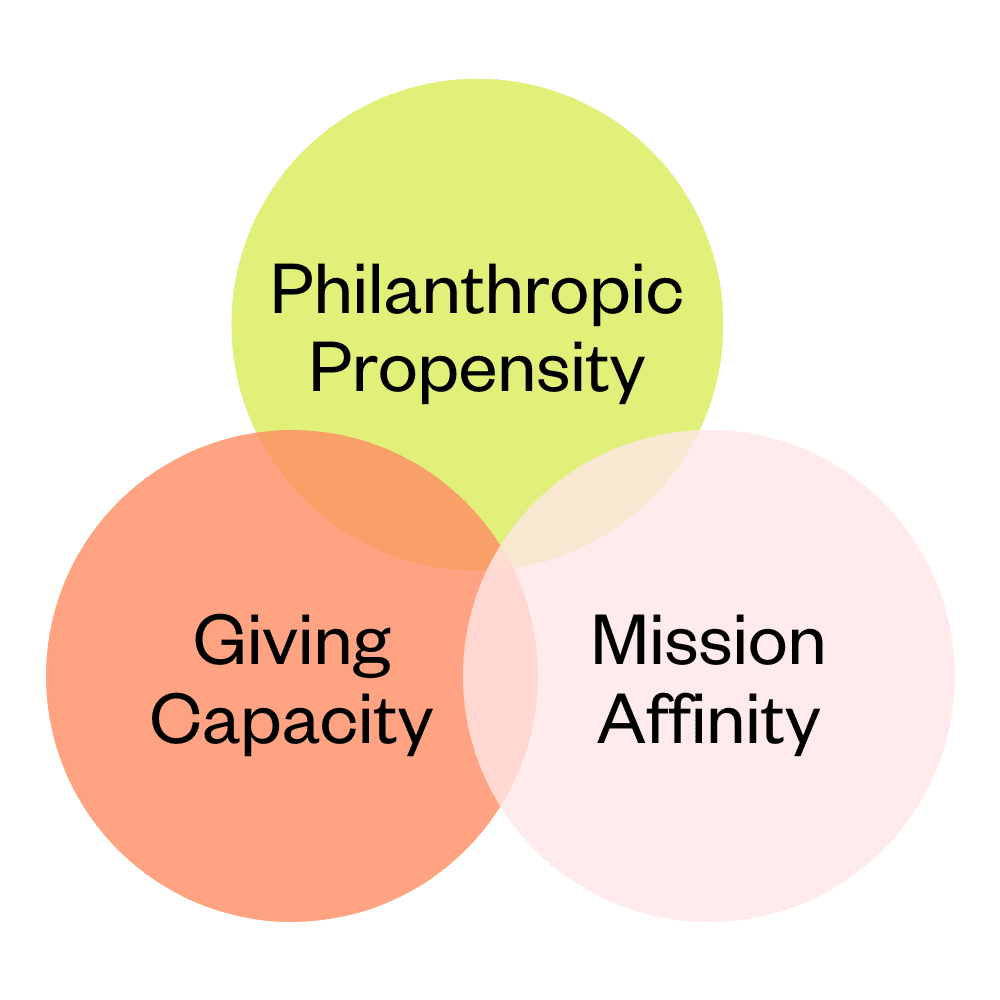
- Wealth indicators: Also known as capacity indicators, wealth indicators signal that someone has the financial means to make a large donation. This may include employer information, homeownership status, business affiliations, or a history of significant political giving.
- Philanthropic indicators: This is the evidence that someone has an interest in giving to charitable organizations. Philanthropic indicators may include donations to your nonprofit or other nonprofits, or serving on the board of a charitable organization.
- Affinity indicators: Also known as warm indicators, affinity indicators show that someone has an interest in your specific mission. They may have attended an event, made recurring donations, or have a history of volunteering with similar organizations.
Top prospects show all three of these indicators.
If you’re looking to secure a significant gift, affinity indicators can get quite specific. For example, a high-ticket donor may only be willing to give if their funds go towards a specific program or capital campaign that aligns with their interests and philanthropic priorities. Take this into account as you plan your ask.
Internal & external prospect research
Many nonprofits start their prospect research by looking to their existing support base—after all, this group has already shown affinity for your mission. It’s a great place to start. Committed mid-tier recurring givers, for example, are often excellent candidates for prospect management.
Looking for prospects externally can be more challenging, but it does lead to the discovery of new potential donors. If you go this route, make sure you also have access to your prospect—perhaps through your board members, friends, religious groups, or alumni associations.
Once you’ve identified prospects, it’s time to move on to the donor qualification stage.
Donor qualification
During the donor qualification stage, dig a bit deeper to determine if the prospects you’ve identified is worth pursuing. Review each of your prospects, and ask yourself the following questions:
- Is there a reason to give? Someone is unlikely to give a large amount unless they have a very personal connection to your cause.
- Do they actually have the means? Look deeper than superficial wealth indicators—someone living in a wealthy neighborhood may also have significant debt, for example.
- Is the timing right? Consider what’s going on in your prospect’s life. If they’re sending a child to college or remodeling their house, for example, it may not be the right time to make an ask.
- Do they want to hear from you? Someone who has never expressed an interest in hearing from you is unlikely to pick up your call.
Some nonprofits fall into the (understandable) trap of putting too emphasis on wealth indicators. But effective prospect management is not just determining if someone can give—it’s also about determining why they would give, and if the timing is right.
Prospect research tools:
You’ll need the right prospect research tools to conduct thorough research. These vary from specialized wealth screening tools to freely available public records or social media platforms, like LinkedIn.
Try collecting data on your potential donors using the following tools and methods:
- Public records: Review publicly available information such as real estate, stocks, or employment records.
- Integrated platforms: Some companies offer special tools that pull prospect data, such as life events or political giving, from a wide range of sources.
- FEC and NEC filings: These filings provide information on investments and political giving, and can help you determine your donor capacity.
- Social media or websites: LinkedIn and other online social platforms can be an effective, low-cost way to gather data points on your prospects. Websites like Zillow can provide valuable insights into real estate and wealth.
Stage two: Prospect portfolio management
During the prospect portfolio management stage, you’ll organize the information you’ve gathered on your prospects, set goals, and determine your next steps.
Segment and prioritize prospects
Prioritize your donors based on how likely it is that you’ll convert them to a high-ticket donor. Prioritize your donors based on how likely it is that you’ll convert them to a high-ticket donor. Donor engagement should be divided into these categories:
- Top priority prospects: These are the prospects most likely to give the largest gifts. They have high capacity and high engagement metrics. Engage this group with one-on-one meetings, personalized tours, or other types of communication that convey a deep interest in their priorities.
- Mid-priority prospects: These prospects typically show higher giving capacity, but lower engagement. Emails, phone calls, or personalized event invitations may be most appropriate for this group.
- Lower-priority prospects: Your lower-priority prospects typically show fewer wealth indicators, but higher engagement levels with your organization. Reach these supporters with impact reporting and personalized emails, or highlight your recurring giving program.
Determine goals
Create a portfolio for each of your prospects, and set a giving goal (also called gift expectancy) based on their capacity. You can change this goal as you gather more information, but you should always aim to maximize the potential of each one of your giving prospects.
Build prospect portfolios
Once you’ve determined your goals and priorities, start collecting data in individual prospect portfolios. Then, you can begin moving your prospect through each stage of the donor pipeline (we’ve outlined these stages in the section below).
Include the following information in each of your donor portfolios:
- Name
- Gift expectancy
- Connection to your organization
- Significant life updates
- Affinity indicators
- Wealth indicators
- Philanthropic indicators
- Donor pipeline status
- Next steps
Donor portfolios should be a living document. Update them regularly as you move your prospects through each stage of the donor management pipeline.
If you want your profiles to be continuously in real-time, try live profiles.
Record any actions that bring your prospect one step closer to becoming a donor—maybe you’ve connected with them at an event, asked for advice on a specific program, or learned something new about their personal investment in your mission.
Wish it were easier to keep your profiles up-to-date?
With iWave’s live profiles, donor profiles are automatically maintained, and real-time alerts are sent to you when meaningful data is updated.

Stage three: Relationship management
It’s time to lay the groundwork for your monetary ask. During this stage, nonprofits systematically and strategically move prospects through each stage of the donor pipeline.
The stages of the donor pipeline below correspond with the stages of relationship building:
- Prospect discovery: The earliest stage of prospect management—you’ve established that someone is a strong prospect for major giving, but haven’t yet contacted them.
- Early-cultivation: Initial contact has been made.
- Mid-cultivation: You’ve been in touch several times, and the relationship is developing (this is often the longest stage in the donor pipeline).
- Solicitation: A strong relationship has been established, and you’re confident that making an ask won’t badly impact your relationship.
- Proposal: You’ve made a tailored ask to your donor and are waiting for a response.
- Donor stewardship: This is the time to nurture a relationship—you’ve already received a donation, but it’s too early to request another one.
Determine how long you intend to spend on each stage, and keep track of how long your prospects stay in each stage. If you see they’ve spent too long in one stage (for example, they’ve spent a year in mid-cultivation when you planned for six months), you could either move them on or consider lowering your gift expectation.
Prospect management best practices
Regardless of your mission, the size of your nonprofit, number of potential donors, or overall fundraising goals, the best practices below will improve your chances of success at every step of the prospect management process:
- Train your fundraising team
Typically, prospect management is owned by a nonprofit’s major gift officer or someone on your development team—but that doesn’t mean you can’t provide structured training guides to other members of your fundraising team.
Update and refresh your training throughout the year, and offer training on how to conduct independent prospect research. When everyone understands the special work that goes into securing major donors, they can engage with your prospects appropriately and help keep track of any significant moments.
- Get the timing right
There’s no two ways about it: Starting up your prospect management process takes time, effort, and resources—but the payoffs are worth it. If possible, mitigate some of these challenges by implementing your prospect management system during a quieter time of year.
Once you’ve got your prospect management pipeline up and running, keep recording your interactions. You should view prospect management as an ongoing process, not a “one-and-done” task.
- Organize your donor database
This is the ideal time to clean up your donor database by deleting duplicate profiles. Update any outdated contact information and remove lapsed donors from your fundraising CRM or donor database. This way, you’ll know your prospective donor is current and relevant before you begin.
- Personalize outreach
Craft your communications so they align with the prospect’s interests and giving capacity. You could highlight giving impact at different levels, for example, offer exclusive opportunities for high-level donors based on their interests, or share success stories from donors of different giving tiers.
Plus, one of the major advantages of prospect management is that by the time you’re ready to make an ask, you’ve already gathered the necessary information for crafting a proposal that resonates.
- Focus on human connection
Prospect management is a behind-the-scenes strategic framework for relationship building—but the goal is always to help nonprofits form genuine, human connections.
Get to know your prospects—including their interests, background, and what drew them to your nonprofit or mission in the first place. The more you express genuine interest, the deeper and more long-lasting your connection will be.
- Implement a code of ethics
Personal data usage is a sensitive topic. Evaluate your own code of ethics beforehand, and make it available on your website. To maintain trust in your nonprofit, be transparent about how you’re using donor data.
Be sure to practice proper due diligence to ensure your major gift prospect is aligned with your mission and values in their own lives—this way, you’ll protect your nonprofit from potential harm.
- Keep track, review, and adapt
Prospect management is an ongoing process. Once you’ve gone through the cycle a few times, review and adapt. While the prospect management process makes things as strategic as possible, there’s always some flexibility and adaptation required for successful donor relationship building.
With the right tools, know-how, and prospect management best practices up your sleeve, you can look forward to discovering new donors, removing the guesswork from major giving campaigns, and developing meaningful relationships with your highest financial capacity supporters—bringing you that much closer to meeting your fundraising goals.

Be the first to read our resources.
The world is changing quickly—and our resources help you stay on top of it all. Sign up to get new insights, success stories, and more, sent right to your inbox.
Explore related resources.
-
How to build actionable donor lists for nonprofits

Post How to build actionable donor lists for nonprofits
Donor lists for nonprofits are the secret to smarter fundraising. Learn how to build, segment, and score your donor data to maximize your impact.
-
Donor Acquisition: A proven strategy for nonprofits

Post Donor Acquisition: A proven strategy for nonprofits
Nonprofits need new donors to grow, but acquisition is one of the hardest and most expensive parts of fundraising. Rising...
-
How to find donors for a nonprofit: 9 expert tactics

Post How to find donors for a nonprofit: 9 expert tactics
Fundraisers often ask: how to find donors for a nonprofit? We went to the experts for the answer.