


Share Article:


Peer-to-peer fundraising, or team fundraising, is an essential strategy that every nonprofit should harness. This approach echoes the phenomenon described 60 years ago by Harold (“Si”) Seymour in his groundbreaking work “Designs for Fund-Raising” (1966):
“People seldom give serious sums without being directly asked to do so. And this goes even for trustees and all others at the very heart of causes. They give because people at their own or a higher level ask them to give [emphasis added]—usually more thoughtfully when asked with good reasons, more proportionately when the giving requirements are explained, and the worker [volunteer] himself has helped set the standards, and more regularly and dependably when the contact is personal and influential.”
This principle forms the foundation of modern peer-to-peer (“P2P”) fundraising. Technology empowers core volunteers and donors to ask their personal networks to support your mission.
This is the core of peer-to-peer fundraising (shortened to “P2P”).
P2P fundraising succeeds because it leverages the cognitive bias known as “social proof.” We make decisions based on what we see other people doing because we want to feel like we belong. This is why it’s often more beneficial to have a community member or fellow donor serve as a solicitor or letter signer than a big-name celebrity or person with a fancy title.
The P2P strategy delivers a low-cost, highly effective way for nonprofit organizations to fundraise. Participants tap directly into their own networks, ensuring new people will hear about your cause for the first time through someone they know and trust.
Understanding peer-to-peer fundraising, available software tools, and best practices will enable your organization to harness this strategy effectively.
What is peer-to-peer fundraising?
Peer-to-peer fundraising recruits supporters close to your organization to run personal campaigns for your nonprofit. Fundraisers share these appeals with their network of colleagues, friends, and family, usually via social media and email.
Dedicated tech platforms streamline and support P2P campaigns. These tools provide individual fundraising pages for each volunteer, along with customized email templates and social media posts to help them publicize the campaign. Many of the platforms also allow any visitor to create their own fundraiser.
P2P is a fantastic way to engage key volunteers and your community in fundraising and advocacy. Done well, these campaigns deliver exceptional fundraising and advocacy results.
Want to hear more from T. Clay Buck?
Check out his Ultimate Guide to Data-led Fundraising! See how to turn connections into action (and learn to love data along the way).
How does peer-to-peer fundraising work?
Peer-to-peer fundraising empowers individual supporters to raise money from their personal networks on behalf of a nonprofit. This takes several forms, often involving a central event to engage the community.
Sometimes campaigns aren’t associated with a particular event or pledge, but are there to honor a person or milestone instead. For example, Facebook users frequently set up fundraising pages for their birthdays, or raise funds in memory of someone who recently passed away.
This type of fundraising generally has a great return on investment for nonprofits. Peer-to-peer fundraising statistics show that you reach wider audiences and generate more donations over time as repeat supporters return for annual fundraisers.
Peer-to-peer fundraising vs crowdfunding
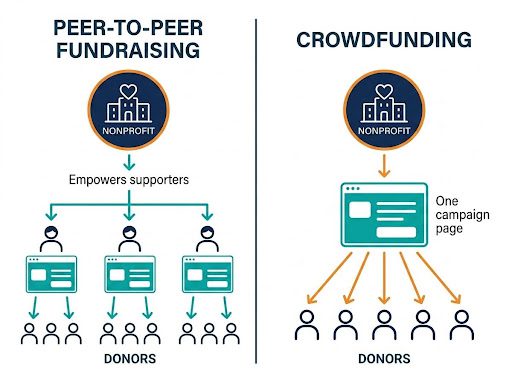
The main distinction in peer-to-peer fundraising vs. crowdfunding comes down to who makes the ask. Crowdfunding uses a single page on which a nonprofit solicits donations directly from the public. Peer-to-peer fundraising empowers supporters to create individual pages and collect donations from their own networks.
Peer-to-peer campaign types with real-world examples
Nonprofits structure peer-to-peer campaigns around three primary modes based on timeline, structure, and audience engagement:
Time-bound events
Multi-week campaigns tied to physical or virtual group challenges where participants collect pledges leading up to an event day.
- Teams in Oxfam Trailwalker undertake to fundraise a certain amount ahead of participating in the 100-kilometer race.
- Walk a Mile in Her Shoes participants walk a mile in high heels to raise funds and awareness for gender-based violence.
- World Vision 40-Hour Famine participants fast from food (or something else) for 40 hours to raise funds to provide food for children living in poverty.
- Children participating in school run-a-thons, walk-a-thons, or read-a-thons collect pledges from family and neighbors to support their school or cause.
Rolling and DIY campaigns
Year-round initiatives that empower supporters to raise funds around personal milestones, creative personal goals, or physical challenges.
- St. Baldrick’s participants shave their heads to raise money for childhood cancer research.
- Dry July participants give up all alcohol for the month of July and request donations for cancer charities.
- Movember participants grow their mustaches for the entire month of November to raise money and awareness for men’s health. They specifically focus on mental health, suicide prevention, prostate cancer, and testicular cancer.
- Individuals creating tribute and milestone pages set up personal campaigns to mark birthdays, weddings, or memorial tributes.
Giving day sprints
Giving day sprints are short-burst, high-intensity activations centered on a single 24-hour period to drive rapid network giving. Nonprofits leverage mini-P2P pages to mobilize supporters quickly across several key formats:
- GivingTuesday: National or global giving events where volunteers run mini-campaigns to spur end-of-year giving.
- Community “give local” blitzes: Regional, 24-hour fundraising drives that unite local organizations and supporters.
- Higher education giving days: University annual giving campaigns where alumni and students rally their personal networks.
- Urgent relief drives: Fast-response campaigns launched to raise immediate funds following emergencies or sudden community needs.
- Anniversary milestones: Single-day celebrations honoring an organization’s founding date or a major impact milestone.
Benefits of peer-to-peer fundraising
P2P fundraising provides nonprofits with distinct advantages, including expanded reach, increased brand awareness, and higher donor retention.
Extends reach
Peer-to-peer campaigns help your organization reach more people than you might otherwise in a regular campaign. There are people who have never been reached in your typical campaign activities, yet are supportive of your cause.
Each peer-to-peer supporter shares their personal connection to the cause, reaching new audiences through friends, family, and social media. This turns them into ambassadors for your organization rather than simply donors.
Even people who wouldn’t typically be supporters of your organization will often step up to support a friend or family member in a peer-to-peer fundraising campaign. When kids post a link to the school walk-a-thon, all sorts of people donate who wouldn’t have done so if directly approached by the Parent Teacher Association.
Builds awareness
Another advantage of P2P fundraising is that you grow awareness of your cause by leveraging your fundraisers’ networks. It’s an opportunity to instill positive brand identity and trust in a wider audience. You will often grow more regular donors over time when supporters share your cause.
Strengthens donor loyalty
This deeper involvement leads to stronger relationships, turning one-time donors into lifelong supporters. Many people become enthusiastic repeat supporters of P2P initiatives, especially if they have enjoyable experiences with the fundraiser.
The sense of camaraderie and shared purpose enhances the nonprofit’s brand, as fundraisers share their personal stories, humanizing the organization and boosting its authenticity. This builds long-term relationships with donors and volunteers, enabling you to hold successful campaigns repeatedly.
Raises funds quickly and easily
Peer-to-peer fundraising campaigns allow nonprofit organizations to maximize their use of time and resources. Instead of relying on staff hours to drive campaigns, supporters put their time into the fundraising process (though staff should continue guiding and encouraging them along the way!). Funds are raised more quickly and easily than if the organization asks directly because people are supported by family and friends.
As an added bonus, nonprofit staff can work on other campaigns or initiatives at the same time, driving the mission forward.
Free marketing for your organization
Peer-to-peer fundraising is essentially free marketing for your organization. Marketing costs soon add up when you try to reach a wide audience as part of your regular fundraising efforts.
P2P fundraising involves minor upfront costs to reach the people who will be your fundraisers. However, you reach a wide, organic audience once supporters sign up and share their custom donation links.
Tip: Match your campaign messaging to the right supporters. A prospect research tool analyzes donor wealth indicators, giving history, and cause affinity. Use these insights to identify which audience groups are most likely to support your P2P campaign.
Peer-to-peer fundraising strategies and tips
To run a successful peer-to-peer campaign, you need a clear plan. Follow a simple four-part roadmap: setup, volunteer recruitment, live event strategy, and donor follow-up. This helps you raise more money and keep supporters engaged for the long run.
To learn the exact step-by-step framework and actionable strategies for every phase, check out our guide: 13 essential peer-to-peer fundraising tips.
Choosing a peer-to-peer fundraising platform
Selecting the right peer-to-peer fundraising platform will make your campaign far more effective. Ideally, you want a platform that is both easy to use and has the right features for what you need.
Look for a peer-to-peer platform that:
- Integrates seamlessly with your fundraising CRM to import donor data and gift histories automatically. This sync also tracks key information about the volunteer solicitor.
- Allows you to create individual giving pages for each volunteer. Ideally, the software should also let visitors set up their own fundraising pages whenever they want to.
- Enables full design customization to upload brand-aligned graphics and images. It should make it easy to present a clear case of support through compelling storytelling.
- Connects with Facebook, Twitter, Instagram, and email channels. These built-in sharing features help fundraisers share their campaigns across personal networks with a single click.
- Delivers secure payment processing with a transparent fee structure.
- Provides robust tracking and reporting tools. These analytics show how fundraisers are performing, where donations are coming from, and which messaging proves most effective.
FAQs
1. How do you motivate volunteer fundraisers to make their first ask?
Ask your volunteers to donate $5 to $10 to their own page when they sign up. This small self-donation builds instant momentum on a $0 balance. Also give them a simple checklist that includes pre-written emails and short text messages that they can send. Teaching them to share a personal story instead of asking for cash turns scary financial asks into authentic advocacy.
2. How long should a peer-to-peer fundraising campaign run?
A standard peer-to-peer campaign should run for six to eight weeks. This timeframe gives volunteers enough room to set up their pages and reach out to their networks without getting tired. For fast-paced events like GivingTuesday, keep the timeline between 24 and 72 hours to build excitement.
3. How do you turn one-time P2P donors into regular supporters?
Send new donors a welcome email series over 60 days that shows the direct impact of their gift. Peer-to-peer donors usually give to support a friend, not your nonprofit. Avoid asking for a second gift right away. Instead, share stories about your work first, then invite them to join your monthly giving program.
4. How early should a nonprofit start preparing a P2P campaign?
Start planning your campaign at least eight to twelve weeks before your official launch date. This window gives your team enough time to set up software, train team captains, and create marketing toolkits. Recruit key volunteer leaders early to ensure your campaign launches with strong momentum.
5. Do third-party fundraisers need official permission to use our logo?
Yes, supporters need written approval before using your nonprofit’s logo or name. Make this easy by including a pre-written Logo Use Request Form in your fundraising kit. Host volunteers use this form to share their event or campaign details and get official brand approval. This keeps the process quick for volunteers while protecting your legal standing.
Plan for a successful P2P fundraising campaign
Peer-to-peer fundraising is a proven way to expand your reach, with 39 percent of Americans saying they’ve donated to charity because a friend or family member asked them. Run a successful P2P campaign by planning carefully and ensuring that all necessary elements are in place. This includes designing a campaign that appeals to your target audience, as well as giving supporters everything they need to raise funds effectively.
The importance of a clear, intentional “donor journey” for everyone who gives through your peer-to-peer fundraiser cannot be overstated. These respondents aren’t “your” donors… yet. Their primary allegiance is usually to the person who solicited them. However, with a strategic structure of follow-ups, acknowledgments, and thank-yous, they often become some of your most loyal and engaged donors in years to come.

Be the first to read our resources.
The world is changing quickly—and our resources help you stay on top of it all. Sign up to get new insights, success stories, and more, sent right to your inbox.
Explore related resources.
-
Peer to peer fundraising statistics every nonprofit should know

Post Peer to peer fundraising statistics every nonprofit should know
Discover critical peer-to-peer fundraising statistics to shape your 2026 strategy. Learn how the top 10 P2P programs raised over $690M.
-
Unrestricted grants for nonprofits: How they work, where to find them, and how to apply

Post Unrestricted grants for nonprofits: How they work, where to find them, and how to apply
Secure flexible funding with unrestricted grants for nonprofits. Learn how they work, where to find opportunities, and how to apply successfully.
-
How to use nonprofit data visualization to tell your story

Post How to use nonprofit data visualization to tell your story
Learn best practices in nonprofit data visualization to transform complex data into an engaging, accessible story that rallies donor support.