


Share Article:


Nonprofit board governance is the foundation of a healthy, effective organization. It defines the board’s role and dictates how the governing body provides oversight, sets strategic direction, and ensures accountability to the organization’s mission and stakeholders. When done well, board governance aligns leadership, strengthens decision-making, and drives long-term mission fulfillment.
Understanding how the board of directors operates (and how it differs from nonprofit management) is essential for any nonprofit leader, board member, or volunteer. Whether you’re forming a new organization or refining an established governance structure, this guide will help you understand the board’s role and how governance ensures clarity, accountability, and sustained impact.
What is nonprofit board governance?
The board of directors serves as a nonprofit’s primary governing body. They are responsible for safeguarding the organization’s mission and ensuring long-term sustainability, providing strategic oversight, financial accountability, and executive leadership support.
Nonprofit board governance encompasses high-level decision-making, policy-setting, and fiduciary responsibility. This includes:
- Ensuring legal compliance and protecting tax-exempt status
- Overseeing financial practices and reviewing financial statements
- Hiring and supporting the executive director or chief executive officer
- Leading strategic planning and setting long-term strategic goals
While the board may occasionally support operational needs in smaller organizations, its primary function is strategic oversight, not day-to-day nonprofit management.
The purpose of nonprofit board governance
Nonprofit board governance is intended to protect and advance the organization’s mission while ensuring accountability, sustainability, and compliance with all applicable regulations.
A well-functioning board of directors or advisory board should help to set and maintain the organization’s strategic direction, provide oversight for executive leadership, ensure compliance with legal obligations and tax-exempt status, and offer financial oversight. In many cases, the board also builds public trust and credibility and directly contributes to the success of the organization, both through personal contribution and by calling on their networks for support as well. There are also many ways board members can drive revenue without direct solicitation, increasing visibility, credibility, and donor engagement.
Ultimately, the board’s role is to ensure that the organization is actively pursuing its mission statement through strategic planning and oversight.
Board governance vs. nonprofit management
Effective nonprofit leadership depends on a clear distinction between governance and nonprofit management. While the board is responsible for general oversight of the organization, nonprofit management—the management of the day-to-day operations—typically falls to the staff.
The board is responsible for strategic direction and long-term priorities, executive oversight, and approval of policies, budgets, and major initiatives. The management team’s key duties include day-to-day operations, implementation of strategic goals, and management of staff and programs.
When board members’ responsibilities drift, they risk micromanagement. Clear expectations between the governing board and organizational leadership are essential to a strong governance structure and a successful organization.
Nonprofit board structure, roles, and responsibilities
The structure, roles, and responsibilities of a nonprofit board typically depend on the organization’s size, maturity, and needs. It is common for a board’s structure to change over time, actively evolving as the needs and policies of the organization change.
Governance models
Board governance models define how authority and responsibility are shared between the board and staff.
Common nonprofit board governance models include:
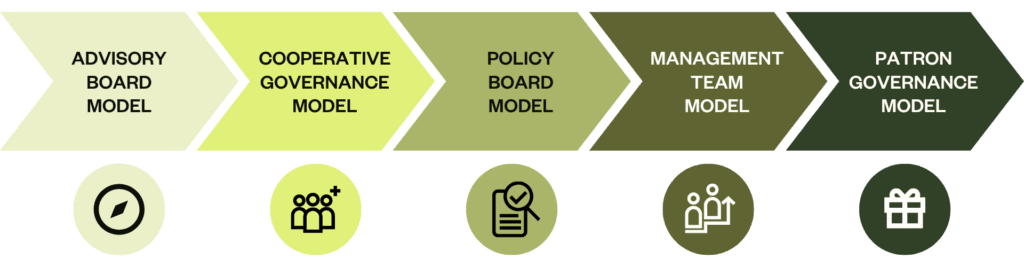
- Advisory board model: An advisory board provides expertise and guidance without formal governing authority. It is typically composed of subject matter experts who offer professional counsel on specific topics that benefit the organization’s operations.
- Cooperative governance model: In a cooperative governance model, all decision-making for the organization is shared across board members and determined by consensus. This model is common in small, volunteer-run organizations.
- Policy board model: A policy board model focuses on high-level policies and strategic direction, delegating execution to executive leadership staff. This is one of the most popular models, giving the executive director primary responsibility for the organization, while the board of directors support their work.
- Management team model: Board and staff collaborate closely in a management team model, which places board members in positions of leadership over individual departments within the organization. Often used in smaller organizations and organizations without paid staff, this model typically relies on the professional expertise of board members to help with day-to-day operations.
- Patron governance: Under the patron governance model, board members primarily contribute resources, influence, or fundraising support for the organization. This model is often used in conjunction with other models.
Selecting the right model (or a hybrid of two or more models) helps to clarify the board’s role and strengthens alignment with the nonprofit’s mission and operations.
Roles and responsibilities
Every nonprofit board requires, at a minimum, a board president, secretary, and treasurer.
- President: The board president or chair oversees all board operations and activity, sets meeting agendas, and leads each board meeting. They also typically act as a primary contact for the executive director, lead annual evaluations, and serve as a spokesperson as needed.
- Secretary: The secretary is responsible for maintaining all board records, including capturing meeting minutes and ensuring the board is following bylaws. They often schedule the board meetings, take attendance, and track board member terms.
- Treasurer: The treasurer oversees the organization’s finances, leading audits and often working with the executive director to manage the budget and resource allocation. In larger organizations, they typically serve as the chair of the finance committee to oversee all financial conversations.
In small or new organizations, the secretary and treasurer roles may be combined. As an organization and board expand, a vice president, past president, at-large board members, and committee chairs are often added to the roster. In many organizations, the vice president is elected as a successor to the current board president.
The responsibilities and expectations for these roles should be clearly documented, with role descriptions (including the basic qualifications for each role), terms of service for both elected roles and members at large, and the process to elect new board members and officers.
Speak your Board’s language when it comes to tech
Modern fundraising tools boost efficiency and results. Learn to educate your board on tech’s impact, measure ROI, and help leadership make data-driven decisions.

Board committees
Many nonprofit boards distribute responsibilities in a committee structure. Three of the most critical nonprofit board committees include:
- Finance: The finance committee leads oversight of organizational finances, including budgets, audits, and asset management.
- Governance: The governance committee is responsible for managing board recruitment and orientation, evaluating board performance, and regular review of policies and bylaws.
- Executive: Made up of current officers, the executive committee may act on behalf of the board between meetings, in emergency situations, or when handling sensitive matters.
Some organizations also have committees for functional areas like marketing and PR, fundraising and development, program management, human resources, and more. These committees provide oversight to staff in related departments and act as a liaison between staff and the board.
Board composition and the importance of diversity
A strong governing body reflects the community it serves. Diversity in board composition strengthens decision-making, improves cultural competency, and builds trust. Board members should reflect a range of perspectives, professional skills, and lived experiences.
Intentional evaluation and recruitment ensures the board is both representative and effective. It also ensures that the board remains inclusive, inviting people of all genders, disabilities, races, colors, religions, sexual orientations, and creeds to have an opportunity to guide the organization.
Board responsibilities: Legal obligations and documentation
Every nonprofit board and board member is legally bound by fiduciary duty, or the responsibility to act in the best interest of the organization and safeguard the organization’s assets. The board’s responsibilities are traditionally expressed as duty of care, duty of loyalty, and duty of obedience.
- Duty of care: Board members should act in good faith and the organization’s best interest, taking an active approach to their board service.
- Duty of loyalty: Board service requires faithfulness to the organization, putting the interests of the organization above their own.
- Duty of obedience: Board members are required to follow all established policies, bylaws, and internal decisions, as well as any applicable laws and regulations.
Together, this includes maintaining accurate records, filing required documents (such as the annual IRS Form 990), and ensuring proper stewardship of the organization’s assets.
Nonprofit board governance best practices
Effective nonprofit board governance requires intentional effort and ongoing evaluation. Some of the best practices for an effective board include:
- Clearly defining board policies, expectations, roles, and responsibilities.
- Conducting regular board evaluations.
- Setting clear expectations for new board members.
- Prioritizing strategic planning over operational discussions.
- Strengthening executive oversight and communication with leadership
- Reviewing financial statements consistently
- Create a clear conflict-of-interest policy.
- Meeting regularly to ensure ongoing oversight of the organization.
Boards should also invest in onboarding and education to ensure all nonprofit board members understand their role and responsibilities, even before joining. When a board member’s interests, values, or capacity do not align with the needs of the organization, they may not be the right fit for board service.
Essential policies for every board of directors
Strong governance policies create consistency, transparency, and accountability.
Important policies that every nonprofit board should adopt include:
- Conflict of interest policy. Sometimes referred to simply as an interest policy, a conflict of interest policy should outline the process for disclosing and managing potential conflicts of interest, including prohibiting board members from voting on matters impacted by those conflicts.
- Whistleblower policy. A whistleblower policy supports staff, board members, and volunteers who choose to come forward with complaints about the organization’s financial and operational activities, protecting them from retaliation.
- Document retention and destruction policy. A document retention policy indicates what records and documents will be retained, in what form, and for how long. It also includes when and how both digital and physical records should be destroyed, reflecting local regulations while protecting the organization and its stakeholders.
- Financial practices and internal controls. Financial oversight is one of the most important roles of any nonprofit board. As such, every board should have clear policies regarding both the use of organizational resources and the structures in place to provide accountability for those policies.
- Gift acceptance policy. Organizational gift acceptance policies outline the types of gifts that can and cannot be accepted by the organization, while board gift acceptance policies indicate the types and value of gifts, if any, that a member is allowed to receive in relation to their board service.
- AI use and governance policy. An AI policy should outline how the organization uses AI tools, which decisions require human review, and who is responsible for monitoring those tools over time. The board approves this framework and ensures it is revisited regularly, since AI oversight doesn’t end once a tool is launched.
These governance policies help manage risk, support ethical decision-making, and reinforce the integrity of the governing body.
Your AI policy needs more than a yes or no.
The question isn’t “Should we use AI?” It’s “How much authority should AI have, and who owns the outcome?” In a blind test, 363 nonprofit pros picked AI’s advice nearly half the time, yet most still wanted a human to sign off.

Common nonprofit board governance mistakes
Even well-intentioned boards can fall into some common traps, especially when its members are not well-aligned to the role, or the board lacks proper governance.
Some of the most common mistakes of nonprofit boards include:
- Blurring the line between governance and nonprofit management. Good governance policies help nonprofit board members understand their role, while helping to protect staff from feeling micromanaged.
- Recruiting the wrong people. Alignment is just as important as expertise and enthusiasm when it comes to board recruitment. Aligned board members understand and are passionate about your mission, while misaligned members may disengage or even actively oppose the organization’s mission and best interests.
- Overlooking potential conflicts of interest. Competing loyalties make it impossible to objectively support an organization. Board members must not only disclose conflicts but also remove themselves from any decisions that could be personally beneficial. In some cases, that means leaving the board altogether.
- Treating board meetings as routine updates instead of strategic discussions. A board’s job is to act as a strategic advisor and guide to the organization, and every update should be considered through this lens.
- Failing to protect confidential information. Board members are bound by the duty of loyalty to protect private information, including financial details, personnel matters, donor details, and more.
- Relying too much on one person. The goal of a multi-person board is to provide checks and balances, offering a variety of opinions and perspectives to help the organization make thoughtful decisions. When board members choose not to participate, either through absence or inactivity, this balance is lost. Overcoming this stagnation requires intentional strategies to invigorate your board for fundraising success.
- Neglecting financial literacy, oversight, and record-keeping. Good record-keeping and financial oversight is critical to a board’s fiduciary duties. Meeting minutes, annual filings, and documentation of policies are necessary for compliance and good oversight.
Avoiding these pitfalls helps ensure the board remains focused and effective, helping the organization to achieve its mission over the long term.
Strengthening governance for long-term impact
By building a strong governance structure, clarifying roles, and prioritizing strategic direction, boards can better support executive leadership and drive meaningful outcomes.
But nonprofit board governance is more than structure or a set of rules to follow, and it’s not static either. It should evolve as the organization grows, allowing the board to continue operating with clarity, accountability, and alignment. That is how a nonprofit board can empower executive leadership, strengthen donor trust, and ensure the organization’s mission continues to thrive for years to come.

Be the first to read our resources.
The world is changing quickly—and our resources help you stay on top of it all. Sign up to get new insights, success stories, and more, sent right to your inbox.
Explore related resources.
-
Understanding nonprofit burnout and how to prevent it

Post Understanding nonprofit burnout and how to prevent it
Learn what causes nonprofit burnout, how to spot the signs early, and how leaders and fundraisers can prevent it and protect their team and mission.
-
The essentials of donor databases for nonprofits
Post The essentials of donor databases for nonprofits
Discover key CRM features, explore top software options, and find the right solution to boost your fundraising.
-
KindCon Partner Spotlight: Driving real impact with Attain Partners
Post KindCon Partner Spotlight: Driving real impact with Attain Partners
Learn how to calculate the most important fundraising metrics, boost retention, and turn data into real donor growth.